Aumovio India develops single-camera ADAS for low cost L2 autonomy, eyes agility after Continental spin-off
The company is developing a single-camera ADAS system in India for affordable Level 2 assisted driving, with the Continental spin-off driving its push to build the country into a global engineering agility hub.
Technology quite often follows a top-down journey. And that applies to one of the hottest trends in the Indian automobile market – ADAS (Advanced Driver Assistance System). Aumovio, the automotive technology company carved out of Continental's automotive business, is developing a single-camera Advanced Driver Assistance System (ADAS) to make Level 2 assisted driving affordable for mass-market vehicles.
The camera-only architecture, validated extensively on Indian roads, is designed to eliminate the need for multiple radars and cameras typically associated with higher-end ADAS systems, potentially lowering costs for automakers targeting India's price-sensitive passenger vehicle market.
Advt
The development comes as Aumovio reshapes its engineering strategy following its spin-off from Continental, positioning India as a strategic innovation hub to compress development timelines and deliver competitive technologies at what executives describe as "China speed".
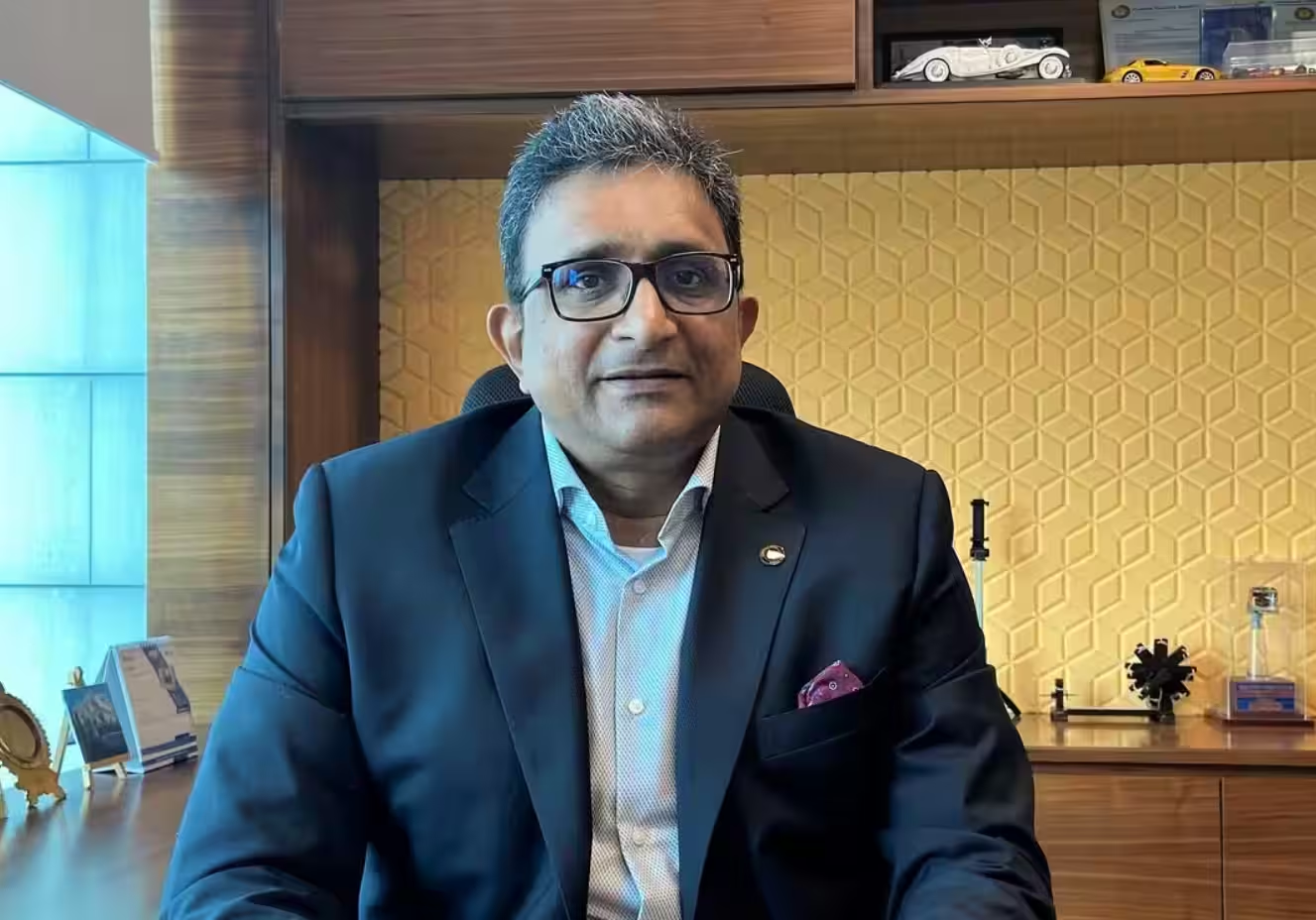
Prashanth Doreswamy, President & CEO, Aumovio India "India is a value-driven market. You cannot have multiple radars and multiple cameras for every vehicle. The challenge is to deliver Level 2 assisted driving with a much simpler architecture," Prashanth Doreswamy, President & CEO, Aumovio India, tells ETAuto.
The company believes advances in perception software have now made that proposition increasingly viable.
Its latest-generation system can distinguish pedestrians from mannequins displayed outside shops, recognise people wearing loose clothing such as full-figure burqas, identify protruding cargo carried by three-wheelers and detect oncoming vehicles in India's often chaotic traffic conditions—capabilities that Doreswamy says are critical for reducing false detections in camera-only ADAS systems.
Several suppliers globally are pursuing similar approaches, but Aumovio believes perception accuracy will determine commercial success.
"We have completed extensive trials on Indian roads. Ultimately, it comes down to how robust your perception is and how low your false detections are," he says.
Advt
The Aumovio India team aims to be the first supplier in India to begin commercial production of a single-camera ADAS solution and further democratise ADAS tech.
Agility, the core driver
In an industry that’s evolving faster than ever before, achieving agility for business sustainability is the key reason Aumovio was officially spun off from Continental in September 2025.
Rather than merely changing ownership, the company is restructuring itself around speed, simplified decision-making and engineering agility as vehicle programmes become increasingly software-intensive and development cycles continue to shrink.
"The world has become far more complex and unpredictable. The only way to deal with that complexity is through agility. The spin-off gives us greater focus. It enables faster decisions, quicker execution and a different mindset," says Doreswamy.
The company has begun re-evaluating virtually every engineering and business process. Doreswamy says, "We are questioning every procedure and asking why it should continue to be done in the same way. Is there a faster way? A cheaper way? A better way?"
The urgency stems partly from the rapid pace of Chinese automotive development, where complete vehicle programmes are increasingly being executed in nearly 24 months, compared with roughly 36-48 months across much of the global industry.
Indian automakers have begun adopting Continuous Integration and Continuous Delivery (CICD) practices to shorten product cycles, although Doreswamy believes the broader ecosystem still has considerable ground to cover. The benchmark for vehicle development time in India is around 36 months.
AI halves automotive development time
One of the most significant productivity initiatives underway at Aumovio India is an AI-powered platform for Requirements Engineering, a critical process in software-defined vehicle (SDV) development, where thousands of technical, regulatory, and functional requirements must be validated before engineering begins.
Modern vehicles increasingly integrate hundreds of suppliers and multiple electronic systems, making requirement traceability one of the industry's most complex engineering tasks.
The AI platform analyses customer specifications, checks regulatory compliance across markets, validates functional completeness and identifies missing or inconsistent requirements, substantially reducing manual effort while improving engineering accuracy.
"In embedded automotive systems, getting the requirements right is one of the biggest challenges. Missing one requirement can create major downstream issues," Doreswamy says.
The system also enables engineering teams to process large sets of requirements significantly faster than conventional manual reviews, helping to shorten programme timelines.
One of the major benefits achieved by AI deployment, Doreswamy says, is in electronic brake development. The development time has been crunched by 50 per cent.
Aumovio has developed Database Assisted Performance Adjustment (DAPA) and Artificial Intelligence Performance Adjustment (AIPA) tools that use historical engineering data and AI models to generate nearly 95 per cent of brake calibration parameters before physical testing begins.
Conventional brake development typically depends on expensive prototype vehicles, seasonal validation across different geographies and extensive proving-ground testing.
By replacing much of that process with virtual simulation and AI-generated calibration, the company estimates development timelines could be reduced by nearly 50 per cent.
"It reduces dependence on mule vehicles, seasonal testing and repeated physical validation. Physical testing becomes largely fine-tuning instead of starting from zero," says Doreswamy, who currently has an additional role as Aumovio’s India Technical Centre Head.
Automated Parking Assist scales up
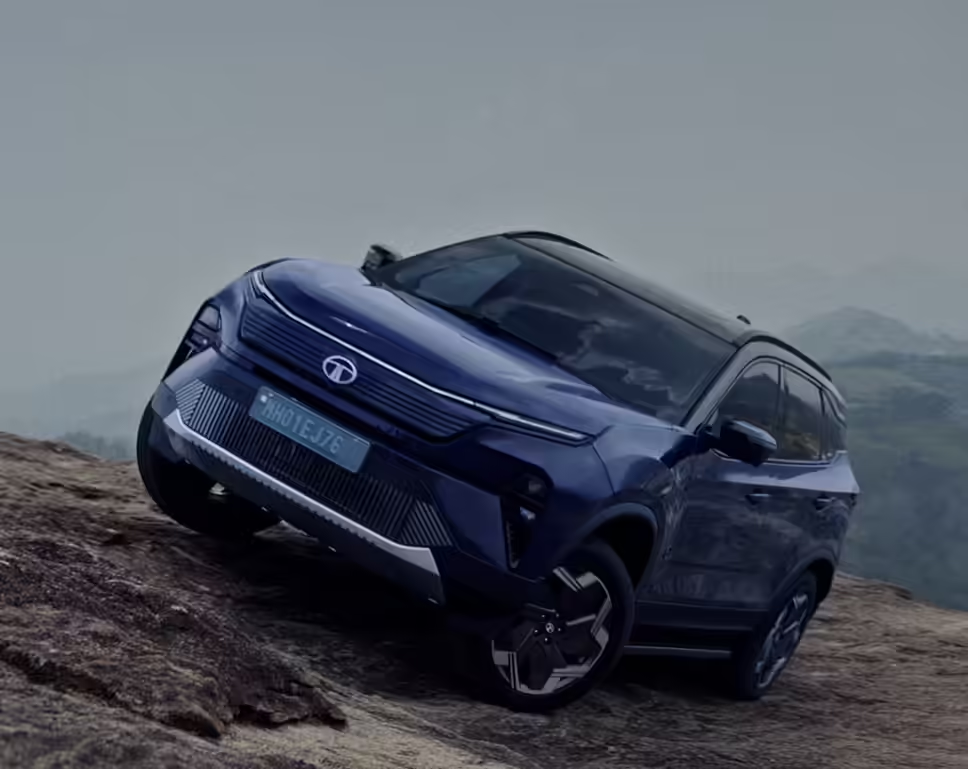
The company's India engineering team has also developed its Automated Parking Assist (APA) platform, which has already entered production and is now being expanded across additional vehicle programmes. The system was introduced in India with the Tata Harrier EV, which debuted in June 2025.
Aumovio's APA was first introduced in Tata Harrier EV Developed in about 18 months, considerably faster than traditional global timelines exceeding two years, the system supports parallel, perpendicular and angular parking, remote summon functionality and ‘park anywhere’ capability that allows users to define parking spaces even in the absence of marked bays.
The solution was engineered specifically for Indian parking environments, where inconsistent road markings remain a major challenge. According to Doreswamy, automated parking has emerged as an increasingly important differentiator for automakers, with multiple OEM programmes currently under discussion.
Within Aumovio, India has steadily evolved from a manufacturing base into a strategic engineering centre, contributing to advanced R&D, embedded software, systems integration, localisation, and product development. Its Bengaluru tech centre is also a global CoE (Centre of Excellence) for Autonomous Driving tech.
"India today contributes across almost the entire automotive value chain," says Doreswamy.
While India remains one of the fastest-growing automotive markets globally, Doreswamy and his team now seek a higher wallet share in the domestic market. He believes the bigger opportunity lies in rising electronics content per vehicle.
As software-defined vehicles, advanced safety systems, cockpit electronics and body controllers become mainstream, suppliers capable of delivering integrated technology platforms stand to gain disproportionately.
For Aumovio, that growth strategy is built around four technology pillars—vehicle safety, user experience, body electronics and affordable automated driving.
Doreswamy wouldn’t reveal Aumovio India’s share of the parent’s overall business revenue, but he sees it as “substantial” over the next couple of years. What also makes him bullish is the fact that the automotive industry’s “growth has shifted from West to East, and in the East, the biggest growth market is India”.
China, the world’s largest car market with sales of 34 million units in 2025, also sits in the East, but it’s witnessing a decline in industry volumes.
"The opportunity is no longer only about selling more vehicles," Doreswamy says. "It is about delivering significantly more technology in every vehicle."
For an organisation that has only recently stepped out of Continental's shadow, the shift towards speed, AI-driven engineering and cost-efficient innovation could prove just as significant as the organisational separation itself.
We strive to uphold the highest ethical standards in all of our reporting and coverage. We StartupNews.fyi want to be transparent with our readers about any potential conflicts of interest that may arise in our work. It's possible that some of the investors we feature may have connections to other businesses, including competitors or companies we write about. However, we want to assure our readers that this will not have any impact on the integrity or impartiality of our reporting. We are committed to delivering accurate, unbiased news and information to our audience, and we will continue to uphold our ethics and principles in all of our work. Thank you for your trust and support.