Most compliance teams do not have an AML cost problem. They have an AML fragmentation problem.
Screening runs on one platform, transaction monitoring on another, entity data somewhere else, and investigators spend their days moving between them.
Our new book, 20 Things That Make the Complete AML System, is written to address exactly this.
It sets out the essential building blocks of a modern AML framework and explains how screening, monitoring, investigations, reporting, governance, and technology combine into a single, defensible compliance environment rather than a collection of isolated tools.
The book is not a theory piece.
Each of the twenty things reflects a decision that compliance and operations leaders face when they build or refresh their AML stack: what to screen, how to resolve entities, when to monitor transactions, how to manage alerts and cases, and how to keep the whole thing auditable.
Read together, and they make a simple case. Completeness is not about buying more. It is about connecting and unifying what you already have.
The Business Case For a Complete System
Fragmented AML programs are expensive in ways that rarely show up on a single invoice.
Every disconnected tool carries its own license, its own integration cost, and its own data cleanup.
Analysts lose time reconciling results across systems, false positives multiply when screening and monitoring do not share context, and audit preparation becomes a manual exercise in stitching evidence together from several places.
A complete AML system removes most of that overhead.
When screening, entity resolution, transaction monitoring, and case management share the same data and the same interface, the duplicated spend disappears. Alerts arrive with context, so investigators close them faster.
Vendor management shrinks from many contracts to one relationship. This is where the 30% to 50% saving comes from.
Not from cutting corners on compliance, but from removing the friction that fragmentation quietly adds to every workflow.
The saving also compounds over time, because a connected system scales with rising data volumes and expanding regulation, while a patchwork of point solutions grows more costly and more fragile with every addition.
What a Complete AML System Looks Like
As the book puts it, a complete AML system is best understood not as a collection of compliance tools, but as a coherent control environment built to withstand regulatory scrutiny.
It brings customer risk assessment, screening, transaction monitoring, investigation workflows, reporting, and record-keeping into one operating framework.
The objective is not simply detection. It is continuity, from onboarding through ongoing monitoring to final reporting, with decisions that can be explained and reconstructed years later.
At the centre of that framework sits a consolidated entity view, where customer identity records, transactional activity, exposure data, and contextual intelligence converge to inform dynamic risk categorisation.
Screening controls operate at entry and through periodic rescreening, while monitoring controls evaluate behavioural patterns over time.
Alerts are investigated through structured workflows, and where suspicion thresholds are met, reports are filed. These stages must stay connected, because fragmentation quickly undermines regulatory defensibility.
At ZIGRAM, That Architecture Takes Shape As a Single Connected Flow
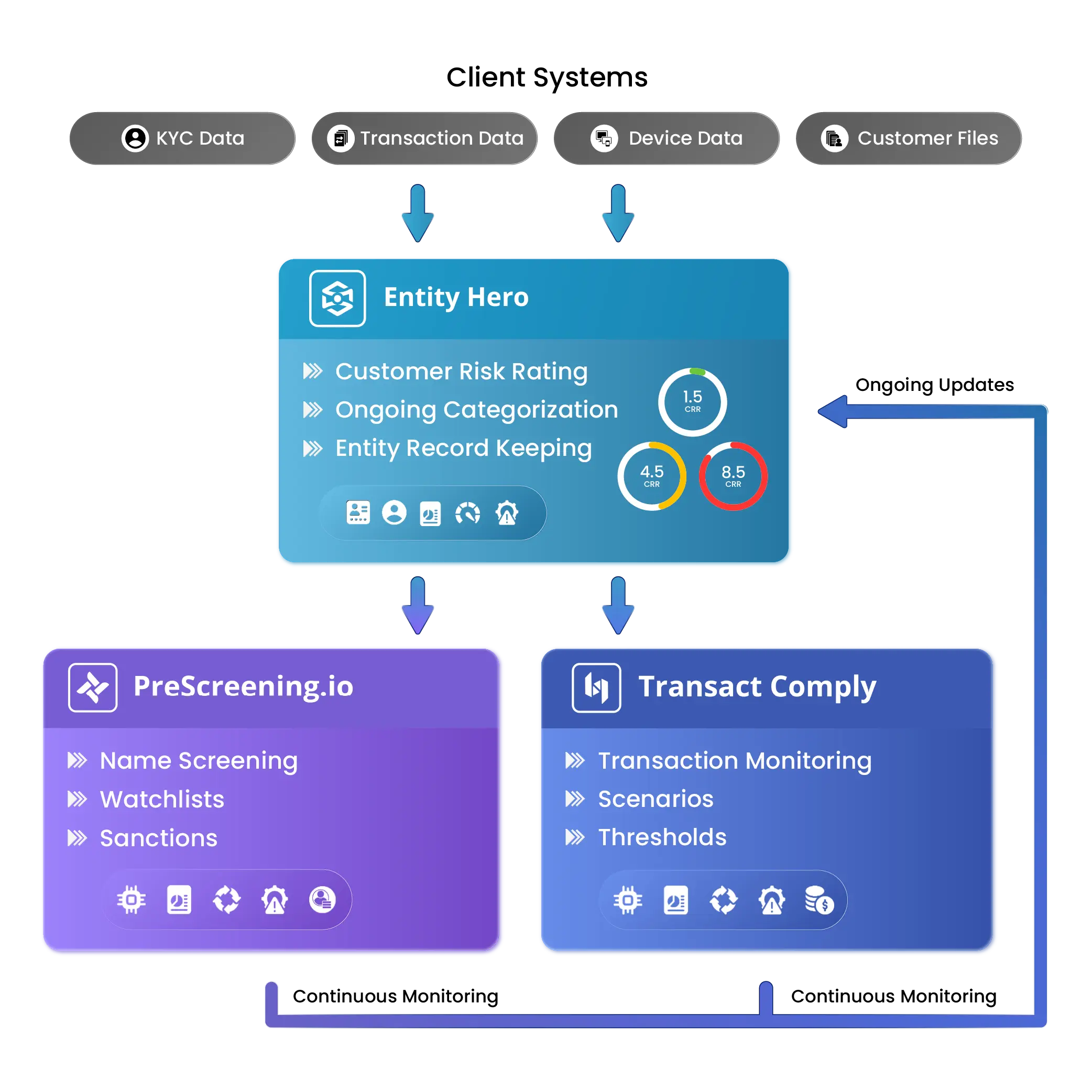
The Complete AML System: client data feeds Entity Hero, which drives screening through PreScreening.io and transaction monitoring through Transact Comply, with continuous monitoring and ongoing updates flowing back to the entity view.
Client data, spanning KYC, transaction, device, and customer files, feeds Entity Hero, which holds the consolidated entity view and produces customer risk ratings, ongoing categorisation, entity data, and record-keeping.
ZIGRAM is a RegTech company focused on anti-money laundering and financial crime risk.
The Complete AML System brings its screening, entity, and transaction products together with the Unified Case Manager, so compliance teams can run their entire program in one place instead of across a stack of disconnected vendors.
20 Things That Make the Complete AML System is a practical guide to what that looks like and why it matters. Read it to see the full twenty, and to find where the savings and efficiencies sit in your own program.
Featured image by ZIGRAM.
The post A Complete AML System Can Reduce Compliance Costs by 50% appeared first on Fintech News Malaysia.
Source link