BenchmarksCLOSED
BenchmarksCLOSED


Business NewsTechFunding QOSMIC raises $3.3 million from Prosus, Accel, South Park Commons to solve space’s growing data bottleneck
QOSMIC raises $3.3 million from Prosus, Accel, South Park Commons to solve space’s growing data bottleneck


Synopsis
Bengaluru-based QOSMIC has secured $3.33 million in seed funding to tackle a growing bottleneck in space: getting vast amounts of satellite data back to Earth. The newly raised capital will be used to scale manufacturing, integration and testing capabilities, while expanding engineering teams across optics, mechanical systems and electronics.

Listen to this article in summarized format
 ETtech
As many as 70,000 low-Earth orbit (LEO) satellites are expected to be launched over the next five years, according to Goldman Sachs Research. As that number rises, spacetech startups say a critical bottleneck is emerging: getting that data from orbit back to Earth fast enough.
Bengaluru-based spacetech startup QOSMIC, which is building laser-based communication infrastructure for space, has raised $3.33 million in seed funding led by Accel and Prosus, with participation from South Park Commons, ARTPARK and angel investor Manish Jain to solve this.
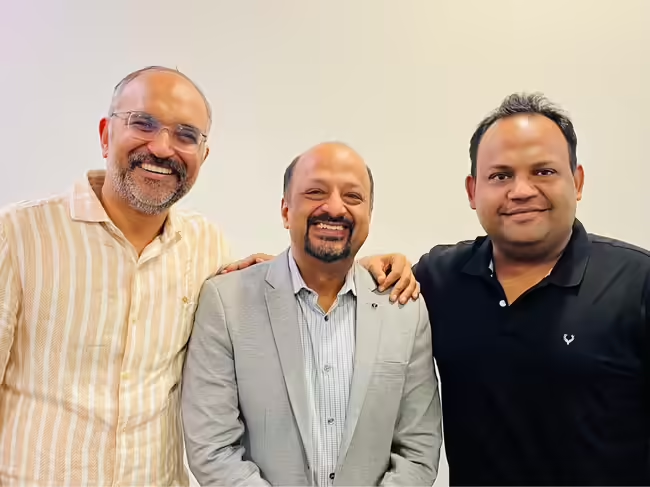
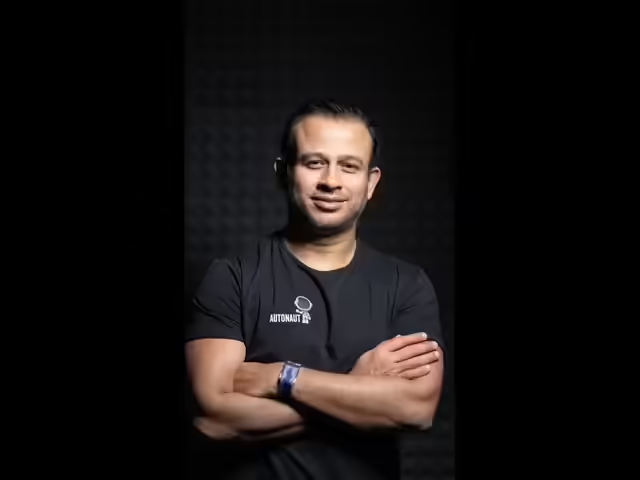
Founded in 2025 by Shreyaans Jain, Rohit Ramakrishnan and Aloke Kumar, QOSMIC is developing optical communication systems that allow satellites to transmit significantly larger volumes of data than traditional radio-frequency (RF) systems.
“A single Earth observation satellite can generate terabytes of data daily, but conventional radio links remain constrained by limited spectrum, congestion and short transmission windows,” Shreyaans Jain, cofounder and chief executive of QOSMIC, told ET.
Today, most satellites communicate with ground stations using radio waves. But as satellites become more advanced, they are generating far more data than existing infrastructure can handle.
“Around 50-60% of satellite data never reaches the end user because the bandwidth simply doesn’t exist. If that data cannot come back to Earth, it has no value,” he added.
Traditionally, satellites have communicated with Earth through RF ground stations operating in spectrum bands such as S-band, X-band and Ka-band. But Jain expalins that these RF systems are struggling to keep pace with the growing data loads.
QOSMIC is betting that optical communication, or laser-based links, will become the next foundational layer of space infrastructure.
“If satellites are already using laser links in space, why should the last mile to Earth remain the slowest?” Jain said. “We are building the optical highway from space to ground.”
The startup is aiming to build both optical ground stations on Earth and optical communication terminals for satellites.
The company said it has field-validated its complete optical communication stack at Technology Readiness Level 6 (TRL-6) within a year of inception. It has demonstrated pointing, acquisition, tracking and high-speed data transfer over a 10-km terrestrial optical link, and is now preparing for in-orbit testing.
The newly raised capital will be used to scale manufacturing, integration and testing capabilities, while expanding engineering teams across optics, mechanical systems and electronics.
First deployment with TakeMe2Space
QOSMIC’s first commercial deployment is with TakeMe2Space, which is building an AI-first orbital data centre in low-Earth orbit. QOSMIC will develop optical communication terminals for the company’s orbital data centre constellation.
Jain said demand is increasingly coming not just from Earth observation players, but also from a newer category of orbital infrastructure companies looking to process and store data in space.
“The entire thesis of orbital data centres breaks if data is coming back to Earth at 20 Mbps,” he said. “These players need high-throughput connectivity between orbit and ground.”
A niche but growing segment
Investors say the opportunity lies in solving a fast-growing but underappreciated infrastructure challenge.
“The space economy of the future will only be as powerful as its ability to move data. Right now, that ability is broken,” said Prateek Mehta, general partner at South Park Commons.
“Satellites are generating terabytes every day, but not everything comes back because channels built for another era are completely choked. Laser-based optical communications is the way to unlock this bottleneck.”
Mahendran Balachandran and Pratik Agarwal, partners at Accel, said QOSMIC is addressing a critical infrastructure gap with laser ground stations that are faster, more secure and cheaper than existing systems.
There are currently no major pure-play Indian startups focused entirely on optical ground station infrastructure.
Dhruva Space has ground station capabilities, though largely around conventional RF-based satellite communication. Astrome operates in adjacent communication infrastructure, focusing on high-throughput wireless and millimetre-wave technologies.
Bengaluru-based spacetech startup QOSMIC, which is building laser-based communication infrastructure for space, has raised $3.33 million in seed funding led by Accel and Prosus, with participation from South Park Commons, ARTPARK and angel investor Manish Jain to solve this.
Founded in 2025 by Shreyaans Jain, Rohit Ramakrishnan and Aloke Kumar, QOSMIC is developing optical communication systems that allow satellites to transmit significantly larger volumes of data than traditional radio-frequency (RF) systems.
“A single Earth observation satellite can generate terabytes of data daily, but conventional radio links remain constrained by limited spectrum, congestion and short transmission windows,” Shreyaans Jain, cofounder and chief executive of QOSMIC, told ET.
Today, most satellites communicate with ground stations using radio waves. But as satellites become more advanced, they are generating far more data than existing infrastructure can handle.
“Around 50-60% of satellite data never reaches the end user because the bandwidth simply doesn’t exist. If that data cannot come back to Earth, it has no value,” he added.
Traditionally, satellites have communicated with Earth through RF ground stations operating in spectrum bands such as S-band, X-band and Ka-band. But Jain expalins that these RF systems are struggling to keep pace with the growing data loads.
QOSMIC is betting that optical communication, or laser-based links, will become the next foundational layer of space infrastructure.
“If satellites are already using laser links in space, why should the last mile to Earth remain the slowest?” Jain said. “We are building the optical highway from space to ground.”
The startup is aiming to build both optical ground stations on Earth and optical communication terminals for satellites.
The company said it has field-validated its complete optical communication stack at Technology Readiness Level 6 (TRL-6) within a year of inception. It has demonstrated pointing, acquisition, tracking and high-speed data transfer over a 10-km terrestrial optical link, and is now preparing for in-orbit testing.
The newly raised capital will be used to scale manufacturing, integration and testing capabilities, while expanding engineering teams across optics, mechanical systems and electronics.
First deployment with TakeMe2Space
QOSMIC’s first commercial deployment is with TakeMe2Space, which is building an AI-first orbital data centre in low-Earth orbit. QOSMIC will develop optical communication terminals for the company’s orbital data centre constellation.
Jain said demand is increasingly coming not just from Earth observation players, but also from a newer category of orbital infrastructure companies looking to process and store data in space.
“The entire thesis of orbital data centres breaks if data is coming back to Earth at 20 Mbps,” he said. “These players need high-throughput connectivity between orbit and ground.”
A niche but growing segment
Investors say the opportunity lies in solving a fast-growing but underappreciated infrastructure challenge.
“The space economy of the future will only be as powerful as its ability to move data. Right now, that ability is broken,” said Prateek Mehta, general partner at South Park Commons.
“Satellites are generating terabytes every day, but not everything comes back because channels built for another era are completely choked. Laser-based optical communications is the way to unlock this bottleneck.”
Mahendran Balachandran and Pratik Agarwal, partners at Accel, said QOSMIC is addressing a critical infrastructure gap with laser ground stations that are faster, more secure and cheaper than existing systems.
There are currently no major pure-play Indian startups focused entirely on optical ground station infrastructure.
Dhruva Space has ground station capabilities, though largely around conventional RF-based satellite communication. Astrome operates in adjacent communication infrastructure, focusing on high-throughput wireless and millimetre-wave technologies.
Add  as a Reliable and Trusted News Source
as a Reliable and Trusted News Source Add Now!
(Catch all the Technology News News, and Latest News Updates on The Economic Times.)
...more
Elevate your knowledge and leadership skills at a cost cheaper than your daily tea.

Akasa aims to be a 226-aircraft airline by 2032, IPO in 2-4 years 
Crude falls, retail prices don’t. Will it be different this time? 
What will the NSE IPO price be? Unlisted market deals offer clues. 
Market darling to drawdown: Why momentum stocks are losing steam 
Down 30% in 1 year, are AI-hit Infy, TCS still value stocks? 
Stock Radar: Indian Hotel stock breaks out from falling channel resistance on weekly charts; time to buy? 
For investors who focus on the long term: 5 mid-cap stocks from different sectors with upside potential up to 28% 
These large-caps have ‘strong buy’ & ‘buy’ recos and an upside potential of up to 24%
Subscribe Now
Now Playing
Source link