As the Covid-19 pandemic swept across the globe with unprecedented speed and impact, countries raced to develop vaccines only to run into an unforeseen bottleneck. International trade slowed to a crawl, and global supply chains collapsed almost immediately when the virus spread. Acquiring key ingredients for vaccines became increasingly challenging, ruthlessly exposing the myth of industrial self-sufficiency.
In India, the crisis was more acute. Despite its scientific capabilities and strong talent pool, the country still relied on imports for key vaccine components such as protein formulations produced by cell culture. This dependency thwarted its ambition to emerge as the world’s pharmacy and quickly turned into an urgent scramble for raw materials.
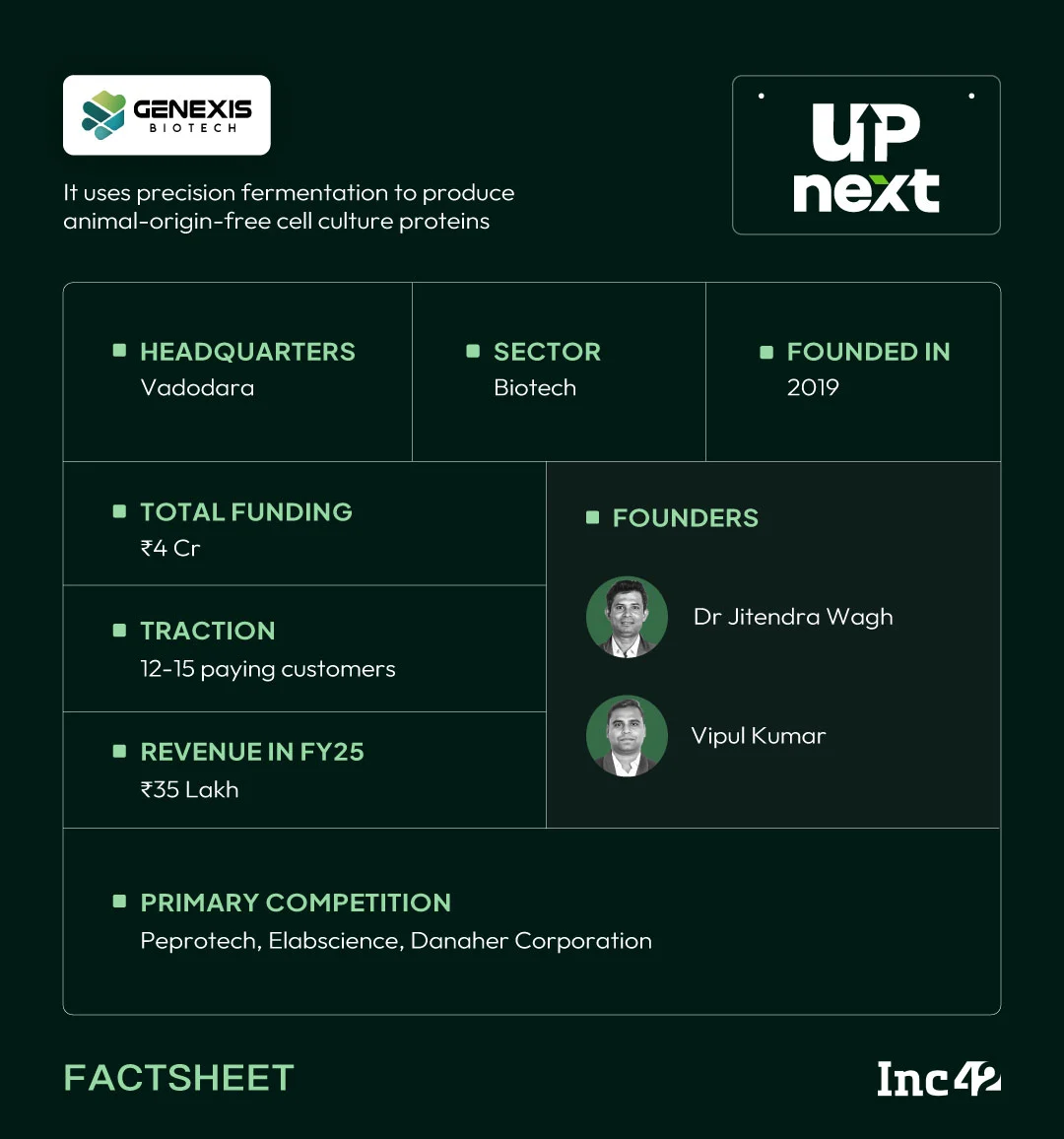
“It is a complex and fragile supply chain,” said Vipul Kumar, cofounder of Genexis Biotech. This Vadodara-based startup is part of a broader network of technology companies working to plug this gap.
The cofounder then stripped back the technical complexity. Cell culture is the bedrock of biotechnology, involving the cultivation of cells in carefully controlled environments to produce vaccines and medicines. However, these cells require protein-rich nutrients for healthy growth, which are typically provided by foetal bovine serum, or FBS.
The issue? FBS is obtained by collecting blood from the heart of an unborn calf, a process widely regarded as both unethical and environmentally harmful.
“We were aware of this much before the pandemic,” said Kumar. “In 2019, Dr Jitendra Wagh and I started working on a cruelty-free protein formula that would not require animal extracts. When the pandemic shut down global supply chains and the FBS shortage delayed vaccines, it proved that we were solving a real and urgent problem.”
Genexis is now producing cell-culture proteins in India at a lower cost, without using animal extracts. It has set up an in-house facility, complete with a cleanroom to maintain strict sterility, minimising airborne particles to 10K per cubic foot, down from an average of several lakh particles per cubic foot. It has also filed for two patents to protect its innovations.
By enabling fermentation-based ingredients and plant-derived bioactives, Genexis reduces dependence on traditional animal agriculture and resource-intensive supply chains. Its core products include animal-origin-free (AOF) growth factors (these are high-purity recombinant proteins), serum proteins and laboratory culture media containing specific ingredients. These inputs are essential across biopharma, diagnostics, cosmetics and academic research. Genexis supplies these proteins in lyophilised powder or liquid form. Although orders are typically delivered in milligrams and micrograms (1 mg is equal to 1K MCG), these volumes provide the necessary potency for high-value applications.
Its commercial footprint is also expanding. The startup now sells to 12-15 companies and has built a pipeline of 30+ prospects currently in the testing phase. Among its buyers are Indian pharma majors such as Sun and Intas, as well as diagnostic firms, cosmetic formulation makers and research institutions.
In FY25, the startup earned ₹30-35 Lakh in revenue and targets around ₹1 Cr in the current fiscal year. It remained bootstrapped for nearly two years before raising external capital. To date, Genexis has raised about ₹4 Cr from Gujarat Venture Finance, with participation from Benzai10.
The Making Of A Biotech Brewery, From Lab To Market
Kumar and Wagh met as working professionals, each bringing over a decade of experience in biotechnology and extensive hands-on work across proteins, cell culture and lab-scale manufacturing. Before founding Genexis, they spent years in different organisations, working closely with the very materials they would later set out to replace.
Their experience gave them a close view of the structural constraints shaping protein sourcing and their applications. The founders saw early on where supply chains faltered, formulations failed and scale introduced friction.
That exposure helped develop a deeper understanding of the underlying science and workflow bottlenecks that slow commercialisation. As a result, they were able to de-risk R&D decisions, compress product development cycles and avoid costly iteration loops. Their ability to navigate technical and operational inflexions evolved from problem-solving into a competitive advantage — one that its peers may not easily replicate.
Over time, the duo identified a persistent gap in India’s biotech supply chain. Imported proteins were expensive, often costing up to 10 times as much as locally produced alternatives, and their delivery could delay projects by 4 to 12 weeks. Companies using those proteins as raw materials had to place orders months in advance and repeatedly revalidate their inputs because each batch could differ from the previous one.
“Our idea took shape around a simple question,” said Kumar. “If insulin and many other vaccines could be produced through fermentation, why not essential growth proteins for cell culture?”
For a familiar context, think of breweries making craft beer. But instead of yeast fermenting barley into beer, engineered microbes are carefully guided here to ‘brew’ essential proteins. This promise of fermentation offers a new way to supply the building blocks of modern medicine.
The process began in October 2019, when the duo decided to build an animal-origin-free alternative from scratch. For nearly two years, the founders focussed entirely on research and development, working towards a proof of concept to demonstrate that animal proteins could be produced using microbes.
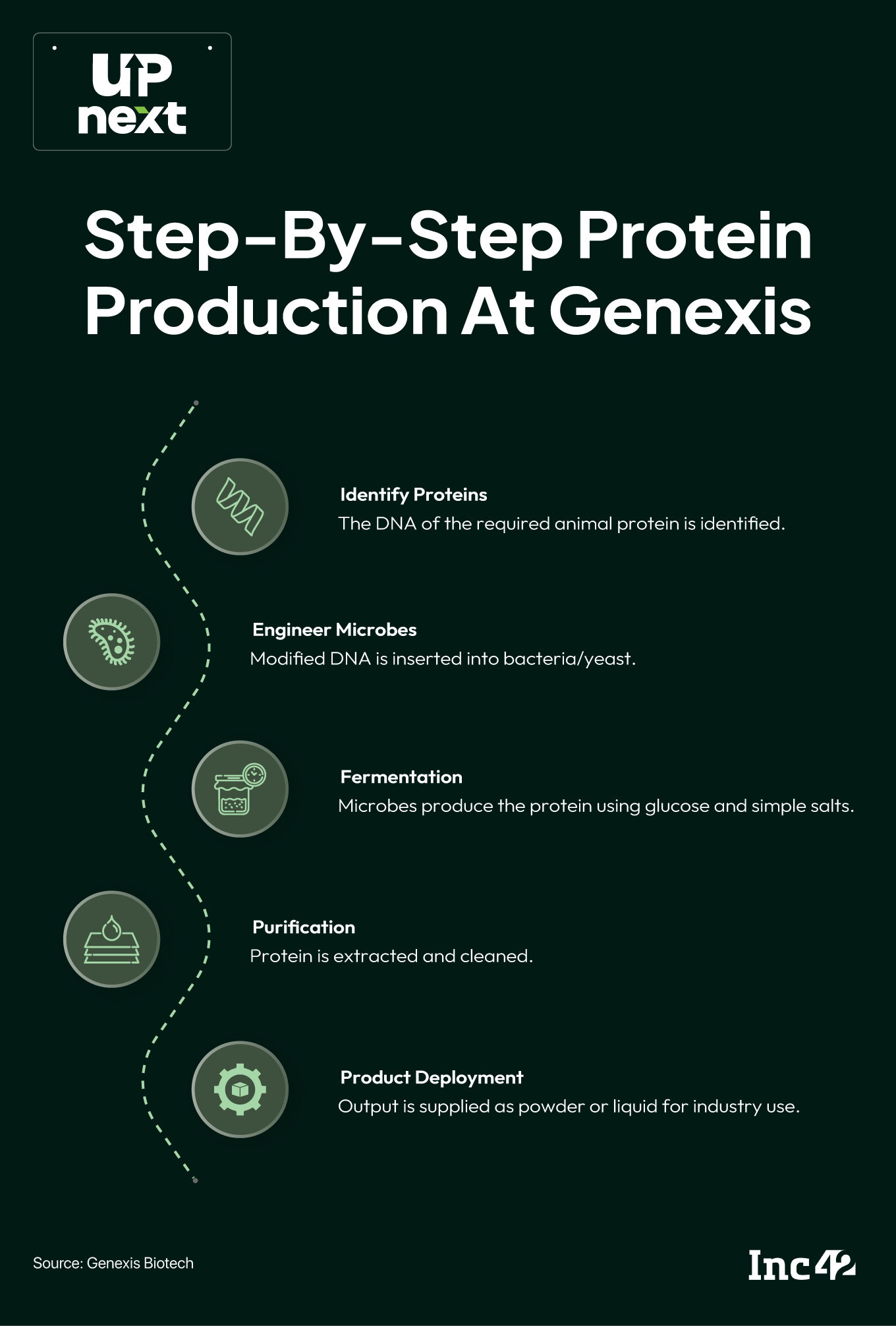
“We engineered bacteria and yeast strains that were capable of producing specific proteins using glucose and basic salts,” said Kumar. “The initial grind enabled us to develop strain engineering capabilities, upstream fermentation processes and downstream purification systems, all in-house.”
However, capital was scarce. The founders committed their own savings before securing government grants from the Department of Biotechnology and the Gujarat government. The funding was used to build and equip its in-house production facility, including fermentation and purification infrastructure.
Spending was restricted to critical experiments, cost-effective essential inputs and in-house process development. Despite this frugality, commercial traction was slow. In biotech, customer acquisition is notoriously slow, with extensive validation cycles built into the process. It meant carrying inventory and R&D costs long before revenue started to flow in.
Today, the startup operates via a sample-first B2B model. It supplies samples to companies, which benchmark them internally against imported alternatives. Following validation, these customers transition to regular purchase orders.
‘Precision Fermentation’ Is Shifting Proteins Away From Animal Sources
Genexis uses precision fermentation to produce proteins without relying on animals. The technology is not experimental. It is the same underlying method used globally to manufacture insulin and certain vaccines, where micro-organisms are engineered to produce specific proteins at scale.
Instead of extracting proteins from livestock, the startup programmes microbes such as bacteria and yeast to serve as biological production units. By inserting defined DNA sequences, these microorganisms are instructed to synthesise the same proteins that animals would otherwise produce.
The engineered strains are cultivated in controlled fermenters and fed basic nutrients like glucose and salts. As they multiply, they continuously produce the target protein, which is then isolated, purified and stabilised.
Because the process is fully controlled, every batch is consistent. This removes the variability often seen in animal-derived proteins and reduces validation time for pharmaceutical and research customers.
“This process has reduced production costs by nearly 10x while improving supply reliability,” said Kumar. “Unlike animal-based proteins, output is not dependent on livestock cycles or imports.”
How Genexis Is Laying The Groundwork For Scale
According to a market report, India’s cell culture market generated a revenue of $498.7 Mn in 2024 and is expected to reach $1.6 Bn by 2033, growing at a CAGR of 14.4% from 2025 to 2033.
The growth is a positive signal for Genexis and its international peers like Peprotech, Elabscience, and Danaher. However, as the startup moves from early commercialisation to scale, the challenges ahead are as structural as they are technical. A primary hurdle is the working capital required to build inventory and capability in anticipation of demand.
“We are producing five to six proteins right now, but a customer may suddenly ask for 15 or 20. Even to provide a sample, we have to invest upfront, and that makes the early phase tough,” said Kumar.
Nevertheless, he expects the model to stabilise as volumes grow.
The immediate focus is expanding the protein portfolio, particularly for nutraceutical and dairy-linked molecules, while tightening cost structures. Genexis has already developed an AOF version of lactoferrin (LF), a milk-derived whey protein, and it is now working to lower production costs ahead of a broader market launch.
“Lactoferrin will likely be our first major non-pharma commercial product,” the cofounder added.
Global expansion is also underway. Genexis recently shipped samples to Australia and is in active discussions with prospects in Japan, the UK, Singapore and Canada.
“We are in talks with a major diagnostic firm in Japan right now. They are really interested in this technology,” Kumar told Inc42.
In the long term, the startup envisions itself as a deeptech manufacturing company rather than a niche protein supplier. The ambition is to replace animal-sourced proteins across biopharma, nutraceuticals and adjacent industries wherever fermentation offers a viable alternative.
The post How Genexis Is Cutting Cell Culture Protein Costs By 10X With Engineered Microbes appeared first on Inc42 Media.
Source link