Chile turned to China for an undersea cable. The U.S. said no
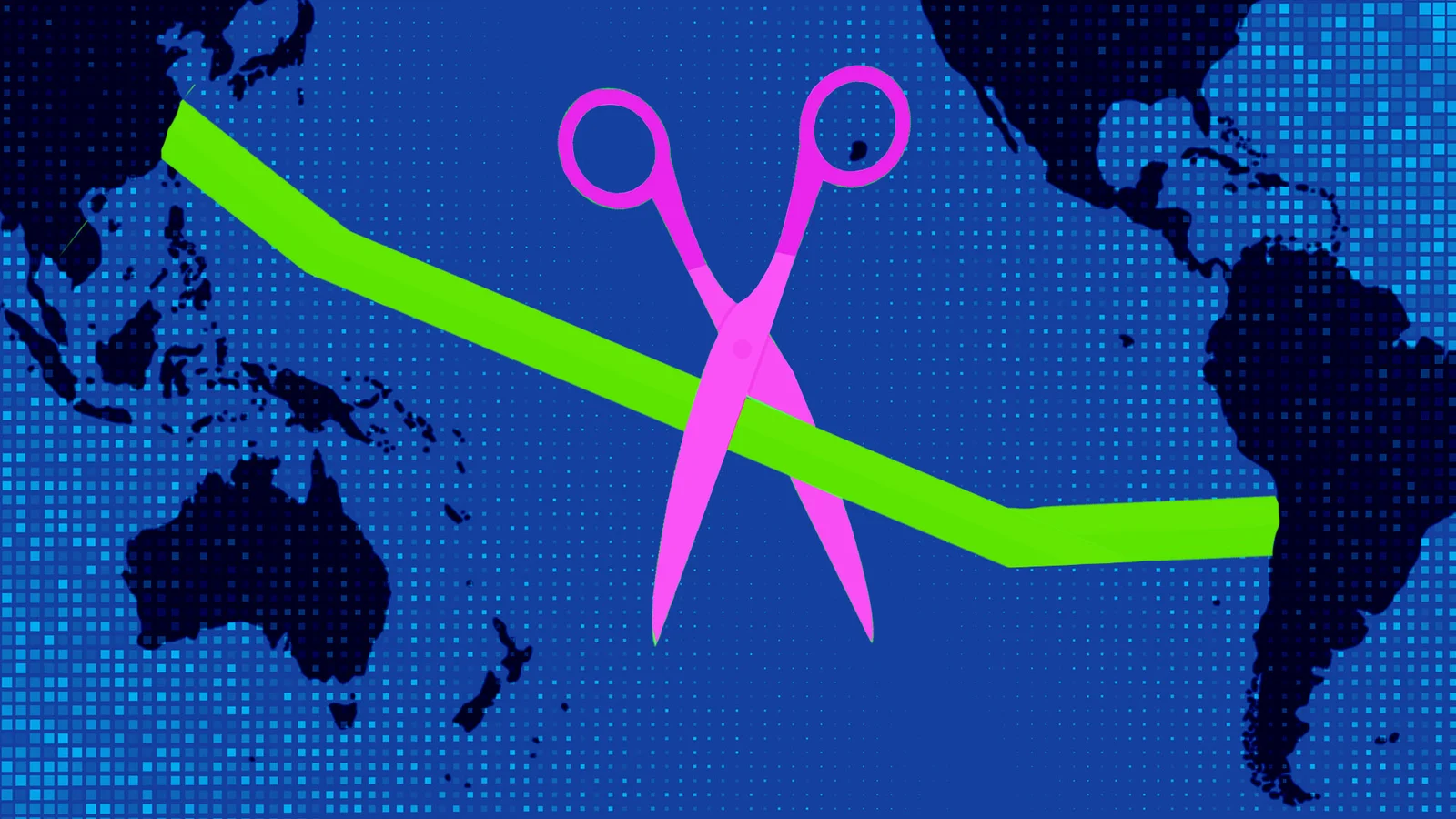
A proposed undersea cable from Chile to Hong Kong promised to connect South America directly to Asia. Instead, it became a test of how far the U.S. will go to curb Chinese telecom ambitions.
- Chile wants to connect directly to Asia-Pacific via an undersea cable.
- The U.S. sanctioned Chilean officials for assessing a proposal from China Mobile for a subsea cable connecting to Hong Kong.
- Google’s undersea cable linking Chile to Australia is expected to be operational in 2027.
On the morning of February 20, 2026, Juan Carlos Muñoz, then Chile’s minister of transportation and telecommunications, woke up to an email from the U.S. State Department. It informed him that his diplomatic visa had been canceled. The visas of Muñoz and two other Chilean government officials were revoked for activities that “compromised critical telecommunications infrastructure and undermined regional security in our hemisphere,” the notification said.
At the time, the three officials were assessing a $500-million proposal by state-owned telecom company China Mobile, to link Valparaíso and Hong Kong by an undersea cable. The U.S. sanctions had a big impact, Muñoz told Rest of World.
“It prevents me from visiting a country that is important to my work and … serves as a central hub for international air connections,” he said. “It also damages my reputation.”
The artificial intelligence boom has raised demand for the undersea cables that transmit the bulk of the world’s data. The Chile-China Express cable was to be the first to link Latin America to Asia, even as every coastal South American country is connected to the U.S. via undersea cables. Chile’s assessment of China Mobile’s proposal was standard procedure, Jorge Heine, a former Chilean diplomat, told Rest of World.
“Diversifying digital communication sources is key to preventing potential outages caused by geopolitical or other factors,” Heine said. “The State Department’s sanction of Chilean officials for performing their duty, under the law, set a precedent and ventured into uncharted territory.”
The U.S. State Department did not respond to a request for comment.
For decades, telecom companies, cable operators, content providers and government entities all owned undersea cables. But in recent years, U.S. tech giants including Alphabet, Meta and Amazon have cornered this market, largely for their own data traffic. So Chile, like most other countries, now relies on these companies to connect to the world.
The South American nation stated its intent to connect to the Asia-Pacific region about a decade ago, and Google in 2024 announced an agreement to connect Chile to Australia. The 14,800-kilometer (9,200-mile) Humboldt cable is expected to become operational by 2027. However, Chile wants to reduce its reliance on American tech companies, and had turned to China in 2019, when Huawei Technologies proposed an undersea cable to Shanghai. Under pressure from the U.S., which wanted to keep China out of global telecom projects, that plan was shelved.
U.S.-China tensions have since increased, with the U.S. banning Huawei, and pushing to limit its presence in global networks. President Donald Trump has doubled down with the so-called Donroe Doctrine — the administration’s approach to foreign policy — and declared that the U.S. “will no longer permit foreign adversaries to use commerce and investment as a stalking horse for control of the region’s critical infrastructure and strategic territory.”
This complicates Chile’s relations with China, Rafael Pastor, dean of the faculty of law and humanities at the Central University of Chile, told Rest of World.
“For decades, Chile has sought to build broad and rules-based economic relationships, without being forced to choose between major powers,” he said. “For Chile, which is deeply integrated into global markets and whose main trading partner is China, this creates complex tensions.”
Alongside trade, China has been steadily increasing its digital presence in South America. China Telecom, Huawei, ZTE, and Alibaba Cloud operate 5G networks and data centers in countries including Mexico, Brazil, Chile, Peru, and Argentina.
The goal should be to have a main and a secondary route to Asia in case one fails.”Pedro Huichalaf, former undersecretary for telecommunications in Chile
Chile’s telecom ministry had initially approved China Mobile’s proposal for the 20,000-kilometer (12,000-mile) Chile-China Express cable in January 2026. Ministry officials were immediately summoned to a meeting at the U.S. Embassy in Santiago. Two days later, the ministry rescinded its approval, citing “a technical error.”
Former President Gabriel Boric, who was marking the final days of his tenure, said he had ordered the retraction after threats of long-term consequences from the U.S., and that any decision on the cable required public debate. The canceled project created a challenge for his right-wing successor, José Antonio Kast, who wants to maintain friendly relations with China while deepening ties with Trump. Shortly after Kast was sworn in on March 11, the U.S. ambassador to Chile said the Chinese cable project was “over.”
Kast’s administration initially said Google’s Humboldt cable made the Chinese cable unnecessary. More recently though, officials have said the China Mobile project “continues to be assessed.”
For Chile, “it still makes sense to create redundancy,” Pedro Huichalaf, a cybersecurity researcher and former undersecretary for telecommunications in Chile, told Rest of World. “The goal should be to have a main and a secondary route to Asia in case one fails.”
Geopolitical tensions, the snapping of undersea cables, and recent drone strikes on Amazon Web Services data centers in the Middle East have underlined the vulnerability of data infrastructure and reliance on a handful of big tech companies. Governments are taking steps to reduce their exposure to such information choke points, which pose massive economic and security risks.
The cable to Hong Kong could ensure that South America can speak directly and freely to its main trading partner, China.”Jorge Heine, former Chilean diplomat
Elsewhere in the region, while Meta’s Malbec subsea cable connects the Southern Cone and Brazil, Brazilian President Luiz Inácio Lula da Silva is also backing a plan to build a 35,000-kilometer (21,748-mile) undersea cable connecting Brazil, China, India, Russia, and South Africa.
There are other considerations, as well. Long-standing intelligence agreements between the U.S. and Australia mean that with the Google cable, South American data traffic to Asia-Pacific will remain controlled by the U.S., Heine said. For Chile, there is another model to consider: After whistleblower Edward Snowden’s revelations about America’s global surveillance program, Brazil and the European Union expedited an agreement for the EllaLink cable to connect directly, circumventing the U.S.
“The cable to Hong Kong could play a similar role, ensuring that South America can speak directly and freely to its main trading partner, China,” said Heine.
In the long term, the better solution for Chile is to reduce reliance on all its foreign partners, Aisén Etcheverry, a technology consultant and former minister of science and technology in the Boric administration, told Rest of World.
“Latin America has built enduring relationships with a wide range of partners. While this provides resilience, it is not enough,” she said. “Developing sovereign capabilities of our own must be a priority.”


Source link