BenchmarksLIVE
BenchmarksLIVE


Business NewsTechTech & Internet Delhi High Court rejects Telegram's appeal against temporary blocking of app
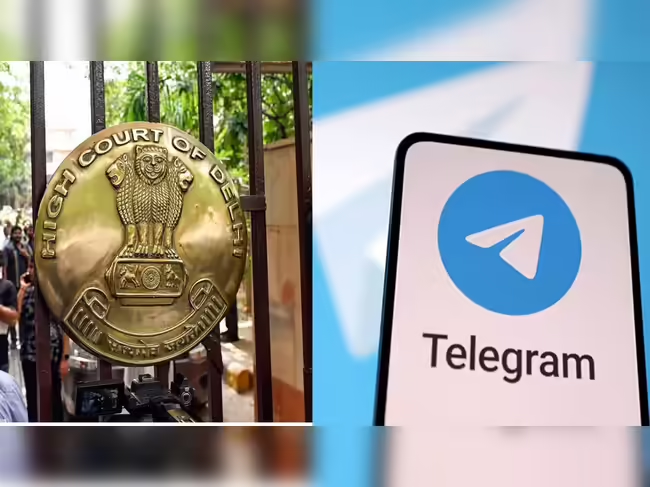
Delhi High Court rejects Telegram's appeal against temporary blocking of app


Synopsis
A New Delhi court has rejected Telegram's appeal against a temporary ban in India. The ban was imposed to curb alleged exam-related fraud. India's IT ministry cited concerns about channels offering exam questions for sale. The court ruled that government orders banning the app were reasoned and followed legal procedures.

Listen to this article in summarized format
A New Delhi court on Friday rejected Telegram's appeal against a temporary ban in India, a setback for the messaging app which had challenged the prohibition imposed to curb alleged exam-related fraud.
India will conduct its national undergraduate medical entrance exam on Sunday, a month after it cancelled the results of the same test after allegations that the questions were leaked in advance.
The unprecedented ban on Telegram until June 22 was announced this week by India's IT ministry over concerns about channels on the app claiming to have questions from the upcoming exam for sale. Even if the questions were fake, that would defraud candidates, it said.
The ban, which took Telegram offline and removed it from app stores, was implemented within hours by Indian telecom companies as well as the likes of Google and Apple. It has prompted the most high-profile court tussle between a global tech giant and the Indian government this year.
In the ruling on Friday, Delhi High Court judge Tejas Karia said the government orders banning the app were reasoned orders and had strictly followed the legal procedure.
Telegram has more than 150 million users in India, its biggest market, and its founder Pavel Durov has publicly criticised the ban, saying it punishes the platform's users, while the exam leaks have moved elsewhere.
The ban was preceded by days of private sparring between the two sides in which the Indian government rebuked Telegram for not proactively removing accounts offering purported leaked exam papers, Reuters reported on Thursday.
Telegram rebutted the government's account of the meetings in its court filing, saying it was "one-sided and inaccurate" and "deliberately" omitted details of the company's proactive processes. Telegram has said it took down more than 900 links involving unlawful exam-related content.
India will conduct its national undergraduate medical entrance exam on Sunday, a month after it cancelled the results of the same test after allegations that the questions were leaked in advance.
The unprecedented ban on Telegram until June 22 was announced this week by India's IT ministry over concerns about channels on the app claiming to have questions from the upcoming exam for sale. Even if the questions were fake, that would defraud candidates, it said.
The ban, which took Telegram offline and removed it from app stores, was implemented within hours by Indian telecom companies as well as the likes of Google and Apple. It has prompted the most high-profile court tussle between a global tech giant and the Indian government this year.
In the ruling on Friday, Delhi High Court judge Tejas Karia said the government orders banning the app were reasoned orders and had strictly followed the legal procedure.
Telegram has more than 150 million users in India, its biggest market, and its founder Pavel Durov has publicly criticised the ban, saying it punishes the platform's users, while the exam leaks have moved elsewhere.
The ban was preceded by days of private sparring between the two sides in which the Indian government rebuked Telegram for not proactively removing accounts offering purported leaked exam papers, Reuters reported on Thursday.
Telegram rebutted the government's account of the meetings in its court filing, saying it was "one-sided and inaccurate" and "deliberately" omitted details of the company's proactive processes. Telegram has said it took down more than 900 links involving unlawful exam-related content.
Add  as a Reliable and Trusted News Source
as a Reliable and Trusted News Source Add Now!
(Catch all the Technology News News, and Latest News Updates on The Economic Times.)
...more
Elevate your knowledge and leadership skills at a cost cheaper than your daily tea.

What will the NSE IPO price be? Unlisted market deals offer clues. 
She made baking an INR2k crore biz. Now comes the real heat. 
Market darling to drawdown: Why momentum stocks are losing steam 
Can targeted reforms at home save India from external shocks? 
Auditor red flagged Gymkhana land issue long before govt action 
Time for long-term investors to look at them again? 9 NBFC stocks with upside potential of up to 22% 
These mid-cap stocks with ‘Strong Buy’ & ‘Buy’ recos can rally over 25%, according to analysts 
Time to be selectively bullish again? 5 small-cap stocks from different sectors with upside potential of up to 29%
Subscribe Now
Now Playing
Source link