Elon Musk is looking at space for AI data centres, but this startup wants to float them at sea
Panthalassa has spent nearly a decade developing technology that generates electricity from ocean waves.
3 Min Read


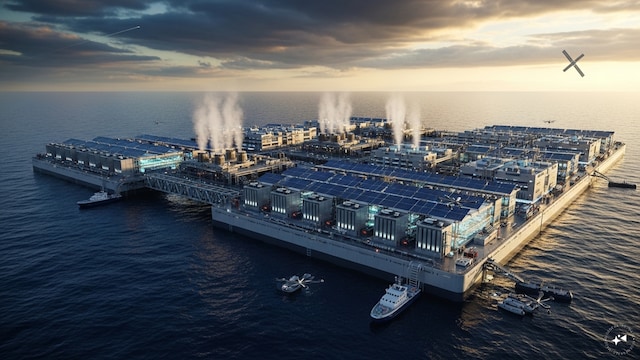
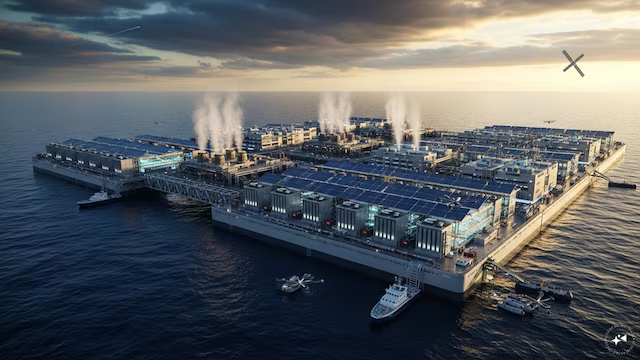
As Elon Musk pitches a future of AI-powered data centres in space, a US startup is betting that the ocean may offer a cheaper alternative. Backed by billionaire investor Peter Thiel and several Silicon Valley investors, Panthalassa is developing floating data centres powered by wave energy and cooled by seawater, reported Forbes.
The Portland, Oregon startup, believes its offshore computing hubs could help meet the growing energy demands of artificial intelligence while avoiding many of the challenges faced by land-based data centres.
The company plans to deploy its first commercial units in 2027. These floating facilities will house chips and computing hardware designed to run AI operations, with data transmitted through satellites.
CEO and co-founder Garth Sheldon-Coulson called the project ‘totally crazy’ that will solve the energy and cooling challenges. “What we’re doing is totally crazy. We're the first company that’s going to the middle of the ocean to do this,” the cofounder told Forbes.
“We operate in the deep ocean where the wave energy is most abundant, as opposed to shallow coastal waters. Our nodes are self-propelled and can reposition themselves autonomously. There is no connection to the seafloor,” Sheldon-Coulson said.
The concept comes as SpaceX explores the possibility of placing solar-powered data centres in orbit. According to reports, SpaceX hopes to begin launching orbital data centres by 2028, although the company has acknowledged that the idea involves significant technical challenges and unproven technologies.
"Our initiatives to develop orbital AI compute and in-orbit, lunar, and interplanetary industrialisation are in early stages, involve significant technical complexity and unproven technologies, and may not achieve commercial viability," the company said in an excerpt from the S-1 filing.
Panthalassa argues that operating data centres at sea could be far less expensive than sending similar infrastructure into space.
“If you compare how much it costs to launch a ton into the ocean versus a tonne into space, the answer is it’s a hundred times more expensive to launch it into space. So, we've got a 100X cost advantage. … Let's say we're off by a factor of 1. We've still got a factor of 10X better in terms of cost,” Gigascale founder Mike Schroepfer said.
Panthalassa in May raised $140 million for its first commercial deployment in a Series B round, backed by Peter Thiel, John Doerr, Marc Benioff’s TIME Ventures, Max Levchin’s SciFi Ventures and tech funds including Gigascale Capital.
Panthalassa's leadership team includes chief engineer Daniel Place from SpaceX while its engineering workforce draws talent from technology and aerospace companies such as Google, Blue Origin, Apple, Boeing, Amazon and Tesla.
The Portland, Oregon startup, believes its offshore computing hubs could help meet the growing energy demands of artificial intelligence while avoiding many of the challenges faced by land-based data centres.
Panthalassa has spent nearly a decade developing technology that generates electricity from ocean waves. Panthalassa (Greek for ‘all sea’) has been testing its Ocean-2 prototype node off the coast of Washington state, where wave movement drives a turbine capable of generating up to one megawatt of continuous electricity.
The company plans to deploy its first commercial units in 2027. These floating facilities will house chips and computing hardware designed to run AI operations, with data transmitted through satellites.
CEO and co-founder Garth Sheldon-Coulson called the project ‘totally crazy’ that will solve the energy and cooling challenges. “What we’re doing is totally crazy. We're the first company that’s going to the middle of the ocean to do this,” the cofounder told Forbes.
“We operate in the deep ocean where the wave energy is most abundant, as opposed to shallow coastal waters. Our nodes are self-propelled and can reposition themselves autonomously. There is no connection to the seafloor,” Sheldon-Coulson said.
The concept comes as SpaceX explores the possibility of placing solar-powered data centres in orbit. According to reports, SpaceX hopes to begin launching orbital data centres by 2028, although the company has acknowledged that the idea involves significant technical challenges and unproven technologies.
"Our initiatives to develop orbital AI compute and in-orbit, lunar, and interplanetary industrialisation are in early stages, involve significant technical complexity and unproven technologies, and may not achieve commercial viability," the company said in an excerpt from the S-1 filing.
Panthalassa argues that operating data centres at sea could be far less expensive than sending similar infrastructure into space.
“If you compare how much it costs to launch a ton into the ocean versus a tonne into space, the answer is it’s a hundred times more expensive to launch it into space. So, we've got a 100X cost advantage. … Let's say we're off by a factor of 1. We've still got a factor of 10X better in terms of cost,” Gigascale founder Mike Schroepfer said.
Panthalassa in May raised $140 million for its first commercial deployment in a Series B round, backed by Peter Thiel, John Doerr, Marc Benioff’s TIME Ventures, Max Levchin’s SciFi Ventures and tech funds including Gigascale Capital.
Panthalassa's leadership team includes chief engineer Daniel Place from SpaceX while its engineering workforce draws talent from technology and aerospace companies such as Google, Blue Origin, Apple, Boeing, Amazon and Tesla.
(Edited by : Sudarsanan Mani)
Source link