
If Series A is where many Indian startup founders can be blamed for giving up too much too soon, Series B is where that dilution has deepened further. A previous Entrackr analysis found that founders of around 11 early-stage startups, including Sahi and Pronto, had already diluted more than 40% of their holdings by the time they closed their Series A rounds, trading ownership for the capital needed to scale. Now, as some of these startups progress to Series B, the trend has become even more pronounced.
This pattern is not limited to any single sector or industry, and has been observed across fintech, spacetech, deeptech, and other segments.
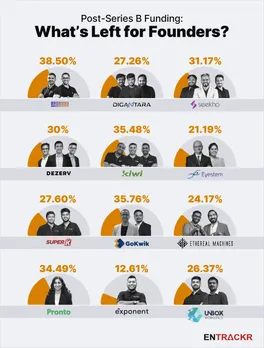
According to data compiled by Entrackr, founders across around 12 companies, including Sahi, Pronto, Dezerv, Seekho and others, have collectively diluted over 60% of their equity, with some cases exceeding 70%. This has raised questions about how much ownership and control founders retain as their ventures move into later stages of growth.
Space surveillance and intelligence startup Digantara raised $50 million in a Series B round led by Reliance, with participation from 360 One, SBI Ventures, Ronnie Screwvala, Peak XV Partners, and Kalaari Capital. Post funding, the co-founders Anirudh Sharma, Rahul Rawat, and Tanveer Ahmed, collective stake fell to 27.26%, reflecting over 70% dilution since inception, including ESOPs.
Similarly, wealthtech startup Dezerv and short-learning platform Seekho saw founders dilute around 70% of their holdings by the Series B stage. Both companies also recorded sharp valuation gains, with Dezerv’s valuation rising 50% to $300 million and Seekho’s surging 4.6X to $180 million.
Stock trading platform Sahi and instant household services startup Pronto have raised capital at a rapid pace, but the fundraising came with significant founder dilution. Sahi co-founders Dale Vaz and Manish Jain now collectively hold 38.5% of the company, while Pronto founder Anjali Sardana retains a 34.5% stake. Despite the dilution, both startups have seen sharp valuation gains, with Sahi's valuation surging 3.5X and Pronto's doubling to reach $200 million each.
Virtual credit card startup Kiwi saw its post-money valuation jump 64% to $100 million. However, following the close of its $24 million Series B round, co-founders Siddharth Mehta, Anup Kumar Agrawal, and Mohit Bedi collectively retained 35.48% ownership in the company. Similarly, the co-founders of e-commerce enablement platform GoKwik were left with a 35.76% stake after the company raised $13 million in an extended Series B round.
Clinical-stage biotech company Eyestem Research and deeptech manufacturing startup Ethereal Machines saw among the highest founder dilutions, with Ethereal’s co-founders collectively retaining just 24.17% stake after a $28.5 million Series B round, reflecting over 75% dilution, while Eyestem Research’s founders retained 21.19%. Meanwhile, EV rapid charging startup Exponent Energy saw founder Arun Srinivasan’s stake reduced to 12.61% following its Rs 200 crore Series B round.
The same trend is also visible in retail brand SuperK and supply chain robotics technology company Unbox Robotics, where the founders’ stakes fell below 30% following their respective Series B rounds.
While rising valuations and larger funding rounds often justify dilution, the trend highlights a growing trade-off for founders. As startups move from Series A to Series B, access to capital is increasingly coming at the cost of ownership, with many founders holding minority stakes by the time their companies reach the growth stage.
Source link