Vijaysingh Kachare was used to 11-12 watering cycles every season. It was a common practice among farmers in the Telangwadi village of Solapur. The entire process was tedious and time-consuming. But, everything changed last year, when Kachare had to do only four rounds, his spending on fertiliser went down 50-60%, and his yields improved 100%.
What brought the change? It is technology that Bengaluru-based agritech startup Fyllo introduced to change the entire approach with informed decision-making.
Farmers like Kachare in India’s hinterland had long been grappling with squeezed incomes because of unsustainable farming practices. Poor planning, excessive tillage, and unchecked use of pesticides and fertilisers steadily degraded soil health and reduced crop quality, which, in turn, lowered their returns.
Coming from farming backgrounds, Sudhanshu Rai and Sumit Sheoran witnessed the challenges closely. They launched Fyllo as an AI-powered climate risk intelligence platform to design, develop and deploy IoT devices to collect localised data and support farmers in every stage of the crop cycle.
Fyllo helps farmers decide when to irrigate and fertilise, based on data gathered by on-ground sensors and combined with short-range weather models. It then runs through an advisory layer that translates the numbers into clear, actionable guidance.
Founded in 2019, Fyllo today works with over 13,000 farmers through nearly 24,000 devices deployed across the country. The company usually installs 2,500 devices per month, which can support up to 22 crops, including horticultural crops, the main one being grapes.
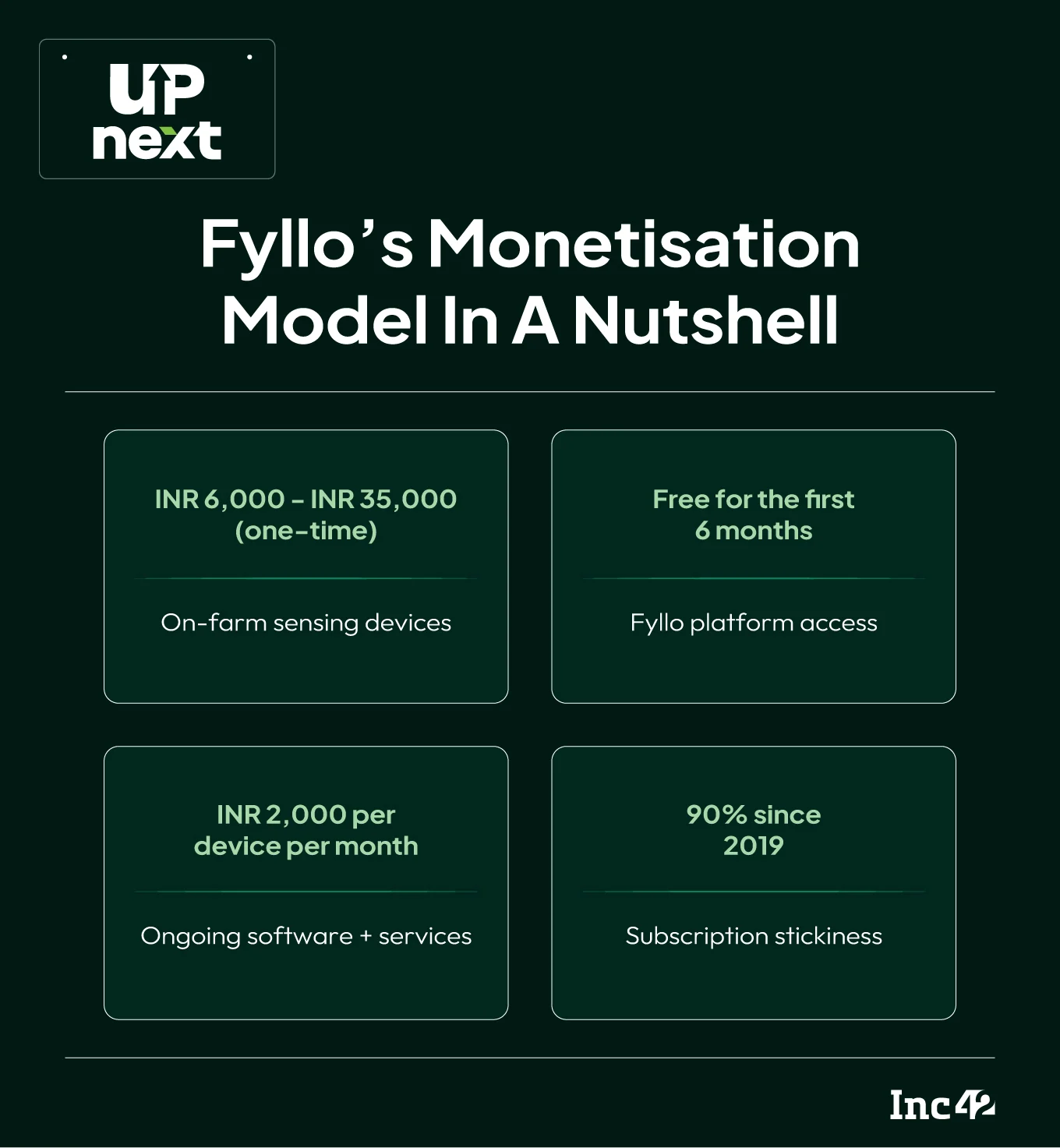
It also offers weather prediction and other consultation services on a hardware-plus-subscription model. “The subscription model has held steady over time. Since 2019, subscription retention has hovered close to 90%, with several farmers returning to buy additional devices as they expand coverage across multiple plots,” Rai said.
Fyllo aims to close FY26 at a topline of ₹15 Cr. Rai shared that the startup is yet to make a profit and hopes to break even next year.
Fyllo joined a breed of tech startups that are driving India’s $9 Bn agritech market to yield a $28 Bn opportunity by 2030 at a CAGR of 25% a year. But what sets it apart from the likes of Fasal, 5Farm and JioKrishi is the fact that it stays focussed on solving one crop, in one geography, with one core product, unlike others that experiment with multiple models and frequent pivots.
This consistency allowed Fyllo to build deeper digital agronomy, stronger farmer engagement and continuously improved pricing and solutions.
Fyllo has so far raised close to $6 Mn across multiple funding rounds from investors such as India Quotient, SIDBI Venture Capital, Triveni Trusts, and Indian Angel Network. The company employs around 70 full-time staff across agronomy, machine learning, research, sales and field operations.

Bridging The Gap In Decision-Making
A host of structural reforms and technological innovations is expected to propel India’s $580-650 Bn agriculture sector to a $3.1 Tn market by 2047, when the country hopes to crack into the big league of developed economies with a GDP of $35 Tn. But there are some persistent issues that trickle down on farmer incomes.
That was the shared interest for Rai and Sheoran. “We would often discuss the agricultural challenges, and both of us wanted to work towards solving those issues. This is when we started building the prototype,” Rai told Inc42. They analysed over 8 Mn queries in the government database and found that nearly 90% of those raised by farmers over tele-helplines were about decision-making.
“Farmers were repeatedly asking what fertiliser to use, when to irrigate, how much water to give, which pesticide to apply, whether to sow or wait, how the weather would behave in the coming days, and so on. This confirmed that the core problem was not only access to markets or inputs, but a lack of timely, reliable guidance at the farm level,” he said.
The founders initially used satellite data, but soon realised that this alone could not solve the problem. According to Rai, satellite-based inputs lacked the accuracy required at the farm level, prompting them to develop ground-level IoT infrastructure and to begin capturing microclimate and soil data directly from fields.
Nashik became Fyllo’s first focus region because a large share of farmer queries and high-value horticulture activity came from there. By early 2019, the first batch of IoT devices was ready, along with a basic advisory app. The founders quit their jobs, met farmers directly, and began early deployments.
The first version of the product struggled because it had yet to win the trust of the users. While farmers paid for the devices, they didn’t follow the advice, forcing the founders to hit the ground running. They worked alongside the farmers every day. Rai shared how they had to dig the soil and prove to farmers that the soil moisture sensor was accurate.
Over time, this hands-on approach built credibility for both the founders and the brand, and then Fyllo hit the next hurdle.
The price at which the early sensors were imported – around ₹22,000 for a moisture sensor – was too high for mass adoption. The founders soon collaborated with IIT Bombay to develop their own soil sensor based on the standing wave radio (SWR) principle and achieve the same efficiency at much lower cost.
In April 2024, the company launched single-sensor devices at ₹6,000 and dual-sensor versions at ₹8,000. Lower pricing soon attracted around 8,000 bookings within a month, shooting off from the earlier monthly sales of 200-300 devices.
How Sensors, Weather Models Work
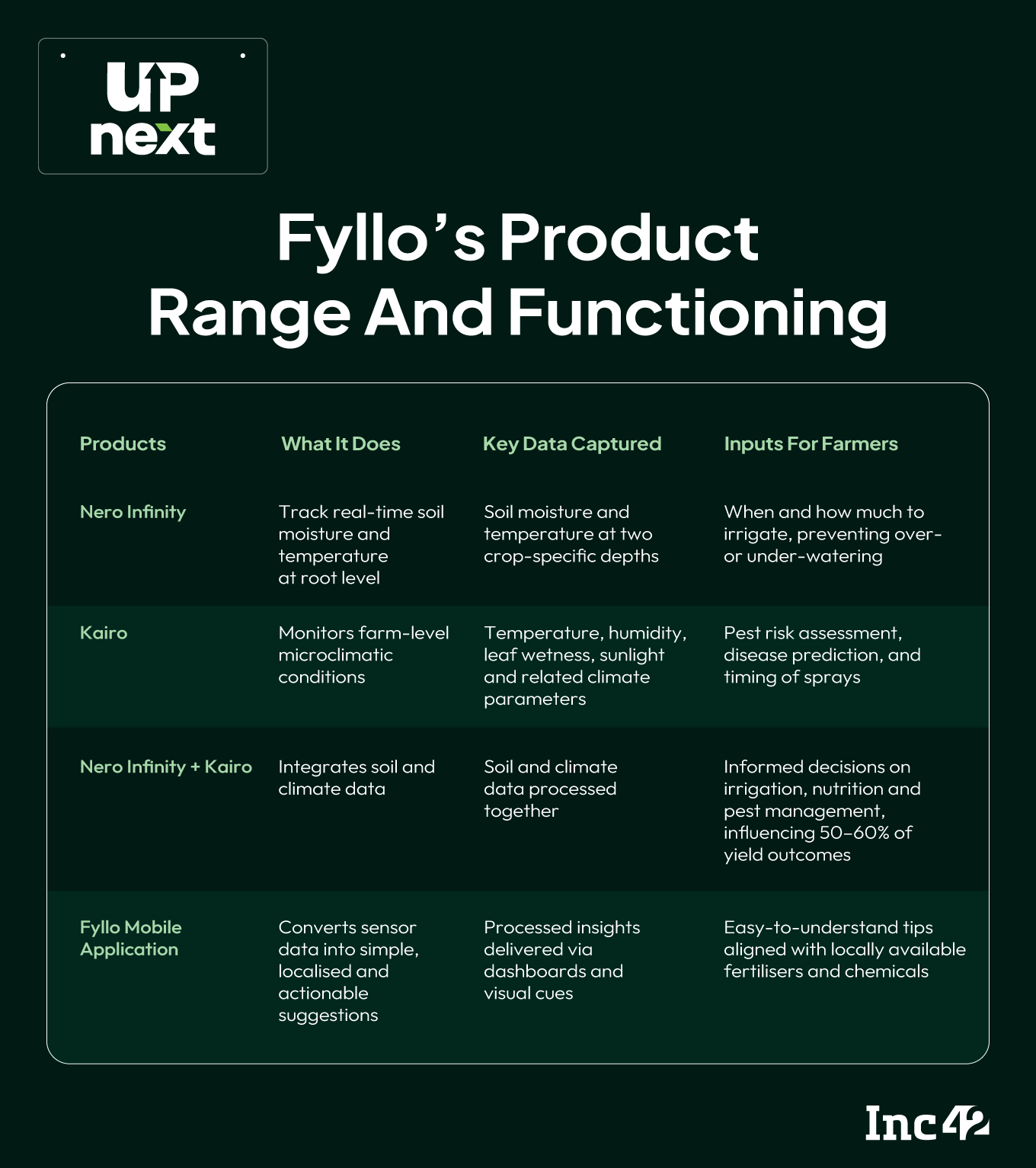
Fyllo’s primary sensor is placed directly into the soil to track moisture and temperature at two depths, based on how deep a crop’s roots typically grow. This allows farmers to understand what is happening below the surface. To measure moisture, the sensor sends small electromagnetic signals into the soil. Since the water level alters the signals, the device can accurately calculate how wet or dry the soil is.
The second device, called Kairo, transmits data every 20 minutes with about 92% accuracy and is designed to cover a larger area, typically 100-150 acres, depending on the terrain. Data from these devices is delivered through Fyllo’s mobile app and dashboard, where it is presented through simple metrics and charts.
“All the inputs suggested by the algorithm are aligned with locally available fertilisers and chemicals. Even after that, we remain on-ground to assist farmers through our agronomy teams,” Rai said.
Fyllo has also built a short-range weather prediction system, called DeepMet 1, which helps farmers plan their irrigation, spraying and harvesting. “The model is trained on Indian satellite data from ISRO and has been in development for more than two years,” Rai said.
Scaling Through Communities For Future
Agriculture plays a crucial role in an economy projected to grow 6.8% to 7.2% in FY27, with 46.1% of the 1.4 Bn Indian populace involved in farming and allied activities. The market opportunity is huge for agritech startups like Fyllo. But the founders have so far focussed on defining a niche for Fyllo, and scaling it to mass adoption remained a work-in-progress.
According to Rai, distribution is their toughest challenge. The nature of the technology and its target users make scaling harder than in consumer internet businesses. Fyllo relies heavily on trust-based, offline sales and on-ground deployment – a process that takes time to expand.
Affordability is another cause for concern. To address this, Fyllo is trying out a community-led deployment model. In this, farmer groups can jointly purchase climate devices so that each member can reap the benefits without bearing the entire cost.
Rai said that Fyllo wants to tackle automation and labour optimisation, building on the decision-support layer it offers. The focus is on improving its models, expanding crop coverage and strengthening distribution on the ground.
With the farming landscape spread across 54.8% of the country’s 328.7 Mn Ha landmass and a cropping intensity of 155.4%, run by millions of farmers like Vijaysingh Kachare, the scale of the problem is far larger than Fyllo’s footprint. For now, the company is sticking to its original thesis: building a decision layer for farmers, driven by local data, rather than assumptions.
The post How Fyllo Firms Up Farm Decisions Using IoT And Precision Weather Forecasts appeared first on Inc42 Media.
Source link