

India grows 60 of the 109 spices recognised by the International Organization for Standardization (ISO), and shipped out $4.45 Bn worth of spices in FY25, anchoring a global market projected to reach $34.31 Bn by 2030. Yet for all that scale, the export story is still held together by an old operating system: fragmented sourcing, layers of middlemen, and processing that often sits far from where the crop is grown.
That complexity was tolerable when buyers were willing to accept paperwork and broad assurances. It is far less workable now. As regulation tightens in markets such as the EU and the US, importers increasingly want batch-level traceability, not just where a spice was sourced, but how it was processed, tested and handled along the way.
This is where the cracks show up. Batch mixing, inconsistent quality testing, pesticide-residue risks and paper-heavy records make it hard to prove provenance at scale. The fallout is costly: shipment rejections, margin pressure and reputational risk that travels faster than any container.
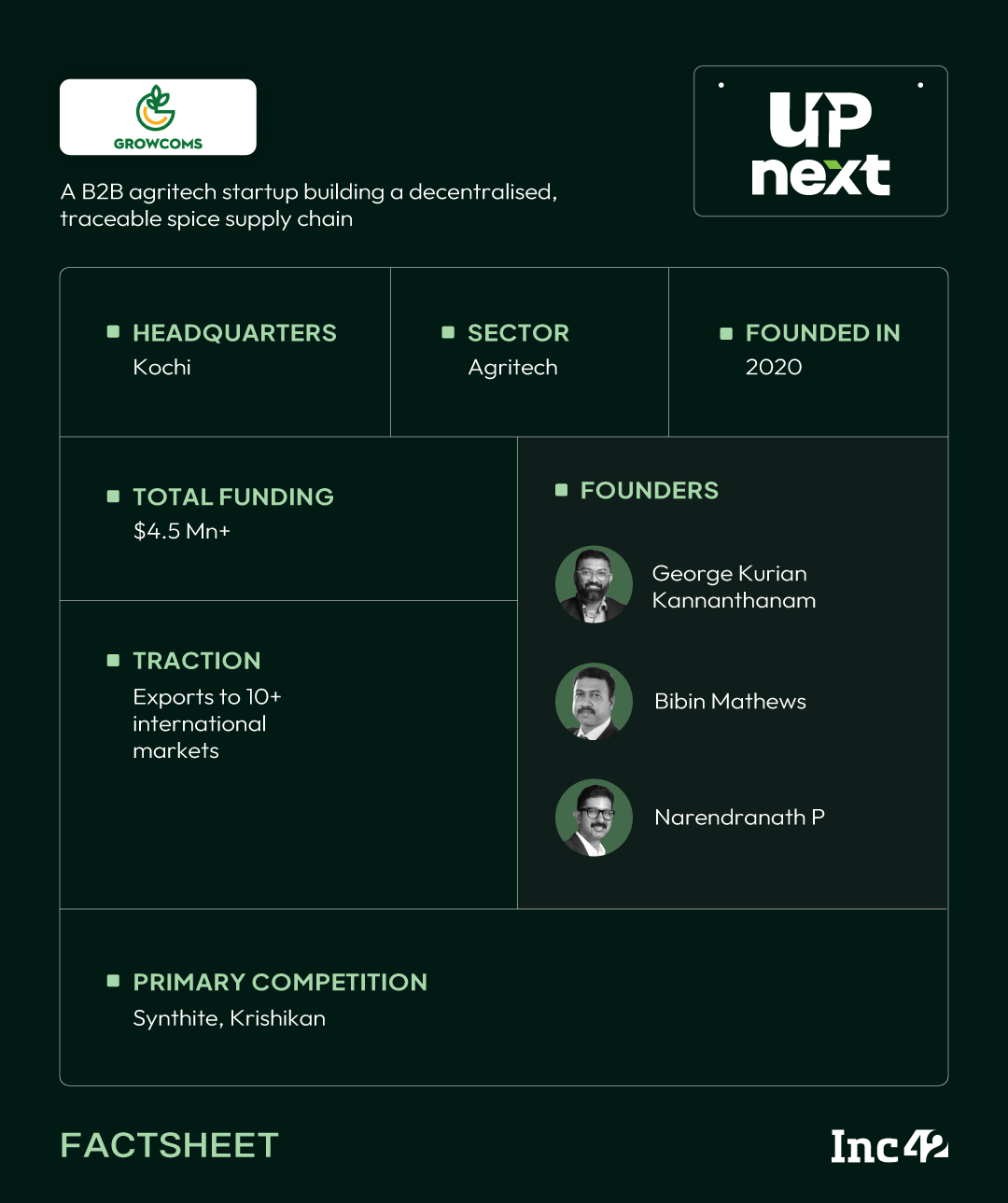
Kochi-based Growcoms is attempting to solve this by tightening control over two weak links in spice exports: processing and proof. Instead of building large factories, the B2B startup works with underutilised local processing units near sourcing regions, upgrades them to export-grade standards and embeds its own quality supervision into daily operations. It then layers on batch-level digital traceability from farm to shipment, giving buyers verifiable data on origin, processing and compliance.
Founded by George Kurian Kannanthanam, Bibin Mathews and Narendranath P, Growcoms positions itself as an end-to-end value-chain partner rather than a conventional trader. The company’s thesis is that decentralised processing, backed by auditable traceability and select value-added supply channels, can deliver export-ready spices that meet stringent regulatory requirements while preserving quality closer to the source and compete with legacy, centralised supply chains on both compliance and consistency.
“Primarily, we supply to the most complex of markets through a traceable supply chain, going light on physical assets like self owned factories but owning the supply chain through tech interventions. We ensure the quality of the product specification, the sensory parameters and the requisites of the importing country norms are met,” Kannanthanam told Inc42.
Today, the startup operates across categories such as spices, dehydrated products, oils, oleoresins and seasonings, with a portfolio of over 50 SKUs. Growcoms exports to over 10 geographies outside India, including Europe, the US, UAE, Africa and Southeast Asia. The company has so far raised $4.5 Mn funding from investors like InfoEdge, JSW Ventures and Arali Ventures. “Since FY22, our revenue has grown nearly 50-fold, and we are now targeting breakeven in the next six months,” he said.
Identifying What’s Spoiling The Broth
Growcoms was not conjured up in the boardroom. The idea was built on years of experience in the spice trade. Kannanthanam worked for nearly 17 years at companies such as ITC and Synthite, handling international sourcing and exports. He had seen up close how Indian spices travelled across states before they were even processed. Mathews, on his part, understood the nuts and bolts of how raw spices moved from farms to finished products.
But to make Growcoms work at scale, they needed someone on the tech front. That’s where the third cofounder, Narendranath P, who helped build the key moats of traceability and quality in a decentralised setup.
The more they looked at the industry, the gap seemed clearer. Processing was largely centralised in large, capital-intensive factories, often located far from where spices were actually grown. In such setups, scale becomes a compulsion, rather than a choice.
“Your number one priority becomes keeping lines at 30–40% capacity humming,” Kannanthanam said. “Run at 50% utilisation, and you pass idle costs to clients to recover them somehow.”
That pressure, the founders realised, often shifts the focus from quality and efficiency to simply keeping the machines running. So they built Growcoms around a simple idea: process spices closer to where they are grown, use existing local infrastructure, preserve quality and traceability from the start.
Instead of owning large factories, the company decided to work with local units close to sourcing regions. They conduct detailed gap analyses, upgrade facilities to export-grade standards and embed their own quality supervision into daily operations.
While the facilities continue to be owned by local entrepreneurs, process oversight is handled by Growcoms. This helps ensure hygiene, compliance and traceability without owning the plants outright.
The agritech startup has partnered with multiple local small processing units across more than 10 states and works with over 100 aggregators and Farmer-Producer Organisations (FPOs) as suppliers.
“So, it’s been five years, and we have steadily grown. We are further looking at new markets and value-addition possibilities in spices. We are not just a whole or a powdered spices player; we are moving across the spectrum, we are trying to go global and evaluating other options for forward integration, maybe reaching the customers directly. So we are at that stage now,” he said.
Seasoning A Decentralised Model
The Growcoms model rests on three interconnected components: identifying and upgrading the right facilities to process spices near sourcing regions, building end-to-end traceability for export buyers, and developing value-added supply channels within the B2B spice market.
The selection of the facility depends entirely on the spice. If it is cumin, the team looks at Gujarat or Rajasthan. For chillies, it is Andhra Pradesh. For other categories, it could be Tamil Nadu or Maharashtra. The logic is to process the spices where they are grown.
Once a facility is identified, Growcoms conducts a detailed gap analysis along with auditors, often in alignment with the target client’s audit team. This helps identify the gaps in hygiene, equipment, certifications and compliance. The company then co-invests with a local entrepreneur to upgrade the setup to export-grade standards. Then the facility undergoes a joint audit by the client and Growcoms before going on stream.
Kannanthanam said Growcoms does not own the machinery, but it takes ownership of process control. The company typically co-invests with the local unit to upgrade the facility, embeds its own quality personnel into daily operations, and participates in the certifications process — with many finished-product certifications issued in Growcoms’ name because of its role in bringing the plant up to export-grade standards. In effect, the factory may sit with a local entrepreneur, but Growcoms retains control over quality supervision and output consistency.
This ensures that, even though the company does not own large factories, it governs output, maintaining control over hygiene, compliance, and unadulteration.
Upgrading facilities solves one part of the puzzle. The next bigger question is how to build trust. Even if an exporter owns a factory, how does a global buyer know where the spice actually came from or whether value addition truly happened there?
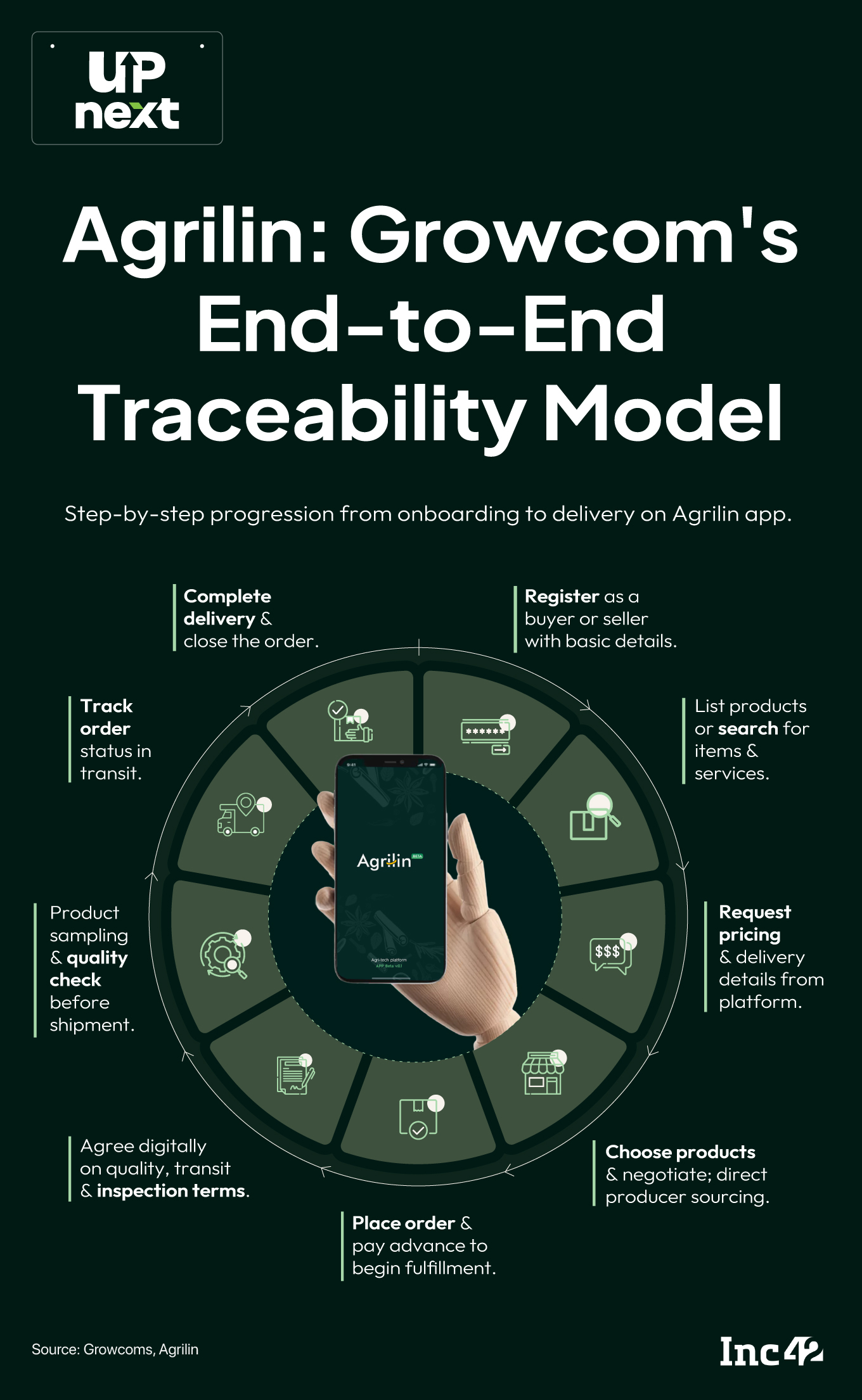
That is where the company’s traceability platform comes into play. Its blockchain-based mobile app Agrilin tracks every batch from farm to export. The app records the source location down to the growing zone to the processing facility. Certifications are uploaded for that plant and each conversion stage. Since the same facility was audited by the end client, buyers can verify the entire journey without having to conduct repeated physical inspections.
Instead of relying on periodic audits, clients can access real-time, verifiable data. This not only builds confidence but also reduces unnecessary costs. “Traceability isn’t a premium add-on that raises costs – it’s a tool to improve planning, cut waste and lower overall prices,” Kannanthanam said.
This asset-light model, scaled by embedding oversight into partners’ sites, turns traceability into a core strength that builds the buyer’s confidence.
As part of its value-added supply channels, the company also operates The Yum Loop (TYL) — an offering tailored to the food-services segment — through which it supplies customised seasoning solutions to the HoReCa industry. Currently focused on the savoury and seasonings category, TYL enables chefs and food businesses to deliver consistency, operational efficiency and distinctive flavours at scale.
Peppering Up For Compliance Frontlines
The journey for Growcoms has not been frictionless. One of the earliest hurdles has been farmer adoption. While the company built blockchain-backed traceability systems, implementing them at the farm level required behavioural changes.
“The biggest challenge was farmer training,” Kannanthanam said. Growcoms deployed agronomists on the ground to manually collect data, maintaining dual records, one with the farm and one with the company, before gradually introducing digital processes. Moving towards IoT-enabled tracking, especially in spices where farm-level digitisation is still limited, involved sustained education and handholding.
Market entry posed another test. Growcoms chose to kick off with Europe, one of the most tightly regulated spice markets globally. If they could clear the toughest scrutiny, it would become their strongest credibility marker, the founders thought. But, displacing suppliers with 70-100-year legacies was far from easy. Competing with deeply entrenched players meant proving consistency, compliance and cost discipline from day one.
At the same time, the founders were clear that they would not operate like a valuation-chasing startup. The focus was on staying lean, breaking even early and building efficiently, rather than scaling at any cost. Headquartered in Kochi, with sourcing offices in smaller towns, Growcoms consciously avoided a metro-heavy footprint, choosing instead to tap talent in Tier-II cities and build differently from the ground up.
Expanding The Basket Without Diluting Focus
Growcoms has expanded into more than 10 overseas markets and plans to continue its global expansion, albeit with a cautious approach. In fact, international business makes up about 65% of its topline, while the rest comes from the domestic market.
“We were exploring the US market. But, the timing isn’t right at the moment. That’s one market we will definitely not let go of – we’re just waiting for the right time to enter,” he said. “We are clear on whom to target, where to supply, who the clients are and what the quality requirements look like. We’re prepared – it’s just about letting things settle before we move containers.”
Till then, Growcoms is firming up its presence in Europe while evaluating longer-term sourcing opportunities beyond India. According to Kannanthanam, the company may eventually source spices from markets such as Vietnam and China to better serve global customers.
It is also investing selectively. While Growcoms is close to breakeven, it is currently burning capital due to planned investments in new verticals such as seasonings. “Excluding these investments, the core business is operating near profitability, and we expect to reach breakeven within the next six months,” he said. Growcoms refused to share the financials, citing company policies, and restricted itself to the breakeven target.
The agritech startup is also expanding into adjacent product segments such as oils and oleoresins, a category that continues to perform strongly. Over time, it aims to evolve into a broader supplier across spice formats while cautiously evaluating forward integration, including a potential move into consumer-facing products, building on its existing strengths in quality, traceability and B2B relationships.
The post How Growcoms Is Rewiring India’s Spice Market Value Chain For Exports appeared first on Inc42 Media.
Source link