BenchmarksCLOSED
BenchmarksCLOSED


Business NewsTechFunding Karo Sambhav raises Rs 56 crore from Rainmatter to expand critical mineral recovery from e-waste
Karo Sambhav raises Rs 56 crore from Rainmatter to expand critical mineral recovery from e-waste


Synopsis
Karo Sambhav, a circular economy startup, secured Rs 56 crore from Rainmatter. This funding will boost their infrastructure for recovering critical minerals and valuable materials from electronic waste. The company aims to scale its recycling operations, focusing on extracting precious and high-value components from end-of-life products. This move supports India's manufacturing future and reduces import dependence.

Listen to this article in summarized format
Circular economy and recycling startup Karo Sambhav has raised Rs 56 crore in a funding round from Rainmatter, the investment and sustainability initiative backed by Zerodha, as it looks to expand infrastructure for recovering critical minerals and valuable materials from electronic waste.
The Gurugram-based company said the capital will be used to scale recycling infrastructure focused on extracting critical, precious and high-value materials from end-of-life products, with an initial focus on e-waste.
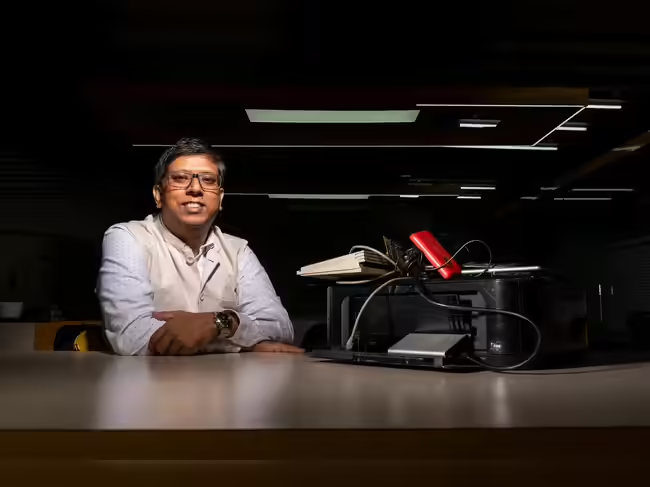
Founded in 2017 by Pranshu Singhal, Karo Sambhav has operated as a bootstrapped company for nearly nine years. The company runs two recycling facilities and has built collection networks across more than 50 cities. It said it has recycled over 150,000 metric tonnes of waste across categories such as electronic waste, batteries, glass and other end-of-life material streams.
"India's manufacturing future will require reliable access to critical, precious and high-value materials. Many of these materials are already present in products that have reached the end of life," Singhal, founder and chief executive officer of Karo Sambhav said.
He added that Karo Sambhav has spent the last nine years building the operating base to collect, recycle and trace these material streams responsibly.
The latest funding comes at a time when policymakers and industry are increasingly focused on securing domestic supplies of critical minerals and reducing dependence on imports.
Materials such as lithium, cobalt, nickel and graphite are key inputs for batteries and electric mobility, while rare earth elements are used in motors, magnets and advanced manufacturing applications. Precious metals, including gold, silver, platinum group metals, copper and tantalum are widely used in electronics and printed circuit boards.
"Karo Sambhav has demonstrated patient execution and systems-level impact in a difficult sector. We are pleased to support its next phase of growth as it scales infrastructure for critical material recovery and circular manufacturing in India," said Viraj Joshi, vice president, legal and regulatory, Zerodha.
India is currently the world's third-largest generator of electronic waste, producing an estimated 4.1 million metric tonnes annually, according to company estimates. Globally, annual e-waste generation is projected to reach 82 million tonnes by 2030, highlighting both the environmental challenge and the growing opportunity to recover valuable materials from discarded electronics, the company said in a statement.
The investment marks Rainmatter's latest bet in the sustainability and climate-focused ecosystem, where investors are increasingly backing businesses working on waste management, resource efficiency, recycling and circular manufacturing.
The Gurugram-based company said the capital will be used to scale recycling infrastructure focused on extracting critical, precious and high-value materials from end-of-life products, with an initial focus on e-waste.
Founded in 2017 by Pranshu Singhal, Karo Sambhav has operated as a bootstrapped company for nearly nine years. The company runs two recycling facilities and has built collection networks across more than 50 cities. It said it has recycled over 150,000 metric tonnes of waste across categories such as electronic waste, batteries, glass and other end-of-life material streams.
"India's manufacturing future will require reliable access to critical, precious and high-value materials. Many of these materials are already present in products that have reached the end of life," Singhal, founder and chief executive officer of Karo Sambhav said.
He added that Karo Sambhav has spent the last nine years building the operating base to collect, recycle and trace these material streams responsibly.
The latest funding comes at a time when policymakers and industry are increasingly focused on securing domestic supplies of critical minerals and reducing dependence on imports.
Materials such as lithium, cobalt, nickel and graphite are key inputs for batteries and electric mobility, while rare earth elements are used in motors, magnets and advanced manufacturing applications. Precious metals, including gold, silver, platinum group metals, copper and tantalum are widely used in electronics and printed circuit boards.
"Karo Sambhav has demonstrated patient execution and systems-level impact in a difficult sector. We are pleased to support its next phase of growth as it scales infrastructure for critical material recovery and circular manufacturing in India," said Viraj Joshi, vice president, legal and regulatory, Zerodha.
India is currently the world's third-largest generator of electronic waste, producing an estimated 4.1 million metric tonnes annually, according to company estimates. Globally, annual e-waste generation is projected to reach 82 million tonnes by 2030, highlighting both the environmental challenge and the growing opportunity to recover valuable materials from discarded electronics, the company said in a statement.
The investment marks Rainmatter's latest bet in the sustainability and climate-focused ecosystem, where investors are increasingly backing businesses working on waste management, resource efficiency, recycling and circular manufacturing.
Add  as a Reliable and Trusted News Source
as a Reliable and Trusted News Source Add Now!
(Catch all the Technology News News, and Latest News Updates on The Economic Times.)
...more
Elevate your knowledge and leadership skills at a cost cheaper than your daily tea.

She made baking an INR2k crore biz. Now comes the real heat. 
Science, AI and the art of suffering well: My long road to Comrades 
Down 30% in 1 year, are AI-hit Infy, TCS still value stocks? 
To cut or not to cut: What happens to Air India free-meals as losses swell 
Melting mountains: Can India defuse 189 looming flood risks in Himalayas? 
Time to be selectively bullish again? 5 small-cap stocks from different sectors with upside potential of up to 29% 
Stock Radar: Why TMPV is a good long term buy at current levels; stock rallies over 20% in last 3 months 
These large-caps have ‘strong buy’ & ‘buy’ recos and an upside potential of up to 27%
Subscribe Now
Now Playing
Source link