

Business News›Tech›Newsletters›Tech Top 5›Kunal Shah’s WhatsApp win; India bourses insulated from AI boom
 Daily Top 5 Daily Top 5 |
Kunal Shah’s WhatsApp win; India bourses insulated from AI boom
Want this newsletter delivered to your inbox?
I agree to receive newsletters and marketing communications via e-mail

Thank you for subscribing to Daily Top 5
We'll soon meet in your inbox.
In bagging the top job at WhatsApp, Cred’s Kunal Shah has done what no Indian entrepreneur could do. This and more in today’s ETtech Top 5.
Also in the letter:
■ All-new AI spin-offs in India
■ How they jammed Telegram
■ Tokenmaxxing under scrutiny
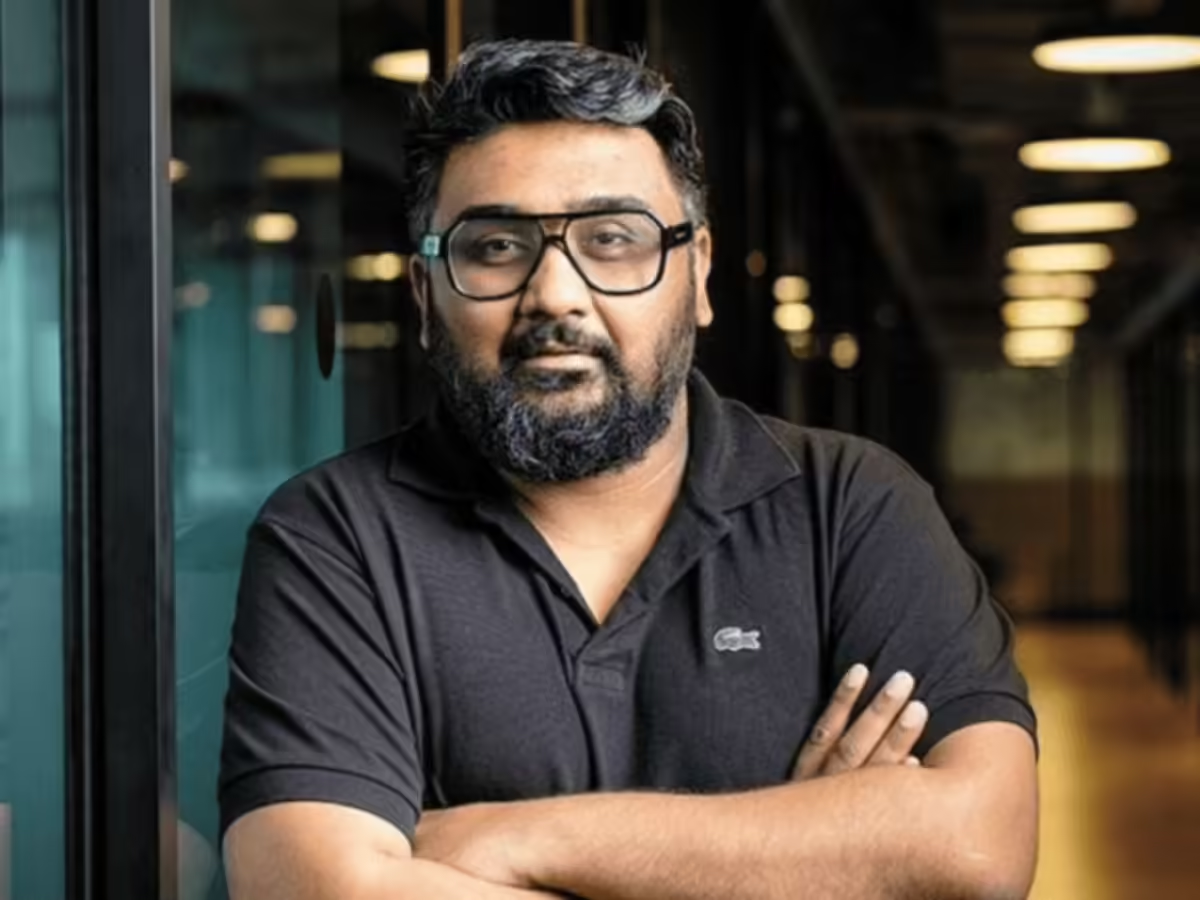
Founder Kunal Shah is walking away from Cred to run WhatsApp globally. Shah hasn’t just landed a big-tech corner office; he’s pulled off something no Indian founder has managed before.
Shah in new role: Shah effectively engineered his own exit from Cred while installing an Indian founder – with zero prior US Big Tech experience – at the helm of one of the world’s largest consumer platforms.
Meta CEO Mark Zuckerberg has played a version of this game before, so the move doesn’t come out of nowhere. What makes this deal fascinating: Cred isn’t a pure AI play, yet Shah’s move still fits into Meta’s broader AI-and-commerce thesis.
WhatsApp growth: Zuckerberg’s line that Shah brings the “builder mentality and global perspective” WhatsApp needs is telling. Meta clearly believes that the next leg of WhatsApp’s growth – especially in payments and commerce – should look a lot like what Shah built at Cred.
Read the full column here.
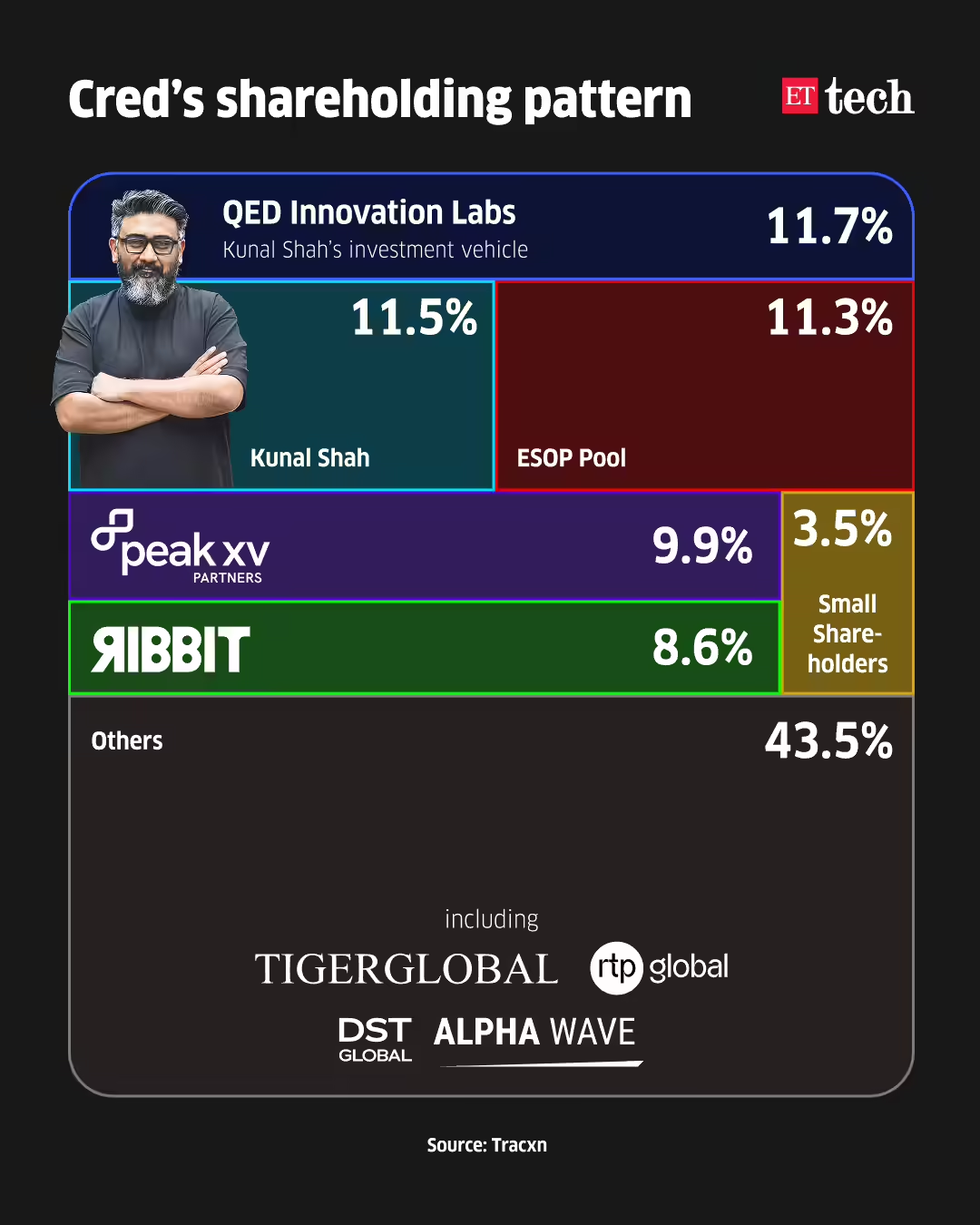
ICYMI: Meta has picked up a $900 million stake in Cred, valuing the fintech at $4.5 billion post-investment and giving Meta roughly a 20% holding.

Meta is leaning into a now-familiar strategy: take a significant minority stake in a startup, hire its founder into a senior role at Meta, and hand the startup’s steering wheel to a new leader.
For instance:
Also Read:Cred founder Kunal Shah’s appointment as WhatsApp CEO sparks discussion on social media
Three companies – TSMC, Samsung Electronics and SK Hynix – now tower over emerging markets. Together, they account for about 28% of the MSCI Emerging Markets Index (MSCI EM), more than 2.6 times India’s total country weight of 10.87% in the same benchmark.
Driving the news: This extreme concentration ties two of Asia’s biggest markets – Taiwan and South Korea – tightly to Nvidia’s order book, US export controls and the broader AI chip cycle.
India’s insulation: India’s Nifty 500 has no fabrication or memory names in its top 10 holdings. Its weight is spread more evenly across banks, consumption, industrials, power and infrastructure, making it less of a pure AI-chip proxy.
Japan and China sit somewhere in between:

India’s unicorns are now turning their in-house AI and data platforms into standalone businesses, echoing the AWS/Jira/Slack playbook where internal tools morphed into category-defining products.
Driving the news: Several companies have carved out independent AI platforms that package years of proprietary data and tooling into enterprise-grade products.
Why this works:
 Pavel Durov, founder and CEO, Telegram
Messaging platform Telegram went back online today after authorities completed the corrective re-examination of the national medical entrance test on Sunday, officials told ET.
However, until June 30, Telegram must disable its message-editing feature.
Tiff with govt: From copyright takedowns to gambling syndicates and national security concerns, Telegram has repeatedly run into Indian regulators. We look at Telegram's history of clashing with authorities in India.

Companies no longer obsess only over how many tokens they burn. Auditors and risk teams are probing how tokens get consumed – and whether they actually deliver value – amid growing chatter around “tokenmaxxing”.
New scrutiny: Enterprises are building a more rigorous cost-value spine for AI usage, tracking metrics such as cost per workflow, cost per transaction, and productivity gains per process. The goal? Tie spending to measurable outcomes.
To do this, companies are rolling out usage dashboards, model-selection guidelines, consumption thresholds, approval flows for expensive models, and governance forums that force AI projects to clear a higher bar.
For instance:
Expert take: “Heavy users are now beginning to track the RoI (return on investment) on AI,” said Sunil Bhadu, leader, risk consulting at PwC India. “Some companies are becoming much more rigorous about auditing AI usage, actively tracking where maximum impact is being felt.”
Also in the letter:
■ All-new AI spin-offs in India
■ How they jammed Telegram
■ Tokenmaxxing under scrutiny
Full stack by Samidha Sharma: Kunal Shah’s WhatsApp coronation is a masterclass in dealmaking
Founder Kunal Shah is walking away from Cred to run WhatsApp globally. Shah hasn’t just landed a big-tech corner office; he’s pulled off something no Indian founder has managed before.
Shah in new role: Shah effectively engineered his own exit from Cred while installing an Indian founder – with zero prior US Big Tech experience – at the helm of one of the world’s largest consumer platforms.
Meta CEO Mark Zuckerberg has played a version of this game before, so the move doesn’t come out of nowhere. What makes this deal fascinating: Cred isn’t a pure AI play, yet Shah’s move still fits into Meta’s broader AI-and-commerce thesis.
WhatsApp growth: Zuckerberg’s line that Shah brings the “builder mentality and global perspective” WhatsApp needs is telling. Meta clearly believes that the next leg of WhatsApp’s growth – especially in payments and commerce – should look a lot like what Shah built at Cred.
Read the full column here.
ICYMI: Meta has picked up a $900 million stake in Cred, valuing the fintech at $4.5 billion post-investment and giving Meta roughly a 20% holding.
- $500 million in primary capital
- $400 million via secondary share sales by existing shareholders.
- Plus $100 million in ad credits to Cred to spend across Meta platforms, including Instagram and Facebook.
Meta's Cred deal showcases new playbook: take stake, hire the founder
Meta is leaning into a now-familiar strategy: take a significant minority stake in a startup, hire its founder into a senior role at Meta, and hand the startup’s steering wheel to a new leader.
For instance:
- In June 2025, Meta acquired a 49% stake in data labelling startup Scale AI for $14.8 billion. Founder Alexandr Wang left to lead Meta's "superintelligence" team.
- After the Manus AI acquisition, its founders joined the tech giant to work on general-purpose agents.
Also Read:Cred founder Kunal Shah’s appointment as WhatsApp CEO sparks discussion on social media
Three AI stocks outweigh all of India: Why this concentration is sounding alarm bells in emerging markets
Three companies – TSMC, Samsung Electronics and SK Hynix – now tower over emerging markets. Together, they account for about 28% of the MSCI Emerging Markets Index (MSCI EM), more than 2.6 times India’s total country weight of 10.87% in the same benchmark.
Driving the news: This extreme concentration ties two of Asia’s biggest markets – Taiwan and South Korea – tightly to Nvidia’s order book, US export controls and the broader AI chip cycle.
- In South Korea, the top 10 stocks now contribute roughly 65% of the KOSPI (the primary benchmark index for the South Korean stock market), with electronics alone at about 60.2%.
- In Taiwan, the top 10 stocks exceed 65% of the TAIEX, with semiconductors at roughly 56%.
- Within MSCI EM, TSMC alone weighs in at 14.2%, Samsung Electronics for 7.8%, and SK Hynix for 6.6%.
India’s insulation: India’s Nifty 500 has no fabrication or memory names in its top 10 holdings. Its weight is spread more evenly across banks, consumption, industrials, power and infrastructure, making it less of a pure AI-chip proxy.
Japan and China sit somewhere in between:
- Japan’s Nikkei 225 sees its top 10 stocks account for 42–45% of the index, with tech and semiconductor equipment names at roughly 30% – the highest concentration since 1989.
- China's CSI 300 is at roughly 25%, with technology at about 22% and "rising rapidly."
A new bunch of AI spin-offs ripe for the picking
India’s unicorns are now turning their in-house AI and data platforms into standalone businesses, echoing the AWS/Jira/Slack playbook where internal tools morphed into category-defining products.
Driving the news: Several companies have carved out independent AI platforms that package years of proprietary data and tooling into enterprise-grade products.
- Moglix, a B2B marketplace for industrial supplies, launched Cognilix, an AI-powered procurement software system.
- Online realty platform NoBroker, unable to find a robust voice AI stack, built its own in-house.
- Apna, a jobs and career platform, spun out BlueMachines AI, an enterprise voice AI platform.
Why this works:
- It monetises proprietary data and tooling originally built to handle internal scale.
- It delivers focused, high-value solutions for enterprises – from procurement to voice AI to clinic concierge.
- It creates high-margin, adjacent revenue streams without diluting or distracting the core consumer brand.
From takedown orders to temporary ban, a look at government's clashes with Telegram
Messaging platform Telegram went back online today after authorities completed the corrective re-examination of the national medical entrance test on Sunday, officials told ET.
However, until June 30, Telegram must disable its message-editing feature.
Tiff with govt: From copyright takedowns to gambling syndicates and national security concerns, Telegram has repeatedly run into Indian regulators. We look at Telegram's history of clashing with authorities in India.
As AI adoption grows, token consumption comes under close scrutiny
Companies no longer obsess only over how many tokens they burn. Auditors and risk teams are probing how tokens get consumed – and whether they actually deliver value – amid growing chatter around “tokenmaxxing”.
New scrutiny: Enterprises are building a more rigorous cost-value spine for AI usage, tracking metrics such as cost per workflow, cost per transaction, and productivity gains per process. The goal? Tie spending to measurable outcomes.
To do this, companies are rolling out usage dashboards, model-selection guidelines, consumption thresholds, approval flows for expensive models, and governance forums that force AI projects to clear a higher bar.
For instance:
- HCLTech is shifting workloads to sovereign models to rein in token costs.
- Tech Mahindra is deploying smaller open-source models to balance performance and price.
- Some clients are consolidating tools and platforms to tighten governance and improve cost control.
Expert take: “Heavy users are now beginning to track the RoI (return on investment) on AI,” said Sunil Bhadu, leader, risk consulting at PwC India. “Some companies are becoming much more rigorous about auditing AI usage, actively tracking where maximum impact is being felt.”
Want this newsletter delivered to your inbox?
I agree to receive newsletters and marketing communications via e-mail
Thank you for subscribing to Daily Top 5
We'll soon meet in your inbox.


Source link