
Mint Explainer| What would it take for India to create a SpaceX?


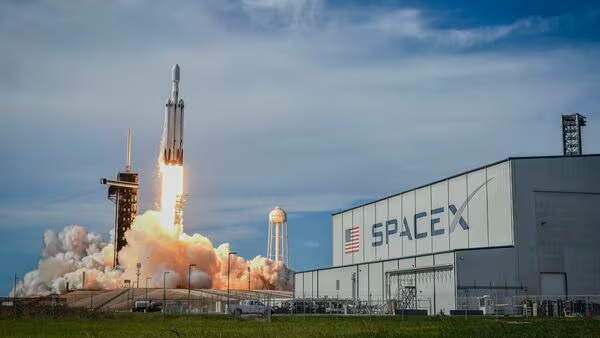
On 12 June, SpaceX completed its record public listing in the US, catapulting to become the fifth-largest company in the world at a valuation of over $2.5 trillion. In many ways, the company remains an outlier—the reusable rocket technology that it has perfected over the past two decades is not truly matched at its scale by anyone. India, meanwhile, is way behind with a nascent space industry. Can it become just as big one day? Mint takes a look.
Why is SpaceX valued so highly?
Founded in March 2002 by Elon Musk, SpaceX is one of a kind in terms of the technology that it indigenously developed and owns and operates today. The tech in question is that of a reusable rocket—a technology that has reduced the cost of launching satellites from over $54 million per kilogram, to under $3 million. SpaceX became the world’s first entity to ever launch and reuse a rocket in December 2015, and today conducts over 100 launches to Earth’s orbit. Its unique capability is essentially unmatched, giving it a near monopoly on the global space market. This helped it scale to $2.5 trillion in value today.
Why are reusable rockets such a big deal?
Yes. Reusability of rockets means that SpaceX saves millions of dollars in each mission by not seeing its engineering get destroyed just upon one launch. The booster stages of reusable rockets can be used several times—in some cases, one of its rockets was reused over 25 times. This record basically makes it possible for anyone to launch their own satellites—starting from the heaviest large broadcasters, to small observation satellites built by students. The additional affordability also makes the rockets accessible to more countries around the world, further increasing the influence that the US has on the global space market today.
Is SpaceX unrivalled then?
While it is unrivalled in its scale, there are private rocket operators worldwide. SpaceX’s nearest and most obvious rival is Blue Origin, the Jeff Bezos-owned rocket operator. France’s Arianespace is the next nearest competitor, and was for the longest time one of three frequently used rockets around the world for satellite launches, alongside Russia’s Soyuz series. In India, Skyroot Aerospace and Agnikul Cosmos hope to rival SpaceX for satellite clients one day.
What is India's opportunity in space?
India, experts believe, is taking a mature stance by targeting a strategic part of the global satellite launch services industry. This strategic part lies in India’s ability to launch small satellites of under 300 kg in weight to accessible, low-earth orbits of under 500 km from the Earth's surface. These launches typically require rockets that are lighter, smaller, and therefore easier to build. India’s Skyroot and Agnikul are also developing patented affordable rocket propulsion and 3D-printed body technologies, in order to be able to turn rockets around at a rapid pace—thus eyeing small satellite launches at scale.
Can India ever build its own SpaceX?
A steady flow of early-stage capital would be crucial for both Skyroot and Agnikul. While the former turned unicorn last month, it would require significantly larger investments in order to scale its rocket operations to once a month—which it does hope to achieve through the next decade. The other crucial aspect is for the two space firms to achieve the kind of consistency that SpaceX achieved once it perfected the reuse of its rockets in 2015. With consistency came trust, and cementing the trust has made SpaceX an uncontested space company today.
About the Author
Shouvik has been tracking the rise and shifts of India’s technology ecosystem for over a decade, across print, broadcast and web-first platforms. He's been a tinkerer of machines and PCs since childhood, a habit he was thrilled to convert into his profession. This has led him to fascinating experiences of technologies around the world, which is what keeps him hooked to his job.<br><br>Shouvik likes to believe that he is one of the few technology journalists in India who can also code. He has also been writing about the rise of AI well before it became a household name, and has met some of the most fascinating people over the years through his work.<br><br>Shouvik writes about AI, Big Tech, data centres, electronics, semiconductors, cybersecurity, gaming, cryptocurrencies, and consumer technologies. He is most fond of the stories he has written during his time here at Mint, for which he also writes 'Transformer', a weekly technology newsletter, and hosts 'Techcetra', a weekly technology podcast.<br><br>Outside of work, Shouvik spends most of his time with Pixel, whom he believes is the world's best dog. He is also an avid reader, a toy collector, a gamer and a frequent traveller.
Catch all the Technology News and Updates on Live Mint. Download The Mint News App to get Daily Market Updates & Live Business News.
MoreSource link