Tom's Hardware Verdict
It was a long wait for Noctua’s NL-LC1 liquid cooler to come to market, but the reward is greater than I imagined. If you prize silence and performance, there is no better AIO.
Pros
- +
Hands-down, the quietest AIO ever built
- +
Chart-topping thermal performance
- +
Three built-in pump profiles with selector switch
- +
Beautiful no-nonsense design with no RGB
- +
6-year warranty
Cons
- -
Expensive
- -
No coolant temperature probe
- -
At its core, it’s an Asetek AIO
- -
Auxiliary fan feels like an afterthought
Why you can trust Tom's Hardware Our expert reviewers spend hours testing and comparing products and services so you can choose the best for you. Find out more about how we test.
For a very long time, many of us have been begging Noctua to build a liquid cooler. In a time when CPUs are becoming ever more powerful, their power consumption is also rising, and air-coolers are often no longer up to the task. However, this was a problem for Noctua’s customers, as the brand has stubbornly not built a liquid cooler – at least until now. Meet the NL-LC1-36, Noctua’s first liquid cooler.
Today we’re reviewing the 360-mm variant, but it also comes in 240mm and 420mm flavors.
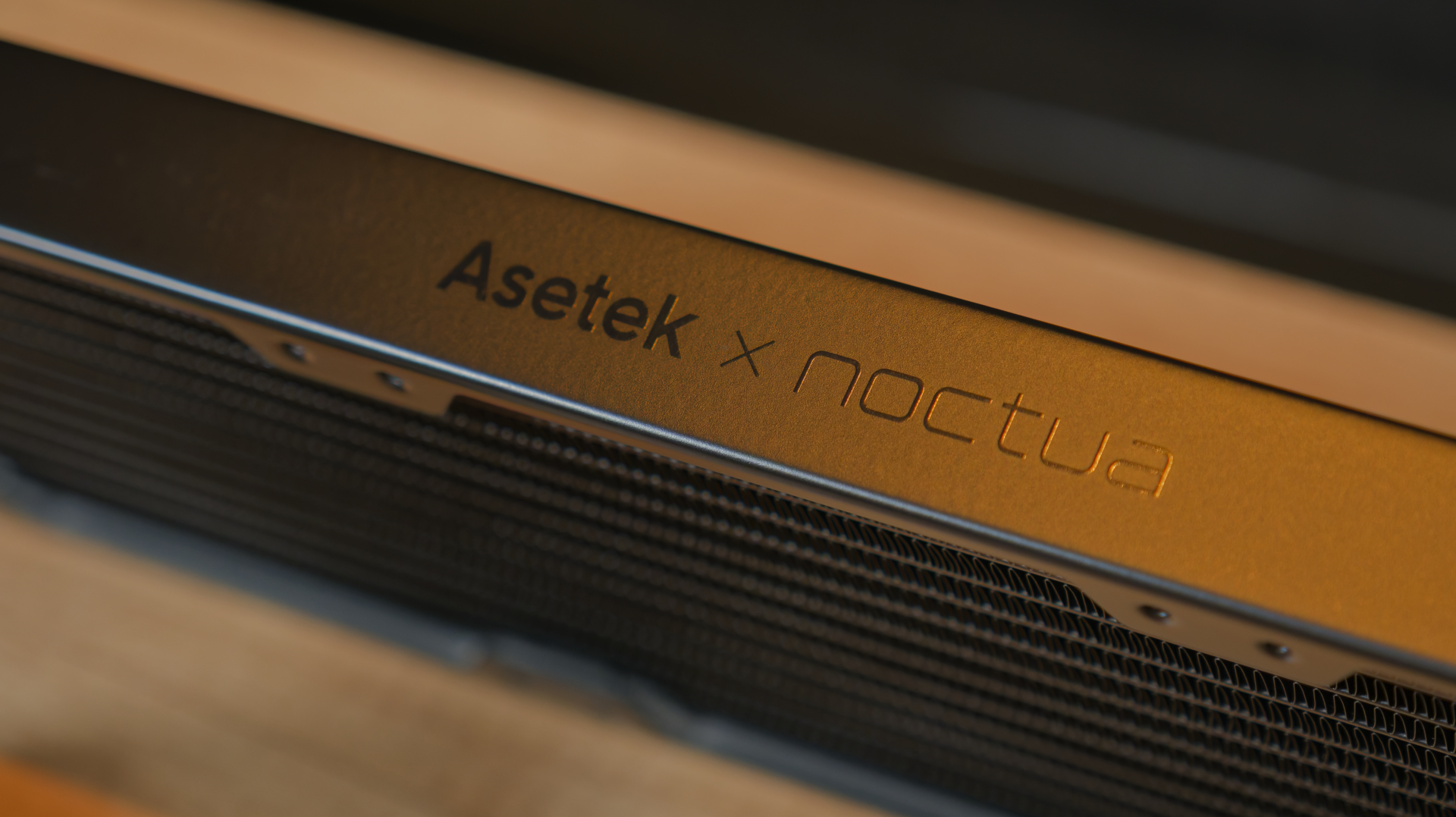
Let’s start with the elephant in the room: At its core, this is not a liquid cooler designed 100% in-house by Noctua – it’s an Asetek cooler with some Noctua touches. This may be a bit of a let-down, especially for Noctua purists – up until now, every product that had a name in Noctua’s nomenclature, such as NL-LC1-36, or NH-D15 G2, or NF-A12x25 G2, was 100% designed and built in-house by Rascom and Kolink, the two owners of the Noctua brand.

Keen readers will note that there is a Noctua case, Noctua PSU, and Noctua GPUs, but that’s not entirely accurate. The Antec Flux Pro Noctua Edition, Seasonic Prime TX-1600 Noctua Edition, and Asus Noctua Edition GPUs are all, as their name implies, Noctua-Edition products, which are not strictly speaking a core part of Noctua’s own lineup, and they do not carry Noctua’s typical nomenclature.
What’s really going on here is something we’ll get into later, but for now, let’s dive into the box and see what we’ve got on the test bench.
Specifications
Cooler | Noctua NL-LC1-36 |
Colors | Black & Brown |
Compatibility | AMD AM5, AM4 |
Radiator Dimensions | 400 (L) x 120mm (W) x 30mm (H) |
Fans | 3x NF-A12x25 G2 |
Fan Speed | 300 – 1800 RPM |
Pump Speed | 750 – 3400 RPM |
MSRP | $249.99 |
Warranty | 6 years |
| Row 9 - Cell 0 | Row 9 - Cell 1 |
Product Walkthrough

The cooler comes packaged in a typical Noctua box with a matte finish and product details written on it. Noctua also sells an auxiliary fan, the NL-ACF1, which can clip onto the pump block to cool the area surrounding the CPU.

Open the box, and we’re presented with a nice appetizer – the large Noctua plaque that can later be installed onto the pump block if you’re not using the auxiliary fan.

This is a truly beautiful plaque, and quite large too – a bit unusually large for Noctua. Is Noctua trying to emphasize its own brand to distract us from Asetek?


An included accessory box contains the mounting brackets, cleaning wipe, instructions, TIM guard, and the classic Noctua Torx screwdriver. Both the AMD and intel mounting brackets come with -7mm offset holes so that the cooler is better placed over the CPU’s hotspots.

The three fans come in their own box too. Here we have three NF-A12x25 G2s, two of which are the PPA variant and one PPB, which have 50 RPM offsets to prevent harmonics from forming between them. These fans spin at such consistent speeds, that if you mount two next to each other on the same fan splitter, they can sing in harmony.

The fans all come equipped with the full rear gasket for a perfect seal on the radiator.

Moving on to the pump assembly, here we find the pièce de résistance, the NL-PNA1. PNA stands for Pump Noise Absorber, and this is a custom pump cover designed by Noctua that features multiple layers of foam, sound barriers, and silicone mounts, all to quiet down the pump.
At its heart, the NL-CL1 is based on Asetek’s Emma Gen8 V2 pump platform that, although very powerful, isn’t the quietest pump on the market. However, the combination of its power and the PNA1 cap means that Noctua is happy to stand behind the product, and we’ll see in testing whether this stance is justified.
This pump cap isn’t only engineered to absorb and deflect noise, however – it’s also a tuned mass damper. Sitting on silicone mounts, its own mass and positioning is engineered such that it dampens mechanical noise. This damping essentially shifts the higher, more annoying frequencies pumps typically produce toward deeper, more pleasant frequencies that typically bother human hearing less.

The cold plate is beautifully milled, and the exposed copper should do a great job at transferring heat.

Hidden between the two tubes is a dip-switch with three positions. They’re not marked, but it’s easy to tell whether you’re in the quiet, balanced, or unrestricted mode. These limit the pump’s RPMs to 2100 or 2600 for the quiet and balanced profiles. Within these profiles, you can use the motherboard’s PWM control to guide the pump. However, the pump’s internal coolant temperature sensor will override the PWM signal at certain duty cycles or beyond certain coolant temperatures and push to 100% duty anyway, which may lead to the pump running louder than you want. In practice, however, we haven’t found this to be a problem.
For full control, you’ll want to use the unrestricted mode, where you have the pump’s full 3700 RPM at your disposal.

What I find a bit of a let-down here, is that there is no two-pin thermal probe output. I have a lot of experience with custom water cooling, and my preferred method of managing pump and fan speeds is by using the coolant temperature as the source value. It’s great that this AIO’s pump will manage itself and I’m stoked to see this feature finally coming to numerous AIOs, but I’d like access to the coolant temperature so that the fans can be controlled by this too.

The AIO’s radiator is a relatively standard aluminum type, but it’s 30mm thick which is an improvement over thinner 25mm radiators on more budget-friendly coolers.
Lastly, the loop is filled with Glycol, and is not user-serviceable.

Optionally, for $20, you can add an auxiliary fan to cool the VRM and memory surrounding the CPU, but this honestly feels like an afterthought and doesn’t look very charming compared to the rest of the cooler. I don’t doubt that it works, but it’s not nearly as neatly integrated into the pump block as we’ve seen with much of Noctua’s premium competition.

Source link