
Nutanix says software companies will fail in GenAI era only if they’re not critical


NEW DELHI: Software as a service (SaaS), a business model that became popular among Indian technology startups over the past decade, is poised for disruption as the emergence of generative artificial intelligence automates various business processes. This, though, isn’t hurting Nutanix, a San Jose, California-based software maker founded by India-born entrepreneur Dheeraj Pandey.
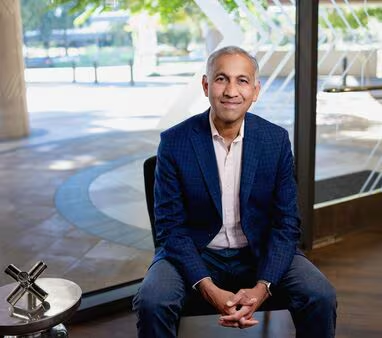
In an interview with Mint, Rajiv Ramaswami, only the second chief executive officer of the company in its 17-year history, said that the rise of generative AI “could offer a sharp tailwind for software companies, but for that, only those software firms that make software that’s essential to the core technology operation and cannot be replaced by automation processes will survive.”
Nutanix offers companies software for running applications and AI on any cloud platform and managing data anywhere. It counts Apollo Pharmacy, Tata Consultancy Services, Infosys and Karnataka Bank among its clients. The company generated ₹1,990 crore ($210 million) from its India subsidiary in FY25, according to data sourced from Tofler, accounting for 8.3% of its global revenue.
Ramaswami is increasingly bullish on India, where both its client base and its engineering operations are growing.
“Eight of India’s top 10 banks work on our software stack, for which we have core research teams in India. Plus, our entire Asia-Pacific support team is based out of Bengaluru and Pune. While India’s revenue contribution is still incremental, from a global market standpoint, India is critical to our business,” the executive said.
The advent of generative AI has offered mixed fortunes for Nutanix. Its market capitalization grew almost 7x to $22 billion between June 2022 and June 2025.
However, after the company announced its Q1 FY26 (quarter ended 31 October) earnings on 25 November, Nutanix lost half its market cap as brokerages and investors flagged concerns over the company’s revenue guidance.
Rise of GenAI
Nutanix, which posted FY25 revenue of $2.54 billion, slashed its revenue growth forecast by 2-3.5% after three straight years of exponential growth, aligning with the rise of generative AI globally. The company’s current market capitalization is about $13 billion.
Negative sentiments toward software companies worldwide saw the market cap of top vendors SAP, Salesforce and ServiceNow decline between 2022 and 2025. However, software vendors have stabilized over the past three months as brokerages highlighted that software and service integrators will play key roles in helping companies adapt generative AI. Ramaswami concurred on this note.
“We’re not one of those software companies who will lose its business model just because a foundational model may automate and replicate certain features,” he said. “The SaaS firms that are dying today are the ones that are building easy-to-automate offerings such as a data dashboard in the age of easy AI model access—why would you want to pay for a software that also does only that?”
Brokerages, including BMO Capital Markets and Goldman Sachs, said on 28 May that they were ‘bullish’ on Nutanix as long as the company can deliver on its revenue guidance. Ramaswami said the company is confident of delivering growing business because its proprietary software platforms “cannot be replaced or replicated by AI.”
Core software
“We are, in fact, key to how companies can make the most of AI. Apps used by companies will evolve to keep pace with AI, but that does not mean that the core software infrastructure can be simply replaced by algorithms. Instead, it is our software that is helping companies today see if they want to directly draw inferences from an AI model onto their apps or use our platforms where we can provide a cost-effective way of using AI without the constraints of AI token prices today,” Ramaswami said.
The top executive, however, said the AI transformation may not immediately impose sovereign AI workloads on global technology providers. He added that it may be possible, but not immediately likely, that Nutanix will have a team solely based in India, building software only for Indian use-cases.
“There are multiple parts to the sovereign AI conversation. The first of these is simple localization of teams, which is easy to do. The next is developing the tech locally and data sovereignty, both of which are more challenging if a business is distributed globally. Having an India team cater only to the India market would be quite inefficient and not productive,” he said.
About the Author
Shouvik has been tracking the rise and shifts of India’s technology ecosystem for over a decade, across print, broadcast and web-first platforms. He's been a tinkerer of machines and PCs since childhood, a habit he was thrilled to convert into his profession. This has led him to fascinating experiences of technologies around the world, which is what keeps him hooked to his job.<br><br>Shouvik likes to believe that he is one of the few technology journalists in India who can also code. He has also been writing about the rise of AI well before it became a household name, and has met some of the most fascinating people over the years through his work.<br><br>Shouvik writes about AI, Big Tech, data centres, electronics, semiconductors, cybersecurity, gaming, cryptocurrencies, and consumer technologies. He is most fond of the stories he has written during his time here at Mint, for which he also writes 'Transformer', a weekly technology newsletter, and hosts 'Techcetra', a weekly technology podcast.<br><br>Outside of work, Shouvik spends most of his time with Pixel, whom he believes is the world's best dog. He is also an avid reader, a toy collector, a gamer and a frequent traveller.
Catch all the Technology News and Updates on Live Mint. Download The Mint News App to get Daily Market Updates & Live Business News.
MoreSource link