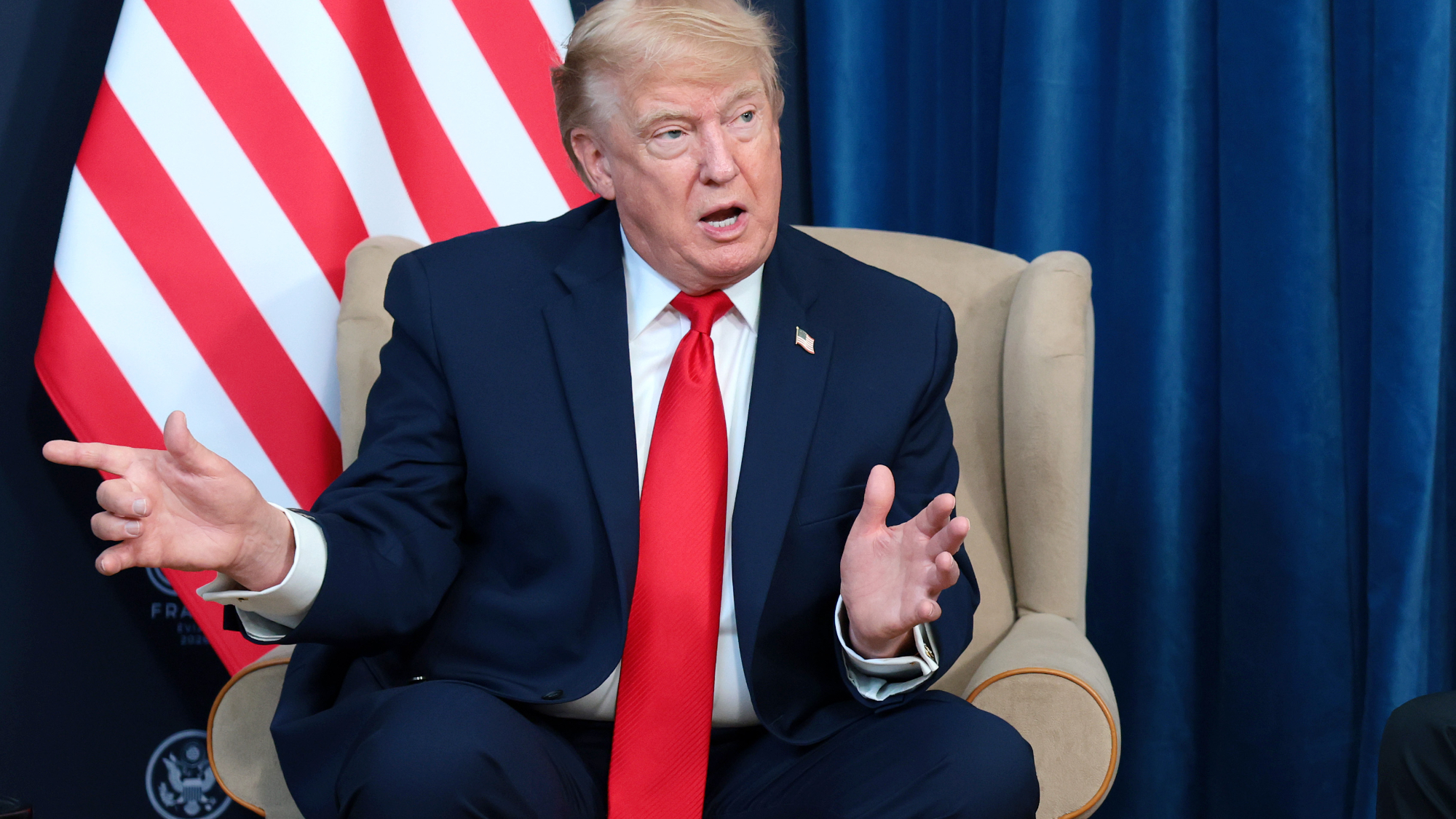
President Donald Trump said on Thursday that Apple has agreed to work with Intel to “design and build” chips in the United States, posting the claim to Truth Social before either company confirmed any arrangement. Apple and Intel didn’t respond to initial requests for comment from Reuters, and neither has issued a statement acknowledging a finalized deal.
Trump says the deal is part of his administration’s push to reshore semiconductor manufacturing, writing that the U.S. needs to build its chips domestically and that he "decided to help Intel because we need to design and build our Chips right here in America.” He credited earlier government intervention for drawing Nvidia and Elon Musk's TeraFab project to Intel's foundry.
Apple already designs its own silicon and has done so since it dropped Intel processors from its products in 2020. Any arrangement here would purely be a foundry deal, with Intel acting as a contract manufacturer for chips Apple designs in-house. It wouldn’t return Apple to Intel-designed processors, and it certainly wouldn’t displace TSMC from Apple's flagship products.

The logic behind any such deal for Apple would be simple supply diversification; the company remains dependent on TSMC, whose leading-edge capacity is being absorbed by AI customers, including Nvidia and AMD. Placing a lower-volume part on a second source reduces single-foundry exposure without touching the iPhone and high-end M-series lines that rely on TSMC's most advanced nodes.
We’ve known about much of this for a little while now. Reporters caught wind of a preliminary deal last month, following discussions that ran for more than a year. Before that, analyst Ming-Chi Kuo and GF Securities outlined the likely scope: Apple's M7 SoC built on Intel's 18A-P process, powering the MacBook Air and entry-level iPad Pro, with mass production targeted for late 2027.
Those two product tiers accounted for roughly 20 million units in 2025, with annual shipments expected to settle between 15 million and 20 million — significant for a new foundry customer, but small enough to leave TSMC's revenue mix intact. Reporting has also suggested that Apple's A21 iPhone chips will move to Intel's 14A node around 2028, but none of this has been confirmed by Apple or Intel.
Trump's announcement comes just two days after Intel said its 18A-P process had entered risk production, announced at the VLSI Symposium in Honolulu. The node is the first performance-enhanced version of 18A, and Intel claims it delivers 9% higher performance at the same power, or 18% lower power at the same performance, while staying design-rule compatible with 18A so customers can reuse existing IP. CEO Lip-Bu Tan told investors last month that he expects multiple foundry commitments to close in the second half of 2026.
Intel has yet to confirm a single leading-edge customer for 18A, and any commitment from Apple would be a best-case scenario in terms of securing the validation the company both desperately wants and needs. The U.S. government holds a 10% stake in Intel, and its shares rose as much as 9% in premarket trading on the news, extending a run that has lifted the stock 464% over the past 12 months to a market cap of $608.7 billion.

Follow Tom's Hardware on Google News, or add us as a preferred source, to get our latest news, analysis, & reviews in your feeds.

Source link