

Business News›Tech›Newsletters›Morning Dispatch›Why Meta tapped Kunal Shah; Beauty’s new factory boom
 Morning Dispatch Morning Dispatch |
Why Meta tapped Kunal Shah; Beauty’s new factory boom
Want this newsletter delivered to your inbox?
I agree to receive newsletters and marketing communications via e-mail

Thank you for subscribing to Morning Dispatch
We'll soon meet in your inbox.
Happy Wednesday! Meta just handed WhatsApp’s steering wheel to Cred’s Kunal Shah, betting he can turn India’s favourite chat app into a payments and AI powerhouse. This and more in today’s ETtech Morning Dispatch.
Also in the letter:
■ Flipkart Minutes hits 1k stores
■ Byju's-Aakash hearing deferred
■ Honasa’s Fluence Pharma bet
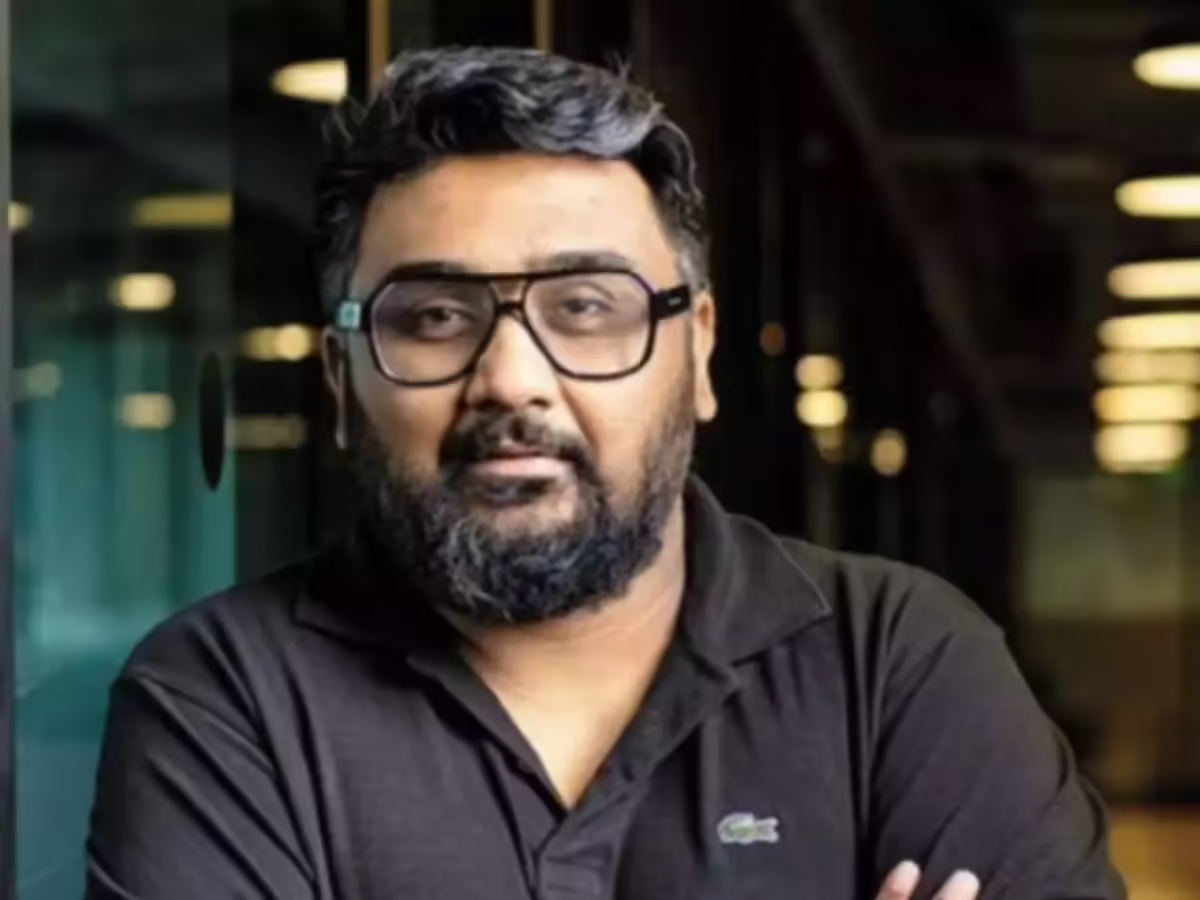
Meta has tapped Cred founder Kunal Shah to lead WhatsApp, signalling an aggressive new push into payments, financial services and artificial intelligence (AI) as the messaging giant hunts for its next leg of growth.
What's happening?
Quote, unquote: “Consumers use the messaging app to initiate the flow but close the transaction on one of the more popular UPI apps,” said the founder of a rival payments firm. “Shah’s deep understanding of Indian payments might help them change that.”
Also Read: Inside Meta's India investments: First Reliance, now Cred
Founder Kunal Shah is walking away from Cred to run WhatsApp globally. Shah hasn’t just landed a big-tech corner office; he’s pulled off something no Indian founder has managed before.
Shah in new role: Shah effectively engineered his own exit from Cred while installing an Indian founder – with zero prior US Big Tech experience – at the helm of one of the world’s largest consumer platforms.
Meta CEO Mark Zuckerberg has run this playbook before, so it’s not surprising. What makes this deal fascinating is that Cred isn’t a pure AI play, yet it still fits into Meta’s broader AI-and-commerce thesis.
WhatsApp growth: Zuckerberg’s line that Shah brings the “builder mentality and global perspective” WhatsApp needs is telling. Meta clearly believes that the next leg of WhatsApp’s growth – especially in payments and commerce – should look a lot like what Shah built at Cred.
Read the full column here.
Also Read: Meta's Cred deal showcases new playbook: take stake, hire the founder

Investors are increasingly writing cheques to the factories behind India’s beauty and personal care brands, betting on a new theme that sits beyond consumer-facing brands.
What’s happening?
Another investor said that as industries mature, capital typically shifts from brands to the broader ecosystem – manufacturing, research and development (R&D), packaging and supply chains.
What else? Deal activity is picking up, too. L’Oréal recently bought Innovist for around Rs 4,100 crore, while Hindustan Unilever acquired a majority stake in Minimalist last year for nearly Rs 3,000 crore.

Flipkart Minutes has expanded to 1,000 fulfilment centres across 130 cities in under two years, intensifying competition in India's quick commerce market.
On expansion: “We are roughly five times the size we were during the same period last year,” Kunal Gupta, senior vice president (SVP) and head of Flipkart Minutes, told ET. “It will be an aggressive expansion from here on. In the next few months, we are targeting 1,500 stores in 180-plus cities.”
Minutes has grown fast from around 750 stores in March this year. Senior executives say Flipkart is currently opening about 100 stores every month, three to four new locations a day.
Flipkart is also pushing deeper into Bharat. Of the 130 cities Minutes currently serves, about 90 are smaller markets beyond the metros and tier-1 hubs.
Rival snapshot:

NCLT posts Byjus-Aakash hearing for July 16: The National Company Law Tribunal (NCLT) on Tuesday granted Aakash Educational Services’ top shareholders and Think & Learn creditors time until July 16 to explore a settlement of their long-running shareholding dispute.
Honasa Consumer to acquire majority stake in Fluence Pharma: Mamaearth parent Honasa Consumer is acquiring a majority stake in Mumbai-based nutraceuticals brand Fluence Pharma at an enterprise value of Rs 135 crore, according to a stock exchange filing.
AI will amplify IT services demand, not replace it: Nandan Nilekani | Infosys on Tuesday reiterated its aim to unlock the AI-first services opportunity, with chairman Nandan Nilekani saying artificial intelligence will amplify rather than replace IT services.
■ Federal workers can’t get the White House’s app off their phones (Wired)
■ Do you know your 'sweat score'? The rise of hydration tech (BBC)
■ The AI-powered World Cup runs on thousands of data workers (Rest of World)
Also in the letter:
■ Flipkart Minutes hits 1k stores
■ Byju's-Aakash hearing deferred
■ Honasa’s Fluence Pharma bet
Kunal Shah's WhatsApp move signals Meta's next growth push
Meta has tapped Cred founder Kunal Shah to lead WhatsApp, signalling an aggressive new push into payments, financial services and artificial intelligence (AI) as the messaging giant hunts for its next leg of growth.
What's happening?
- WhatsApp is rapidly turning into Meta’s frontline distribution channel for AI products.
- Meta is rolling out a broader suite of AI tools for businesses and consumers—from AI agents to its Meta AI chatbot—directly inside WhatsApp.
- Executives say Shah’s arrival could reboot WhatsApp’s India payments play, which stalled after former India head Abhijit Bose exited in 2022.
Quote, unquote: “Consumers use the messaging app to initiate the flow but close the transaction on one of the more popular UPI apps,” said the founder of a rival payments firm. “Shah’s deep understanding of Indian payments might help them change that.”
Also Read: Inside Meta's India investments: First Reliance, now Cred
Full Stack by Samidha Sharma: Kunal Shah’s WhatsApp coronation is a masterclass in dealmaking
Founder Kunal Shah is walking away from Cred to run WhatsApp globally. Shah hasn’t just landed a big-tech corner office; he’s pulled off something no Indian founder has managed before.
Shah in new role: Shah effectively engineered his own exit from Cred while installing an Indian founder – with zero prior US Big Tech experience – at the helm of one of the world’s largest consumer platforms.
Meta CEO Mark Zuckerberg has run this playbook before, so it’s not surprising. What makes this deal fascinating is that Cred isn’t a pure AI play, yet it still fits into Meta’s broader AI-and-commerce thesis.
WhatsApp growth: Zuckerberg’s line that Shah brings the “builder mentality and global perspective” WhatsApp needs is telling. Meta clearly believes that the next leg of WhatsApp’s growth – especially in payments and commerce – should look a lot like what Shah built at Cred.
Read the full column here.
Also Read: Meta's Cred deal showcases new playbook: take stake, hire the founder
Beauty's back-end gets investor attention; Naturis in talks to raise Rs 100 crore
Investors are increasingly writing cheques to the factories behind India’s beauty and personal care brands, betting on a new theme that sits beyond consumer-facing brands.
What’s happening?
- Naturis Cosmetics, which manufactures products for brands such as Pilgrim and Plum, is in talks to raise Rs 80-100 crore, with Sharrp Ventures and several domestic family offices among potential backers, sources say.
- In April, JM Financial’s private equity arm pumped Rs 150 crore into NG Electro Products, a supplier to both direct-to-consumer (D2C) startups and fast-moving consumer goods (FMCG) companies.
- As new-age beauty brands scale and keep outsourcing production, investors are zeroing in on the contract manufacturers powering this growth.
Another investor said that as industries mature, capital typically shifts from brands to the broader ecosystem – manufacturing, research and development (R&D), packaging and supply chains.
What else? Deal activity is picking up, too. L’Oréal recently bought Innovist for around Rs 4,100 crore, while Hindustan Unilever acquired a majority stake in Minimalist last year for nearly Rs 3,000 crore.
Flipkart Minutes expands to 1,000 stores as quick commerce competition intensifies
Flipkart Minutes has expanded to 1,000 fulfilment centres across 130 cities in under two years, intensifying competition in India's quick commerce market.
On expansion: “We are roughly five times the size we were during the same period last year,” Kunal Gupta, senior vice president (SVP) and head of Flipkart Minutes, told ET. “It will be an aggressive expansion from here on. In the next few months, we are targeting 1,500 stores in 180-plus cities.”
Minutes has grown fast from around 750 stores in March this year. Senior executives say Flipkart is currently opening about 100 stores every month, three to four new locations a day.
Flipkart is also pushing deeper into Bharat. Of the 130 cities Minutes currently serves, about 90 are smaller markets beyond the metros and tier-1 hubs.
Rival snapshot:
- Amazon is scaling up Amazon Now, which operates around 500 stores. It is adding at least two dark stores a day and aims to reach 100 cities through more than 1,000 micro-fulfilment centres.
- Among pure-play quick-commerce operators, Blinkit leads with 2,243 dark stores.
- Swiggy Instamart and Zepto closed FY26 with 1,143 and 1,139 dark stores, respectively, while Flipkart Minutes has now crossed the 1,000-store mark.
Other Top Stories By Our Reporters
NCLT posts Byjus-Aakash hearing for July 16: The National Company Law Tribunal (NCLT) on Tuesday granted Aakash Educational Services’ top shareholders and Think & Learn creditors time until July 16 to explore a settlement of their long-running shareholding dispute.
Honasa Consumer to acquire majority stake in Fluence Pharma: Mamaearth parent Honasa Consumer is acquiring a majority stake in Mumbai-based nutraceuticals brand Fluence Pharma at an enterprise value of Rs 135 crore, according to a stock exchange filing.
AI will amplify IT services demand, not replace it: Nandan Nilekani | Infosys on Tuesday reiterated its aim to unlock the AI-first services opportunity, with chairman Nandan Nilekani saying artificial intelligence will amplify rather than replace IT services.
Global Picks We Are Reading
■ Federal workers can’t get the White House’s app off their phones (Wired)
■ Do you know your 'sweat score'? The rise of hydration tech (BBC)
■ The AI-powered World Cup runs on thousands of data workers (Rest of World)
Want this newsletter delivered to your inbox?
I agree to receive newsletters and marketing communications via e-mail
Thank you for subscribing to Morning Dispatch
We'll soon meet in your inbox.


Source link