India faces a looming AI talent crisis, with projections indicating a shortage of over a million professionals by 2027. Companies are struggling to move AI projects beyond pilot phases due to a significant gap in skilled workers, particularly in deployment roles. This demand-supply imbalance is driving up salaries and impacting enterprise-wide AI adoption across various sectors.
Listen to this article in summarized format
India could face a shortage of more than 1 million artificial intelligence workers by 2027, staffing firms and experts told ET. The widening gap between demand and supply is emerging as a major constraint as companies race to deploy AI at scale.
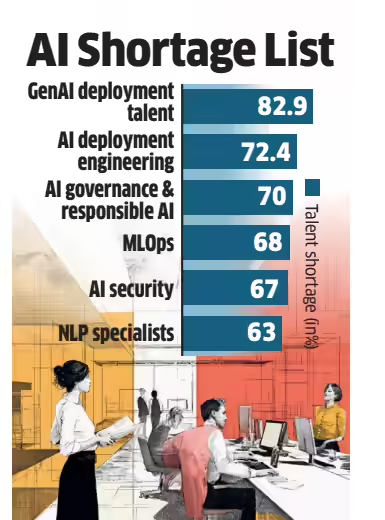
Demand for AI professionals could reach 2.3 million by 2027, against an available talent pool of about 1.2 million, according to some estimates. The shortage is most severe in production and deployment-focused roles, with generative AI deployment talent facing a gap of nearly 83%. Around 80% of employers are struggling to find the AI talent they need, while hiring timelines for niche AI roles have stretched beyond 90 days. The shortage is increasingly affecting companies’ ability to move AI projects beyond pilot stages and into full-scale deployment.
The talent crunch comes at a time when companies across sectors, from information technology services and global capability centres to banks, healthcare firms and manufacturers, are ramping up investments in AI.
“The demand-supply imbalance is becoming more visible as AI adoption moves from experimentation to enterprise-wide deployment,” said Sanketh Chengappa, director at staffing firm Adecco India. In generative AI, the firm estimates, there is currently only one qualified engineer available for every ten open roles.
The shortage is being felt most acutely in specialised deployment roles rather than research positions.
According to staffing firm Quess Corp, GenAI deployment talent faces a shortage of 82.9%.
ETtech
“India is already facing a structural gap of nearly 900,000 AI professionals,” said Kapil Joshi, CEO-IT staffing at Quess Corp. India currently has about 920,000 AI professionals, but demand continues to outpace supply. Nearly 350,000 AI-related jobs were advertised in the last 90 days alone, Joshi said.
“The challenge is no longer AI awareness but production-ready capability,” Joshi noted. “While many professionals have AI exposure, only a small percentage can build and deploy enterprise-grade AI systems at scale.”
The hiring pressure is also driving up compensation. Core AI professionals are commanding salary premiums of 30-40%, while specialised GenAI engineers, AI architects, and domain-focused AI talent can attract premiums of 50% or more, according to experts.
“About 80% of employers say they are unable to find the AI talent they need,” said Neeti Sharma, chief executive of staffing firm TeamLease Digital. “The challenge is not just the availability of talent, but finding professionals with the right mix of AI expertise and domain knowledge.”
GCCs have emerged as one of the biggest demand drivers, accounting for more than 60% of AI-related hiring demand, she said. Hiring is increasingly concentrated in mid- and senior-level professionals, while companies are stepping up investments in reskilling programmes to build AI capabilities internally. TeamLease estimates that talent gaps in specialised AI and GenAI roles can exceed 50%.
Enterprise readiness remains another hurdle. Less than 10% of enterprises are truly AI-ready from a data, governance and process perspective, according to Pareekh Jain, chief executive at market research firm EIIRTrend. “Companies are facing challenges in taking projects from pilot to production, but not because of a lack of AI talent,” he said.
Many organisations are still grappling with data readiness and governance requirements needed for large-scale AI deployment, although a slowdown in hiring and training by major IT services firms could create a talent bottleneck over time, he added.
We strive to uphold the highest ethical standards in all of our reporting and coverage. We StartupNews.fyi want to be transparent with our readers about any potential conflicts of interest that may arise in our work. It's possible that some of the investors we feature may have connections to other businesses, including competitors or companies we write about. However, we want to assure our readers that this will not have any impact on the integrity or impartiality of our reporting. We are committed to delivering accurate, unbiased news and information to our audience, and we will continue to uphold our ethics and principles in all of our work. Thank you for your trust and support.








 ETtech
 as a Reliable and Trusted News Source
 Add Now!