The Chip Is A $15,000 25-MPH EV That Makes Driving Optional
Chip Motors is a new EV startup betting that Americans are willing to go smaller—and pay up to have someone else do the parking.

Go to any European city and you’ll find tiny city cars jittering over cobblestones and dodging tourists. Japan is positively teeming with adorable “kei” versions of everything from off-road SUVs to box trucks. Across the globe, practical little cars are everywhere. But you’d never know that looking at our Escalade- and F-150-filled roads.
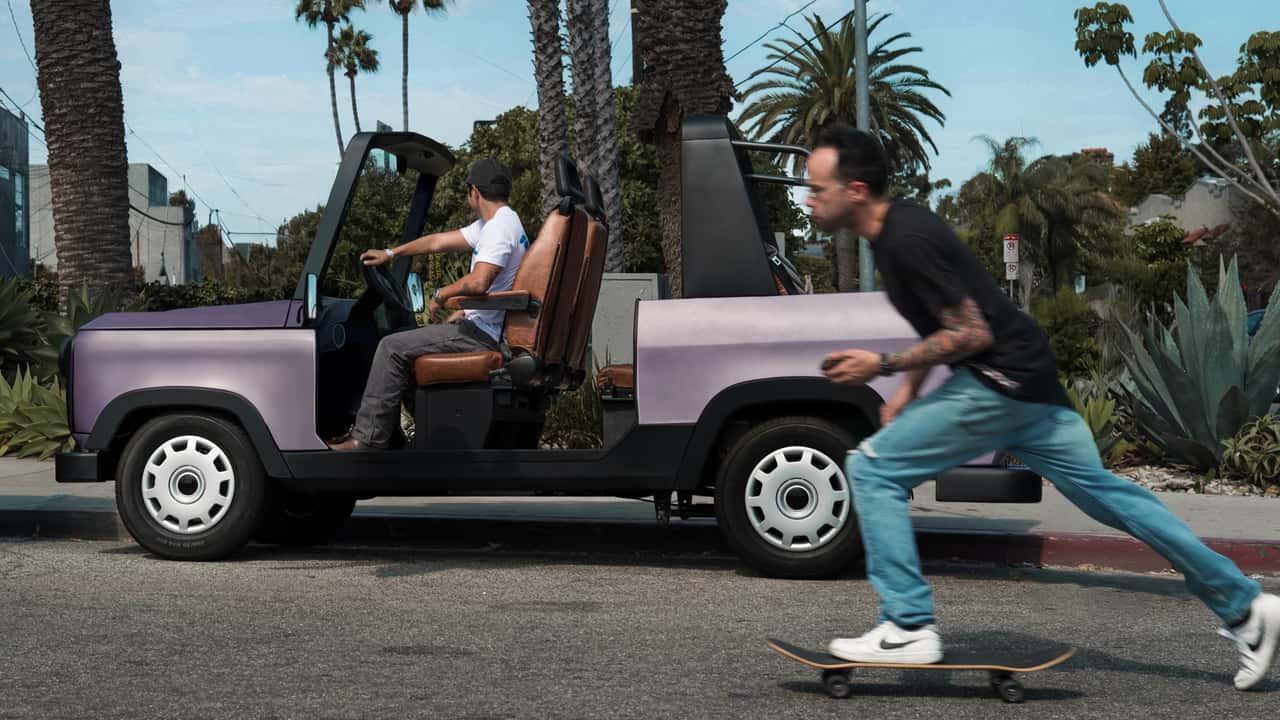
A Miami-based startup called Chip Motors has spent the last two years working on a small, low-speed electric vehicle that it’s betting even SUV-obsessed Americans will go for. On Wednesday, it emerged from stealth and opened up preorders for its first product, a boxy, oddball affair with a tall windshield, no doors, a cheery LED smile on its face, and a bold promise to make driving optional. It reads like a cross between a golf cart and a Jeep Wrangler—or maybe a VW Thing—and that speaks to the market Chip is trying to conquer.
All over the country, in private communities but also in warm climates, people are hitting the beach and the grocery store in golf carts, Jameson Detweiler, Chip’s cofounder told InsideEVs.

Chip Motors
“During the pandemic, something happened. The golf carts escaped the golf communities, and were adopted widely and rapidly by families in markets where you could have the doors off basically year round, or in seasonal markets too,” he said. “And it just turns out a lot of people are doing this.”
Indeed, market research and reporting indicates that golf cart sales are on the rise, including from people who want to bop around town alongside fully grown cars. That’s possible due to a section of federal vehicle standards that allows for so-called “low-speed vehicles.” They can travel at up to 25 mph and can typically be driven on roads with speed limits up to 35 mph, though that depends on the state.
Detweiler had been thinking about small, autonomous vehicles for years—he founded a company in the micromobility space that was acquired by one of the biggest scooter-sharing players—but the "aha" moment came in 2022, when Detweiler got a call from his brother in Florida. His brother had traded in one of his two SUVs for a six-seat golf cart for shorter trips, and was loving it.
“He's like, ‘I don't want to get in my car. I drive it everywhere. I just charge it in a normal outlet in the garage. It's easy,’” Detweiler recalls. He spotted a gap in the market to sell a vehicle that's far more practical for short trips than the typical huge SUV—but also better than a golf cart.
Chip Motors
“The upgraded golf cart form factor is the one that, by and large, almost everyone was buying, in spite of the fact that they're not built for roads,” he said. “There's no real category-defining, purpose-built product and no great brands in the space, and that's what ultimately needed to happen.”
The Chip starts at $15,000 for a four-seat model with a soft-top roof, which is in line with what you’d pay for a nice street-legal golf cart. That’s before options like doors, paint colors, and other accessories. It uses in-wheel motors and a roughly 15-kilowatt-hour battery to deliver a range of around 100 miles, Detweiler says. That's pretty amazing efficiency, but remember that this thing has a top speed of 25 mph.
It’s a bit larger than a golf cart and includes a front trunk for some enclosed storage. A six-seater version will cost $18,000. Deliveries of the U.S.-assembled vehicle are scheduled to start in 2027 in Florida, before expanding from there.
Non golf-cart LSVs are not a new concept. GEM has been making them for years. Moke has taken a crack at it with retro-inspired open-air buggies. But none of those offer Chip’s standout promise: a remote-driving feature called Chip Go!

The pitch is that owners will be able to tap a remote driver to take over for the boring parts of driving, namely parking. It means you can drive to to the beach, unload, then dispatch the car to go park in some far-away lot. The feature will start with remote human drivers based in the U.S., Detweiler said, and at first it will only be available when people aren’t in the car. He makes it a point to note that Chip is liable for anything that happens in the vehicle when the teleoperator is in control. Chip says the remote operations service would be governed by the same rules that cover robotaxi companies using remote assistance, and that it is working with state and local officials in Florida, which will be the launch market for the feature.
The company is still working on pricing for the remote-assist feature, but Detweiler says customers will be able to buy bundles of time—minutes or hours of remote operation.
Over time, the plan is to expand those capabilities and eventually offer Level 4 autonomous driving by licensing and adapting the technology. It’s an enormous claim, seeing as there’s currently no vehicle you can buy that can drive itself. Tesla has tried for years. Rivian and Lucid are aiming to deploy Level 4 systems later this decade, but those are vehicles that cost several times what a Chip does.
To make that happen, Chip has designed the vehicle with surround-view cameras and a forward-facing radar but, notably, no lidar. Detweiler says he’s not against lidar, but doesn’t think it’s necessary for the low-speed environment Chip vehicles will be driving in.
“So it's not to say that we never would,” he said, referring to adding lidar. “But this is what we see as more than safe for the nature of which we operate. Were we moving at high speeds and on highways today, that'd be quite different.”
Whether Chip can deliver a personally owned autonomous vehicle at such a low price remains to be seen. Detweiler has high hopes. "I want this to be the first mass market American robot," he said. "It's just going to be on four wheels and sitting in your garage or in your driveway, as opposed to, you know, in your kitchen on two legs."
One thing is clear, though. There are plenty of Americans who have way too much car for their daily needs, and that has big implications for our roads and our air quality. We’ll soon see if the Chip can convince more of them to downsize.
Contact the author: Tim.Levin@InsideEVs.com
You Might Enjoy...
RECOMMENDED FOR YOU
Someone Is Already Trying To Flip One Of The Last Tesla Model S's Built. The Price Is... Ambitious
Recharging Your EV's A/C? It's Not Quite As Simple As You May Think
LFP Wins This Tesla Model 3 Battery Degradation Comparison
Volkswagen’s Cheapest New EV SUV Has 265 Miles Of Range
America Lost Over 111,000 Jobs Due To Trump's Clean Energy Pullback
The 16 Cheapest Electric Cars In 2026
'Completely False': Lucid Denies Report That It's Weighing Bankruptcy After Shares Crash
Source link