The most recent earnings period shows that when capital markets become unusually active, leading banks are looking to monetize nearly every stage of that activity.
That, at least, was the case with Goldman Sachs, which on Tuesday (July 14) announced record quarterly net revenue of $20.34 billion, up 39% from a year earlier, while net earnings jumped 78% to $6.63 billion.
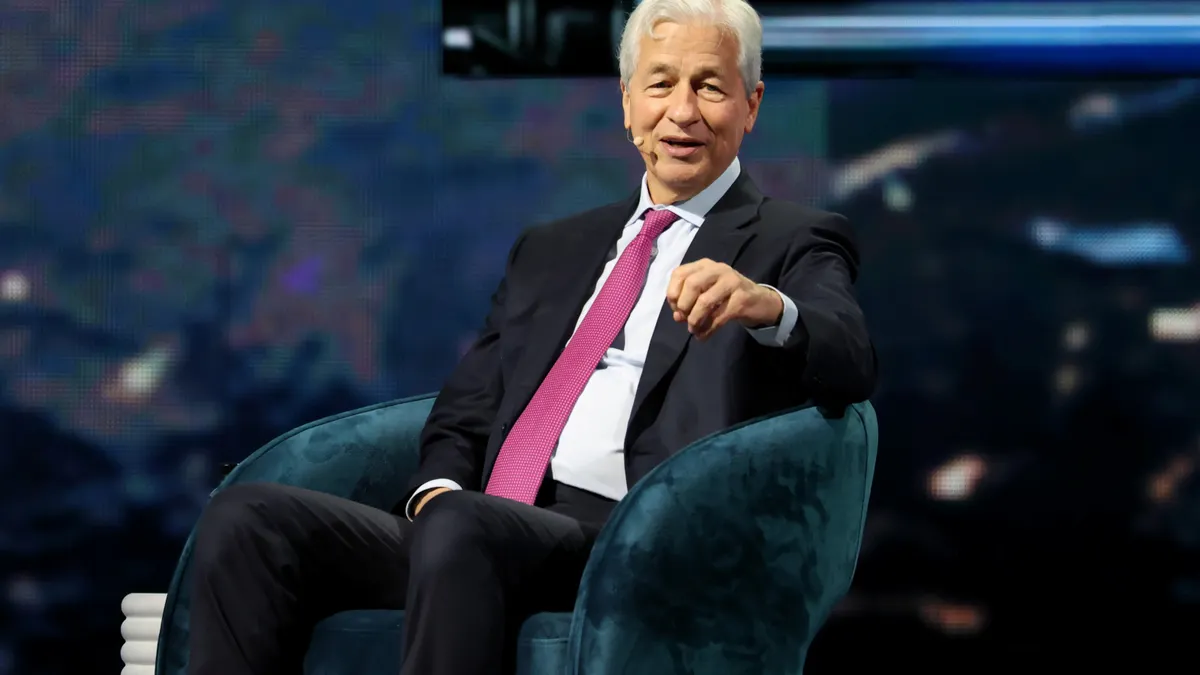
“Momentum has accelerated throughout our businesses. Clients are turning to us to lead their most strategic and consequential transactions, which are often the genesis of activity across the franchise,” Chairman and CEO David Solomon said on the bank’s investor call Tuesday.
Goldman Sachs beat analyst expectations healthily across all estimates, and the bank’s record second-quarter results initially look like a familiar Wall Street story: Volatility increased, clients traded more, companies returned to capital markets and the investment bank sitting closest to that activity produced a windfall.Goldman’s Global Banking and Markets division generated a record $15.52 billion in revenue, 53% more than a year earlier. Investment-banking fees increased 55% to $3.40 billion as equity underwriting more than doubled and debt underwriting reached a record.
But the quarter’s more consequential business signal was not simply that Goldman had an unusually profitable trading period. It was that the artificial intelligence investment boom is beginning to function as a full-firm revenue engine.
See also: Why Decentralized Systems Can’t Clear the CFO Sniff Test
AI Is Expanding the Addressable Market for Banks
Large-company M&A volumes rose 90% during the first half of 2026, CEO David Solomon told analysts. Goldman advised on $1.2 trillion of announced transactions, giving it a roughly $425 billion lead over its closest competitor. Even after converting part of that pipeline into second-quarter revenue, the firm’s investment-banking backlog increased to its highest level in five years and its second highest on record.
But rather than extolling traditional dealmaking wins, Goldman’s executives spent much of Tuesday’s call positioning the AI investment cycle today as a multiyear generator of advisory, underwriting, financing, trading and wealth-management revenue.
Artificial intelligence is no longer generating business only for technology bankers or the underwriting teams handling semiconductor and data-center financings. The capital cycle is extending into the AI boom’s physical buildout. After all, the buildout requires real estate, power generation, transmission capacity, cooling systems, commodities and structured financing. Suppliers need working capital. Infrastructure developers need private credit. Technology companies may issue shares or debt. Utilities may acquire assets or restructure portfolios to meet new energy requirements.
That expansion plays directly into Goldman’s effort to connect its historically volatile investment-banking and trading businesses with more durable financing and asset-management revenue. Solomon described this as a “multiplier effect,” with advisory assignments serving as the starting point for financing, risk management, capital-markets execution and investment opportunities across the firm.
Goldman sees the cycle as being in its early stages, but Solomon was careful not to describe it as linear. He acknowledged that spending could be recalibrated as companies learn how much infrastructure is needed, how enterprises will purchase computing capacity, how chip efficiency evolves and how AI services are ultimately priced.
See also: AI Agents Push CFOs to Rethink Business Payments
The Wall Street Flywheel Effect Is Back
Goldman’s second quarter suggests that when corporate transactions, investor volatility and financing demand arrive together, a traditional banking model of extracting more revenue from fewer, deeper relationships remains extremely difficult to replicate.
Still, the bank’s results were not uniformly strong. Platform Solutions revenue fell 64% to $221 million, primarily because of markdowns associated with the Apple Card loan portfolio, which Goldman had moved into held-for-sale status. The decline is another reminder that the firm’s retreat from consumer banking continues to impose costs even as its core Wall Street businesses prosper.
Goldman’s attempt to make its earnings less dependent on capital markets was also visible in Asset and Wealth Management, where revenue rose 20% to $4.60 billion. Since the beginning of 2025, Goldman bankers have made nearly 900 referrals to the wealth-management business, according to Solomon.
The firm is applying a similar model to institutional clients. Its new mandates involving $70 billion in Verizon and Lockheed Martin retirement assets strengthen a fee-based business serving companies that increasingly want outside managers to oversee complex portfolios spanning public and private markets.
The strategy is not merely to win more deals or execute more trades. It is to place Goldman at enough points in the capital cycle that one strategic corporate decision can generate revenue throughout the organization. AI may be the catalyst accelerating that cycle. Goldman’s competitive advantage is its ability to monetize nearly every financial consequence that follows.
The post Goldman’s $20 Billion Quarter Powered by Banking’s New AI Flywheel appeared first on PYMNTS.com.
Source link