Sendo Farm, the online grocery platform operated by e-commerce company Sen Do Technology, has wound down operations, marking the company’s withdrawal from Vietnam’s highly competitive e-commerce industry after more than a decade of competing against well-funded giants.
Sen Do Technology announced that the Sendo Farm website and applications would shut down on July 10, 2026 as part of a wider restructuring aimed at optimizing resources, strengthening competitiveness, and restructuring its business portfolio for the next phase of development, Vietnam Investment Review reported on July 05, 2026.
Before closing, Sendo Farm said it would continue offering promotional activities until July 09, and said that customers with unused membership packages and wallet balances receive refunds into their Farm Wallets.
The rise and fall of Senda Farm
Sen Do Technology had already undergone a strategic shift last year, announcing in April 2025 its exit from the multicategory e-commerce marketplace business and the closure of its original platform, Sendo. The company said it would focus exclusively on online sales of agricultural products, fresh food, and daily consumer goods through Sendo Farm after Sendo’s market share slipped below 1%.
Launched at the end of 2021, Sendo Farm was introduced as an online grocery shopping platform. It operated under a next-day delivery model, allowing customers to place orders through an app and collect them the following day at nearby Farm Hub pickup points.
Products were consolidated at central warehouses, sorted overnight, and distributed to a network of collection points, including convenience stores, pharmacies, and household-operated locations. The model helped reduce last-mile delivery costs and minimize inventory, particularly for fresh products with relatively low profit margins.
The platform initially benefited from COVID-19 lockdowns, which closed traditional wet markets while demand for delivered vegetables and meat surged. By mid-2024, Sendo Farm had become Sen Do Technology’s largest and fastest-growing segment, handling approximately 50 tonnes of goods daily and serving 10,000 customers. Its network included 5,000 partner locations providing pickup points and last-mile delivery across Hanoi and Ho Chi Minh City (HCMC), according to the Business Times.
However, Sendo Farm also started seeing intensifying competition in Vietnam’s expanding online food retail market. Traditional supermarkets like WinMart, GO!, and MM Mega Market began strengthening their digital sales channels, while tech giants launched on-demand grocery services including GrabMart, ShopeeFood, and beFood. Sendo Farm was also competing with convenience store chains, traditional markets, and food-selling communities on social media.
Sen Do Technology’s e-commerce journey
Sen Do Technology started in 2012 as an internal project within FPT Corporation, one of Vietnam’s largest IT services companies, before spinning off independently in 2014. The company’s flagship platform Sendo operated as an online marketplace connecting buyers with sellers.
At one point, Sen Do Technology was one of Vietnam’s best-funded local e-commerce companies, raising a total of US$130 million through three key funding rounds: US$18 million in December 2014, US$51 million in a Series B in 2018, and a US$61 million Series C in 2019.
At the time of its Series C, the Sendo platform catered to more than 500,000 sellers, with an estimated 17 million stock keeping units (SKUs) listed, and served more than 12 million customers across all 63 provinces in Vietnam, making it one of the most prominent e-commerce platforms in the country. Sen Do Technology was the first e-commerce company in Vietnam to be awarded an e-wallet license, and its e-wallet service, SenPay, ranked third by transaction value in 2019.
That year, Sendo achieved its annualized gross merchandise value (GMV) target of US$1 billion, with net revenue peaking to about VND 547 billion (US$21 million), according to Vietdata, a provider of economic data and research on Vietnam. However, the company incurred sustained losses due to high expenses on marketing, losing VND 1,586 billion (US$60.9 million) in 2019 or nearly three times its revenue that year.
In 2020, Sendo entered merger talks with Tiki, aiming to consolidate the two domestic e-commerce leaders against foreign competitors. However, negotiations ultimately collapsed over shareholder disputes, with some believing the deal disproportionately favored Tiki, Deal Street Asia reported in July 2020. The COVID-19 pandemic further undermined the transaction by making investors more risk-averse.
Sendo was now competing against Shopee and Lazada, backed by investors with significantly deeper pockets including Tencent, Alibaba, and Sea. According to an analysis by the Runway Ventures, a weekly newsletter analyzing startup failures, Sendo made the mistake of adopting these competitors’ playbook by offering free shipping, flash sales, and vouchers. Ultimately, it lost the capital war to rivals with virtually unlimited funding.
Compounding these challenges, Sendo struggled to build genuine customer loyalty and failed to truly differentiate itself, with purchases on the platform ceasing as soon as promotions ended. This occurred despite aggressively expanding its ecosystem, with SenPay for payments, SenMail for brands, and delivery coverage across all 63 provinces in Vietnam.
A highly competitive e-commerce industry
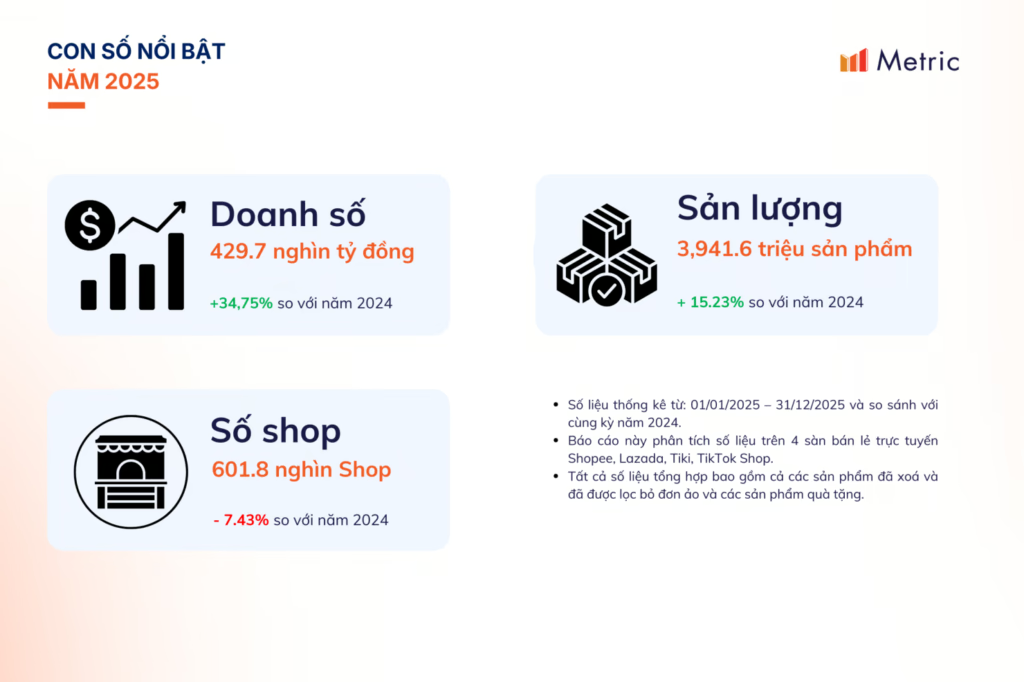
Vietnam’s e-commerce industry is currently dominated by four major platforms: Shopee, TikTok Shop, Lazada and Tiki. In 2025, these platforms boasted a total of 601,800 active shops, generating total sales revenues of VND 429 trillion (US$16.5 billion), up nearly 34.8% from 2024, according to market data research platform Metric.vn. More than 3.9 million items were sold via these platforms in 2025, up 15.2% year-over-year (YoY).
However, after a decade of growth, Vietnam’s e-commerce market is now entering a more disciplined era, marked by rising platform fees and tightened regulators oversight.
Major platforms are gradually retreating from their cash-burning strategies, shifting towards profitability, operational efficiency and long-term sustainability. This transition is putting pressure on sellers, who now face more charges.
At the same time, tighter tax enforcement and stricter product quality controls on e-commerce platforms are adding further burden, with non-compliant players increasingly being filtered out. In 2025, more than 13,700 shops were removed from e-commerce platforms for selling counterfeit, banned or untraceable products, according to Vietnam News, quoting the Vietnam E-Commerce and Digital Economy Agency under the Ministry of Industry and Trade (MIT).
Additionally, the Law on E-Commerce came into effect from July 01, 2026, marking a significant step in strengthening the legal framework for online commerce.
Under the new regulations, operators of e-commerce platforms are required to verify sellers’ identities before allowing them to conduct business on their platforms. This measure is expected to reduce anonymous accounts and unverified online stores while facilitating traceability, law enforcement, tax administration, market surveillance and consumer protection.
Featured image: Edited by Fintech News Singapore, based on images by Sendo and sodawhiskey via Magnific
The post Sendo Shuts Down Online Grocery Platform; Exits E-Commerce appeared first on Fintech Singapore.
Source link