
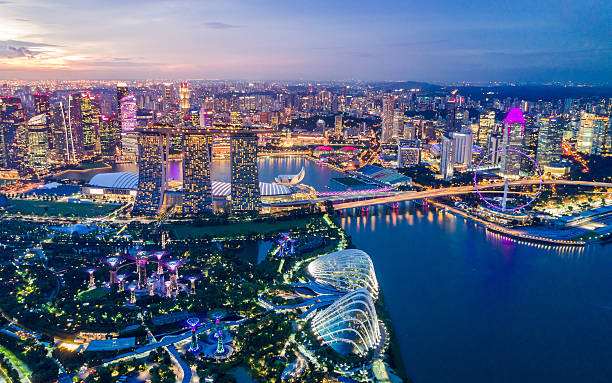
The following showcases the 2026 developments of fintech and wider digital in the island-nation of Singapore.
Singapore no longer needs to prove that it can build a successful fintech ecosystem. The city-state has already become one of the world’s most important financial and technology centres, attracting international banks, start-ups, investors and regulators from across Asia and beyond.
The more relevant question in 2026 is what Singapore does with that position.
As explored in my previous The Fintech Times article, Spotlight on Singapore: A Fintech Powerhouse Fuelling Innovation in Asia, much of the ecosystem’s success can be traced to deliberate government support, regulatory clarity and Singapore’s ability to serve as a gateway to the wider Asia-Pacific region. Two years later, its fintech story is becoming less about the number of companies it hosts and more about whether new technologies can be incorporated into mainstream finance.
Singapore’s economy is projected to grow by 3.5 per cent this year, with nominal gross domestic product (GDP) approaching $660billion and GDP per capita reaching approximately $107,760. Financial services, trade, transportation, advanced manufacturing and technology remain central to the economy. Singapore itself is the financial centre, anchored by institutions including DBS, OCBC and UOB.
Beyond start-up numbers
According to the Monetary Authority of Singapore (MAS – the country’s central bank), Singapore is home to more than 1,300 fintech firms, alongside over 50 innovation laboratories established by financial institutions and technology companies. The ecosystem includes payments, wealthtech, regtech, digital assets, insurtech and financial infrastructure providers.
Companies such as Nium, Thunes, Aspire and YouTrip illustrate Singapore’s role as a base from which fintechs can expand across multiple Asian markets. Grab and Sea have also developed extensive digital financial-services operations, solidifying their applications as super-apps. Also, international firms continue to use the city-state as their regional headquarters.
However, Singapore’s relatively small domestic population means that local adoption alone cannot sustain every fintech business. Successful companies are generally expected to operate across borders, making regional connectivity and regulatory cooperation particularly important.
Tokenisation moves closer to the financial mainstream
The defining development for Singapore in 2026 is arguably the shift from experimenting with tokenised assets towards building the infrastructure required for their commercial use.
Through Project Guardian, MAS has worked with financial institutions and international regulators to test tokenised bonds, funds, foreign exchange and other financial assets. What began as a series of pilots has expanded into a wider attempt to establish common standards, legal structures and interoperable networks.
This year, MAS is progressing plans to trial tokenised MAS bills settled using wholesale central bank digital currency. This follows the first live trial of Singapore-dollar wholesale central bank digital currency (CBDC) for interbank overnight lending involving DBS, OCBC and UOB.
Singapore is also developing legislation for regulated stablecoins, with an emphasis on reserve quality and reliable redemption. Meanwhile, the BLOOM initiative is exploring how tokenised bank liabilities and regulated stablecoins could be used for settlement.
These developments matter because tokenisation will only gain wider acceptance if digital assets can be settled securely and consistently. Singapore is therefore concentrating not merely on creating tokens, but on building the financial plumbing around them.
Connecting payments across borders
Singapore’s role as a regional hub is also evident in payments.
PayNow provides instant domestic transfers, while SGQR consolidates multiple QR-payment options through a common standard. More significantly, Singapore has linked its payment infrastructure with countries including Thailand, India and Malaysia, enabling consumers and businesses to make faster cross-border transfers.
These arrangements address a persistent weakness in international finance: cross-border payments can still be slower and more expensive than domestic transactions. For a trade-dependent economy surrounded by large remittance and tourism markets, greater interoperability offers both commercial and strategic value.
MAS is also working with international counterparts, including the Bank of England, the Bank of Thailand and Germany’s Bundesbank, on experiments involving foreign exchange and digital-asset settlement.
Artificial intelligence becomes the next priority
The other major theme is artificial intelligence (AI). Financial institutions in Singapore are already using AI for fraud detection, customer service, risk assessment and compliance. The focus is now shifting towards how these systems can be deployed at scale without undermining accountability, data protection or financial stability.
Just this past June, MAS announced the establishment of a Future of Finance Institute, initially focused on AI and tokenisation. The institute is intended to give financial institutions access to shared expertise and resources, particularly where implementation costs or skills shortages might otherwise restrict adoption.
This builds on earlier MAS initiatives supporting responsible AI, including the Veritas framework for assessing fairness, ethics, accountability and transparency in financial services.
Looking ahead to the future
Singapore’s fintech sector is entering a more complicated stage of development. It has already demonstrated that public policy, investment and regulatory support can create a major innovation centre. The challenge now is turning experiments in AI, tokenisation and digital money into infrastructure that financial institutions genuinely use.
Singapore may not produce the largest consumer fintech market in Asia. Its greater influence could come from defining the standards, networks and regulatory models through which the region’s financial systems increasingly connect.
The post Singapore: From Fintech Hub to Laboratory for the Future appeared first on The Fintech Times.
Source link