Explore more conversations like this From the Block.
The blockchain industry has spent years promising to replace the filing cabinet to either make illiquid assets tradable or provide an immutable record in the event a natural disaster wipes out the paper record.
Dubai may have finally found a filing cabinet worth replacing.
At least that’s what the region’s effort to tokenize real estate directly through its land registry suggests.
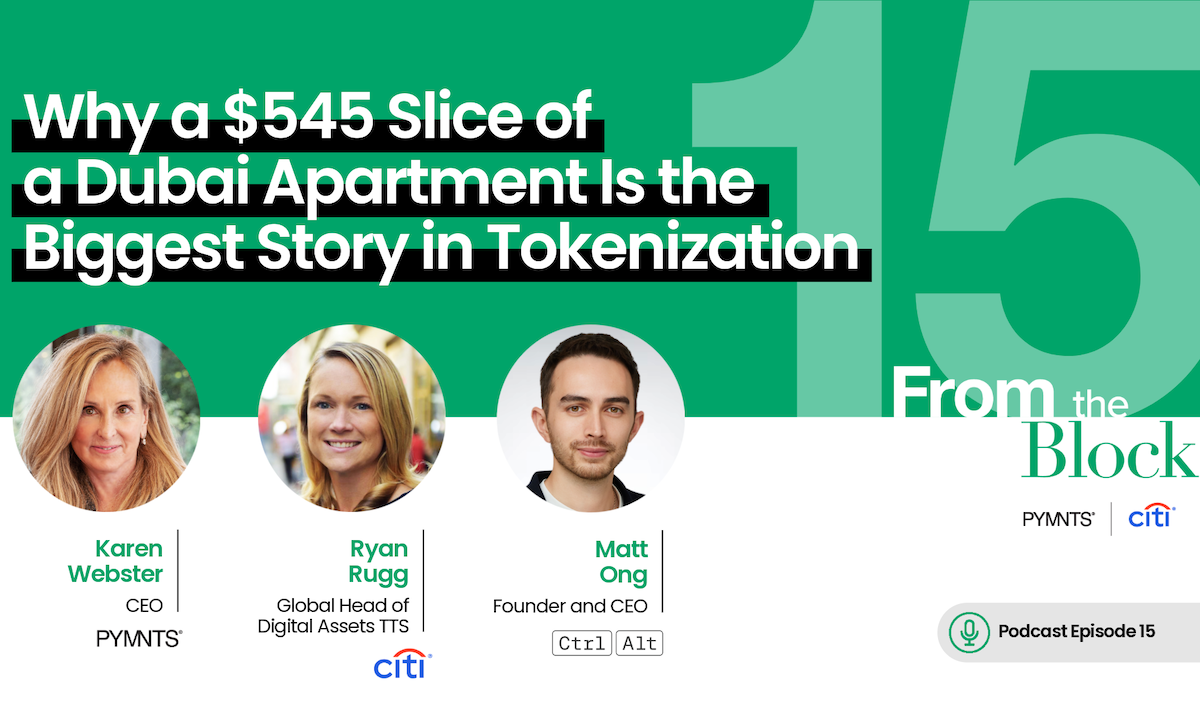
“No one has fallen in love with a land registry,” PYMNTS CEO Karen Webster said during the latest episode of “From the Block.”
Tokenization might provide a means to that end. Although Dubai’s move to put real estate on-chain makes fractional property ownership possible at a lower entry point, its greater significance is not that an apartment or building can be represented by a digital token. It’s that the token is being connected to the authoritative record of ownership.
Earlier fractional real estate offerings commonly placed properties inside special-purpose vehicles (SPVs) and sold investors shares in those entities. That structure made access possible, but it also introduced legal entities, administrators and additional fees between the investor and the property. In other words, friction.
“What we’d seen before in the market was that doing it through SPVs, doing that through structures, was really difficult to scale,” Ctrl Alt Founder and CEO Matt Ong said in a conversation with Webster and Ryan Rugg, global head of digital assets for Treasury and Trade Solutions (TTS) at Citi. “So doing that right directly at the source, at the land register, was what made sense.”
Dubai had an advantage because its land records were already relatively digital, its regulatory system is more centralized, and the government could support a market-wide project, Ong said.
Creating a token is becoming relatively easy. Connecting it to enforceable ownership rights is not.
Tokenization’s Real Breakthrough Is the Infrastructure Around the Asset
The promise of on-chain finance is that the asset and payment can move at the same time through atomic settlement, Ong said. But that requires regulated money capable of operating across the same networks. Tokenized deposits are one possible solution. Their usefulness, however, depends on interoperability among banks and between digital and conventional balances.
“If you’re in traditional cash or tokenized deposits, you should have fungibility between both instantaneously,” Citi’s Rugg said.
That is the practical enterprise requirement. Companies are not about to abandon bank accounts, payroll systems or tax payments for a closed token ecosystem, and digital assets must work with traditional money before they can replace traditional market infrastructure.
“What’s ultimately driving the interest in our products is payments,” Ong said. “The ability to now be able to settle that with on-chain money is the real driver as to why everyone’s so interested.”
Without a usable form of regulated on-chain money, a tokenized asset may still depend on conventional bank transfers, operating hours and reconciliation processes. The asset can move on a blockchain while its payment remains constrained by the traditional banking calendar.
Rugg compared today’s networks to the internet’s early collection of disconnected intranets. Individual bank tokens may improve transactions inside one institution, but they become more valuable when customers can move money across banks, ledgers and clearing systems. The tokenized asset market may therefore be shaped as much by the banks that provide interoperable settlement as by the firms that originate the assets.
While Dubai’s real estate model may be hard to replicate in other markets, particularly the United States with its miles of filing cabinets and acres of paper records, tokenization is becoming a competition among jurisdictions as much as a competition among technology providers.
The appeal of bringing illiquid assets on-chain, including private company shares, real estate, private credit, infrastructure projects, collectibles and more, will evolve region by region, rather than a global scalable model around a single use case, Ong said.
The value is not in placing an asset on-chain. It is in removing the barriers that made the asset difficult to own, finance or transfer in the first place.
Liquid Assets May Have More Race to Run Than Competitors
Modernizing the administrative machinery that determines who owns an asset, how that ownership is transferred and what happens when something goes wrong is work that requires the cooperation of registries, regulators, courts, banks, distributors and asset managers.
It also requires rules for disputes, transfers, defaults, unpaid rent and fractional ownership. Blockchain may record the transaction, but it doesn’t decide what happens when the parties disagree.
Above all, it requires liquidity, Ong said. Tokenization was initially promoted as a solution for illiquid investments, such as real estate, private companies and collectibles. While tokenization can make an asset transferable and provide a venue in which investors may be able to sell it, the act of tokenization itself cannot guarantee buyers, deep markets or continuous price discovery.
That matters for assets such as individual properties, private credit and private-company shares. Their underlying economics do not change simply because the ownership record becomes digital. Real estate is generally a long-duration investment. An individual building is not expected to trade like a public stock, and fractional ownership does not eliminate valuation uncertainty or the possibility that an investor may have to wait for an exit. That’s where secondary markets come into play, Ong said.
Still, looking ahead, Ong said he expects public equities and other liquid instruments to reach broad on-chain adoption, as it remains promising to put illiquid assets on-chain.
“It will surprise a lot of people that the liquid side of the market actually is going to go to full-scale adoption before the illiquid side of the market,” Ong said.
Dubai’s land registry matters because it demonstrates what happens when the record of ownership, legal authority, investor access and market infrastructure begin to align.
“If you solve the hard problems, there’s greater economics in it for you,” Ong said.
The post Why a $545 Slice of a Dubai Apartment Is the Biggest Story in Tokenization appeared first on PYMNTS.com.
Source link