20 Years Later, No Game Captures Teenage Angst Better Than Persona 3


I will never forget the first time I played Persona 3, and how, like so many seminal games of my childhood, I stumbled upon it by complete accident. When I was growing up, I was utterly obsessed with JRPGs and would pick any I came across, regardless of name or quality.
This helped me discover hidden gems like Valkyrie Profile, Disgaea, Xenogears, Legend of Dragoon, and Shadow Hearts alongside the big hitters like Final Fantasy or Dragon Quest. But as the millennium eclipsed its first handful of years, a new kid appeared on the block in the form of Shin Megami Tensei: Persona. To be blunt, it wasn’t the first game in the franchise I played — that honour goes to Digital Devil Saga and its excellent sequel. If Atlus was smart, these two cult classics would be next on their list of potential remasters.
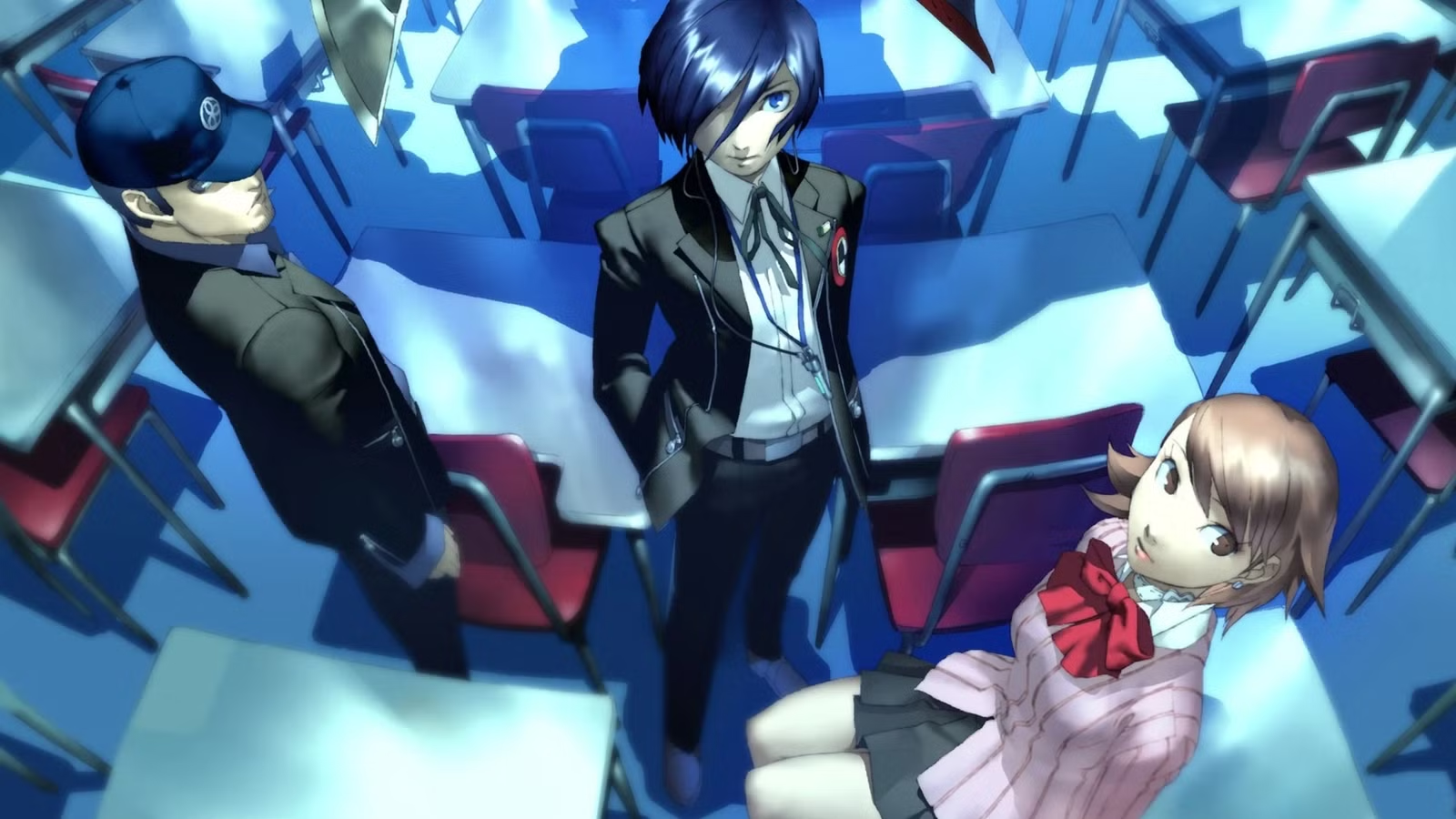
Shifting back to Persona 3, I picked it up on a whim after trading in some old games and in mere moments found myself transported to an achingly melancholic world filled with stellar characters that felt like reflections of my teenage self. I wasn’t even as old as its characters at the time, but I could already relate to their struggle to fit into a modern world that felt dead set against them. From a gameplay perspective, it has defined what Persona would be for the next several decades. Even today, it lingers within the third entry’s beautiful shadow.
Persona 3 Will Always Be An Absolute Mood
Let’s start with the most important thing — the atmosphere. When it was first released, Persona 3 depicted a modern world. A Japan where cell phones were still in their infancy and the World Wide Web was quickly growing in popularity. But young people were yet to be swallowed up by social media, as only a select few occupied forums or spent their time flaming each other on computers. Aside from texts and phone calls, the follies of youth were still experienced in person.
Beyond the headphones our mostly silent protagonist uses to shut out the world, it’s refreshing to revisit Persona 3 and get lost in a world that still feels so lo-fi, especially in the original, which isn’t shy about going hard on its visual themes of death and decay. Once you look past the hustle and bustle of Tokyo and get lost in the dark, it’s an empty world ready to drop dead at a moment’s notice.
Future games would come to use television, cell phones, and the internet as core parts of their mechanical and visual identities. It made sense considering they reflected the times in which they were made, and I wouldn’t be surprised if Persona 6 talks about AI, VTubers, or delves even deeper into how technology has shaped who we are as people.

Persona 3 is a far more raw examination of that teenage melancholy and how withdrawn young people can become in the face of their own trauma if nobody is around to support them. Seeing our crew of random teenagers come together for a common cause despite their differences is powerful stuff, and the strong writing reflects that.
It reminds me of a time when, aside from film, music, and video games, there wasn’t a place to escape online that everyone in the world could access. That loss, depression, and doubt take on a new form under these circumstances, and it was something that Persona 3 gave us with tremendous effect.
Atlus Changed Persona Forever With The Third Entry

I’ll always have a soft spot in my heart for the first two Persona titles, and I’m willing to bet that the vast majority of modern fans haven’t even played them. Mostly because Persona 3 was when the gameplay formula millions fell in love with first reared its head. It’s the game that introduces nightly dungeon crawls, compelling social links, and a big party of characters all trying to find a place to belong in.
There was something so refreshing — especially for western audiences — about attending a normal Japanese high school during the day and being expected to balance education and relationships like you were a real human being. The after-school clubs you opted to attend and the part-time jobs you decided to take factored into the character you would become. We’d not played anything like this before, and it felt so fresh, doubly so when the dungeon crawling combat was deep, challenging, and satisfying.

Every moment mattered and could splinter into multiple playthroughs if you wanted it to, not to mention the individual character arcs each major party member possessed that bled into almost every part of the experience. Despite the long runtime, you cared, and that only held more true when Persona 3 FES came along and added so much to the narrative.
Since its inception, I don’t think any other series has offered a combination of gameplay and narrative that feels as compelling, hence why Persona still relies on these systems over two decades later. I personally hope it evolves in some form with the sixth entry, but whether the Atlus folks will risk it remains to be seen.
But as Persona 3 celebrates its 20th anniversary, it deserves to be revisited in its original form, FES, Portable, or even Reload if you fancy a far more modern take on things. However you slice it, it’s a masterpiece that I’ll hold dear for the rest of my life.






Source link