Indian tech unicorns are transforming their internal AI tools into independent businesses, mirroring successes like Amazon Web Services and Slack. Companies such as NoBroker, Moglix, Apna, and Practo are leveraging years of accumulated data and domain expertise to launch AI-powered platforms. This strategic pivot capitalizes on the current AI wave, creating new revenue streams by offering sophisticated solutions to external enterprises.
Listen to this article in summarized format
A growing number of Indian unicorns are spinning off AI-native platforms, seeking to turn internal tools into standalone businesses. ET takes a closer look.
“Then a business miracle happened.” That is how Jeff Bezos described the birth of Amazon Web Services. In the early 2000s, the idea of renting computing power on demand was unheard of.
AWS emerged out of necessity. Faced with soaring resource consumption, logistical complexity, and inefficient utilisation of servers, storage and networking infrastructure, Amazon reimagined computing as a service delivered over the internet; an on-demand utility, much like electricity supplied through a grid.
“At AWS we completely reinvented how companies buy computation,” Bezos said about the cloud computing breakthrough. Today, AWS is Amazon’s cash cow, generating more than $110 billion in annual revenue in 2025. CEO Andy Jassy has estimated that the annual revenue of this most profitable unit could swell to $600 billion by 2036.
Atlassian’s Jira was started as an internal bug tracking tool, before it became a multimillion revenue generating business for the firm. The gaming company Tiny Speck developed an internal communication tool Slack for real-time collaboration and file sharing. They shut the game they were developing but launched Slack as a workplace messenger platform. Five years ago Salesforce bought Slack for $27 billion.
A process innovation or a tech solution for internal usage turning into a tremendously successful business spin-off is an exciting dream for entrepreneurs. While it is too early to say the eventual scale of success, the AI wave has set the stage for a bunch of Indian consumer internet unicorns to tap into their domain expertise and proprietary data to build out new businesses.
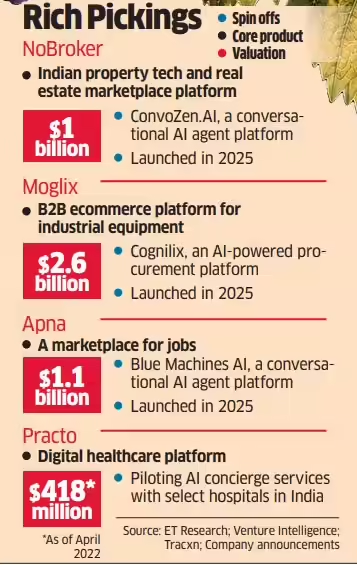
In the past two years, companies such as NoBroker, Moglix, Apna and Practo have spun-off tech businesses that leverage AI and data they have accumulated over the years.
ETtech
Moglix, a B2B marketplace for industrial supplies, launched Cognilix, an AI-powered procurement software system. Five months ago, unveiling Cognilix, Rahul Garg, cofounder of Moglix, said years of operational data helped the company build the procurement and supply chain and software for enterprises.
This tech stack was developed over years and used by companies such as Unilever, according to Garg. With the AI remake, it acquired a new level of elegance and sophistication, emerging as a full-fledged business with a brand name of its own.
Online realty platform NoBroker’s search for a reliable voice AI solution led it to build one in-house. It has evolved into ConvoZen.ai, a standalone voice AI business. Akhil Gupta, chief product and technology officer and cofounder, describes the venture as a byproduct of the trove of data the company has accumulated over a decade of operations. “We started building a speech-to-text (STT) platform in 2018 because the models available in the market at that time did not meet our requirements,” he said.
Since then, the company has developed proprietary voice models, Akshara for speech-to-text and Ragini for text-to-speech, which it combines with select external voice AI models depending on enterprise use cases. What began as an internal tool is now used by 50 enterprise customers across banking, financial services and other sectors, including businesses in West Asia, Gupta said.
Last year, Apna, a jobs and career platform, launched BlueMachines AI, an enterprise voice AI platform, and has secured $6 million in enterprise contracts within 45 days of launch, the company said. Srijesh K, chief product and technology officer, Practo, said that they are currently piloting an AI concierge platform for clinics and hospitals in India and are testing the market. “We have 18 years of data sitting with us and this puts us in an unique position to leverage,” Srijesh said.
Right response
At a time when AI is disrupting the way businesses are run and could potentially threaten or rewire revenue models, some of them have found an opportunity to capitalise on the data they have collected to create a brand new vertical. As Moglix’s Garg puts it, the technology is at an inflection point and it is about realising how we utilise it.
Practo’s Srijesh concurred that this has a lot to do with the timing and not just with the product.
“Five years ago, if I went to a doctor and I told him that I want to sell an AI concierge service, they would be like, no, I have this receptionist who will probably do this for me,” he said. Now, with the scale and the changes the market is undergoing due to AI, there is openness and people are seeing value.
UiPath, a robotics process automation (RPA) service provider, has developed AI agentic products for enterprise automation.
Raghav Malpani, chief product and technology officer, told ET that they expect the AI products to outperform its RPA counterparts going forward. But launching an AI-powered product isn’t necessarily guaranteeing a new age venture a competitive edge. There is a proliferation of such offerings and competition is intense. Potential customers are torn between choices and that is a big challenge, according to UiPath’s Malpani, “With so many products in the market, customers are confused and it is our job to help them navigate,” he said.
We strive to uphold the highest ethical standards in all of our reporting and coverage. We StartupNews.fyi want to be transparent with our readers about any potential conflicts of interest that may arise in our work. It's possible that some of the investors we feature may have connections to other businesses, including competitors or companies we write about. However, we want to assure our readers that this will not have any impact on the integrity or impartiality of our reporting. We are committed to delivering accurate, unbiased news and information to our audience, and we will continue to uphold our ethics and principles in all of our work. Thank you for your trust and support.








 ETtech
 as a Reliable and Trusted News Source
 Add Now!