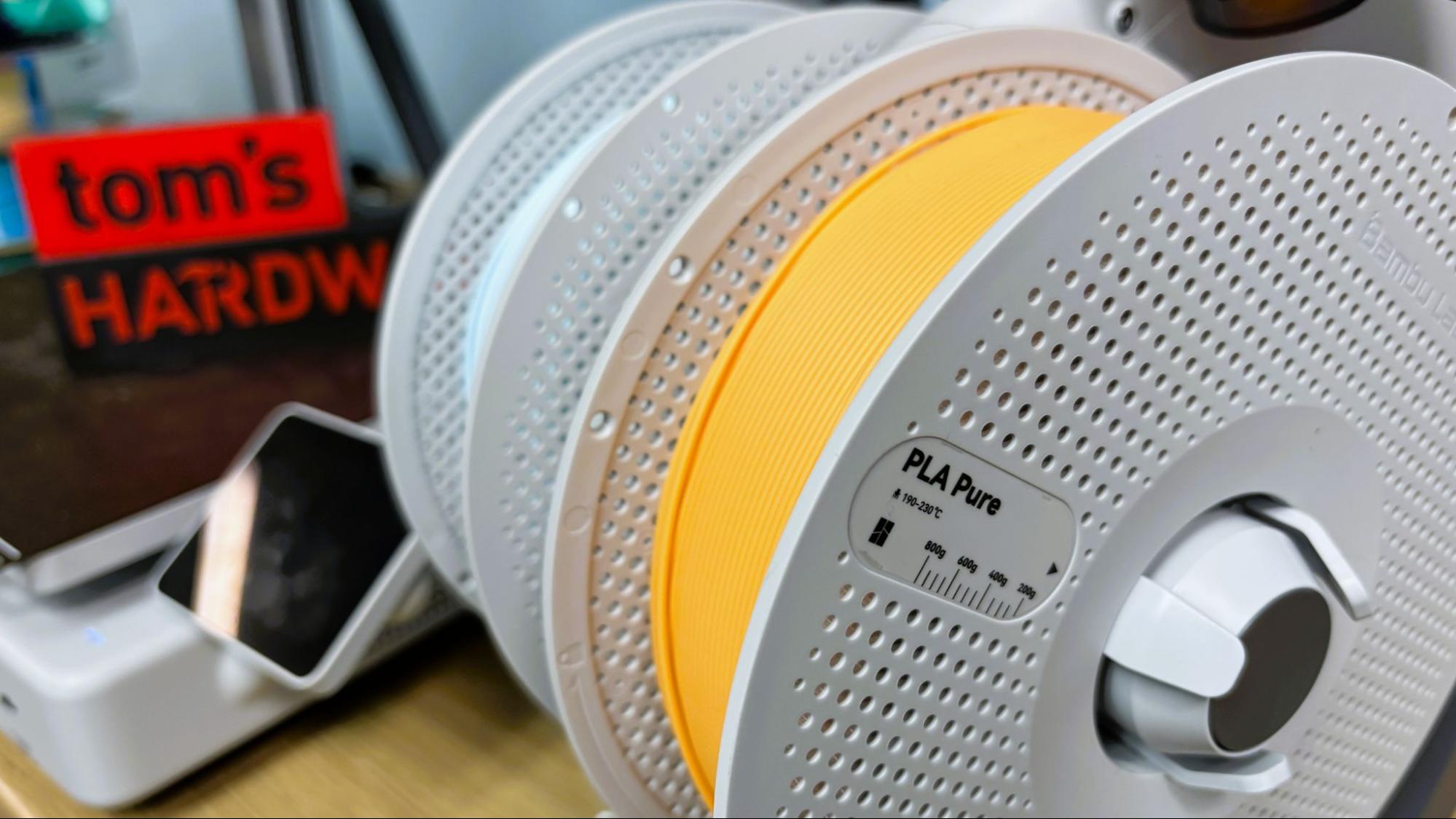
Bambu Lab announced a new line of PLA filament that might just be too good to be true. It’s PLA Pure, a new family-friendly, clean printing, and “food safe” material that’s UL Greenguard certified. PLA Pure is available now at Bambu Lab’s Official Store. It comes in three soft pastel colors, plus black and white, and retails for $24.99 on a spool or $21.99 as a refill.
The company says PLA Pure is the answer to rising concerns from new makers who want to keep a 3D printer in their family room, and share the space with children and pets. The concern is quite real, now that 3D printers have made the move from geeky garage lairs and workshops into the home itself. Only the manufactures know what’s actually in 3D printer filament, and few scientific studies have been conducted to analyze how printers affect air quality. Most makers shrug it off and crack a window, or purchase an air purifier to park next to their printer.
Manufacturers aren’t required to list the ingredients of their filament on the box or website. Even the Safety Data Sheet (SDS), which declares a product’s chemical makeup, is incredibly vague. For example, the SDS for Bambu Lab’s Basic PLA says it contains 95 to 99 percent Polylactic Acid (PLA) and 1 to 5 percent “additive.” These additives are mixed in to give the filament extra strength, flexibility, or cosmetic finishes and are a closely guarded secret.

Bambu Lab’s PLA Pure peels back the curtain a little bit and lists the five ingredients: polylactic acid, acrylic copolymer, color pigments, ethylene bis-stearamide, and talc. They further explain that polylactic acid (PLA) is from corn and sugarcane, the acrylic copolymer is also found in children's toys, the pigments are the same used in baby tableware, EBS is from food packaging, and the talc is verified asbestos-free.
The asbestos-free line ends up raising more questions than it answers. First, if this new line proudly features asbestos-free talc for the matte finish, does that mean standard matte PLA does not? And if there are five ingredients in a “pure” PLA, what on earth could be hiding in the tough PLA, the silks, or the variants with glitter?
If you’re wondering why talc could contain asbestos in the first place, the reason is sadly simple. Both are minerals that naturally form under the same conditions, and these deposits mingle together. Talc is so abundant that it's incredibly cheap, but keeping it separate while mining can be nearly impossible, especially at a commercial scale.
While this new PLA successfully passes muster as a non-toxic material, the lab tests can only speak for the spool of unprinted plastic. Once printed, you’re back to the age-old problem of tiny cracks formed by the layer lines that harbor germs and bacteria on plastic that can not survive the sanitizing heat of the dishwasher.

We should also note that raw PLA, which is derived from corn or sugarcane, is a non-toxic, food-safe material. It is only the things manufactured and added to raw PLA that raise concerns.
Bambu Lab says PLA Pure carries UL 2904 Greenguard certification, which measures particulate matter and Volatile Organic Compounds (VOCs) for indoor air quality impact. These levels during printing fall below what's typically present in an average kitchen, living room, or office.
The company says that its PLA Basic also holds indoor air quality certification under the same standard, but PLA Pure's cleaner ingredient profile yields even lower emission levels. Testing was conducted on Bambu Lab A1 and A2L printers, without enclosure or filtration to reflect an average home setup.
The real reason Bambu Lab may have introduced this family-friendly filament is the toy safety aspect. PLA Pure passed a European safety standard, EN 71-3 certification, that governs the migration of harmful heavy metals from toy materials. This includes notably lead, cadmium, and chromium, which can be dangerous if a child puts a contaminated toy in their mouth.
Obvious PLA Pure won’t prevent toys from becoming choking hazards, and germ-trapping layer lines still exist. Bambu Lab warns that PLA can’t be used for liquids or exposed to temperatures above 60°C (like your dishwasher).

Follow Tom's Hardware on Google News, or add us as a preferred source, to get our latest news, analysis, & reviews in your feeds.

Source link