

 Daily Top 5 Daily Top 5 |
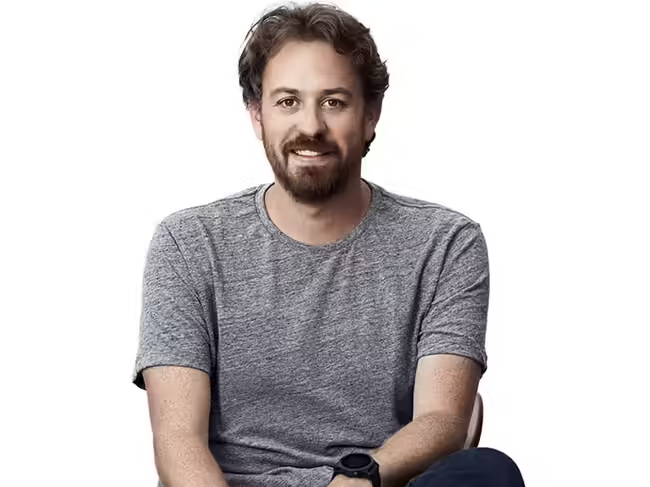
Cred’s Kunal Shah is WhatsApp’s new CEO
Want this newsletter delivered to your inbox?
I agree to receive newsletters and marketing communications via e-mail

Thank you for subscribing to Daily Top 5
We'll soon meet in your inbox.
Cred founder Kunal Shah will join WhatsApp as its global head after Meta announced a nearly $900 million investment in the fintech firm. This and more in today’s ETtech Top 5.
Also in the letter:
■ AI boom sparks talent war
■ Info Edge’s AI, deeptech bets
■ SK Hynix’s record-breaking AI rally
Cred announced on Monday that tech giant Meta will invest Rs 8,550 crore (around $900 million), in what is among the largest financing deals for an Indian fintech startup.
Deal details:
Money matters:
From the horse's mouth: In a post on X, Shah said Cred is ready for its next phase. "I am stepping back and @miten steps in as interim CEO, partnered with an incredibly talented team. He has been heading strategy and finance and suffering me since 2020. I’m stepping away from the operating role and will continue as a shareholder. My commitment doesn’t change. Just the role," he wrote.
Yes, and: Will Cathcart, who headed WhatsApp for seven years, has stepped down. "WhatsApp is in the strongest position it's ever been — and that felt like the right moment to step back," he wrote on his social media channels.
Meta CEO Mark Zuckerberg also wrote on Facebook that Cathcart will be transitioning to a new role within Meta, while also introducing Shah as the next WhatsApp chief.

Coursera CTO Mustafa Furniturewala told us in an interview that the key challenge for education platforms today is convincing people that learning still matters, even if AI makes information easy to access.
For the NYSE-listed company, the answer isn’t churning out more content, but helping learners turn information into practical, marketable (real-world) skills.
Expert needed: “It’s not possible to put the people who require learning in front of a chatbot and expect them to learn. The grounding from the expert content, as well as the pedagogy that’s behind learning, is still important,” he said.
Missing the point: Furniturewala argued that much of edtech is fixated on AI models and benchmark scores, while the real opportunity lies in the application layer.
The real bottleneck is no longer access to AI models, but whether organisations have the skills to use them effectively, he said. “The value generation is more about what’s built on top of the frontier models with the ecosystem you create and with the application layer you create. The next stage will be how you actually create an ecosystem that generates value with AI.”
India market: India, Coursera’s second-largest market globally with over 35 million learners, now leads the world in generative AI learning on the platform, with more than four million GenAI enrolments.
“India has such a big talent pool of young people who are the perfect age group to upskill in AI and leverage this technology,” he said. “Whether or not there will be a foundation model in India, it might have something to do with the need for it.”
Also Read: India must speed up AI upskilling: Coursera cofounder Andrew Ng

India’s AI startups are on a hiring tear. As of May, they posted a 21% year-on-year jump in hiring, far outpacing the broader startup ecosystem’s 12% growth.
Why hiring now: AI-native startups are aggressively recruiting across engineering, product, research, and customer-facing roles as demand spikes for generative AI, agentic AI, and enterprise automation.
Recruitment and search firms say mandates have surged in the past year, fuelled by fresh funding, new product launches, and growing enterprise adoption. Companies such as Qure.ai, Observe.ai, Fractal, and Redrob AI are expanding teams to keep up with growing customer demand and accelerate product development.
Talent shortage:
Beyond AI: And the hiring is not just for coders. While AI and core tech jobs make up about 38% of roles, nearly two-thirds of new positions in AI-led startups are outside pure AI – covering consulting, product, sales, implementation and customer success. As these companies scale, the battle is shifting from just building models to selling, integrating, and operationalising them.
Also Read: AI, AI Sir! Indian execs back in the classroom for a fresh chapter
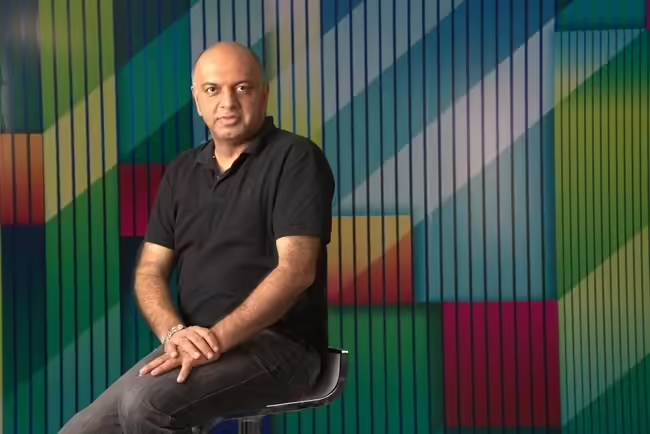 Info Edge founder Sanjeev Bikhchandani
Info Edge, the Sanjeev Bikhchandani-led parent of Naukri, has deployed Rs 1,003 crore across AI and deeptech startups since 2020, according to a recent shareholder letter.
Data decoded:
Yes, and: In the letter filed with the exchanges on Monday, Info Edge also mapped its broader investment journey across four phases.
Also Read: Info Edge commits Rs 250 crore to deeptech fund; sells Shopkirana stake
SK Hynix, a leading supplier of high-bandwidth memory (HBM) chips for AI systems, has overtaken Samsung Electronics to become South Korea's most valuable listed company.
Driving the rally: SK Hynix, which counts Nvidia and Google among its customers, has been one of the biggest winners of the global AI boom. Its shares have surged more than 340% this year, propelling its market value past both Samsung and Micron.
SK Hynix shares closed up 5.6%, taking its market capitalisation to 2,080.4 trillion won ($1.35 trillion). Samsung's stock slipped 0.14%, leaving it at 2,066.7 trillion won, excluding preferred shares.
Dramatic reversal: In 2023, a deep downturn crushed memory prices, pushing SK Hynix to an annual operating loss of 7.73 trillion won. As the AI cycle turned, and Microsoft, Google, Meta, and others ramped up investment, SK Hynix swung back to an annual operating profit of 23.5 trillion won in 2024 – a record at the time.
Also in the letter:
■ AI boom sparks talent war
■ Info Edge’s AI, deeptech bets
■ SK Hynix’s record-breaking AI rally
Meta to invest $900 million in Cred; Founder Kunal Shah to be global CEO of WhatsApp
Cred announced on Monday that tech giant Meta will invest Rs 8,550 crore (around $900 million), in what is among the largest financing deals for an Indian fintech startup.
Deal details:
- Founder Kunal Shah has left Cred to lead WhatsApp globally.
- The transaction comprises $400 million in secondary stake purchases and $500 million in primary capital infusion.
- Shah will keep his personal shareholding in Cred. Miten Sampat has been appointed interim CEO.
Money matters:
- The deal values Cred at Rs 43,239 crore, or about $4.5 billion, post-money.
- Meta will join Cred’s cap table as a minority investor (less than 20% shareholding) and will not have access to the company’s customer information.
- Shah will continue to be the single largest individual shareholder in Cred. His stake is now less than 20%.
- The company last raised Rs 617 crore at a valuation of $3.5 billion. This was at a 45% cut from its $6.4 billion value in 2022.
From the horse's mouth: In a post on X, Shah said Cred is ready for its next phase. "I am stepping back and @miten steps in as interim CEO, partnered with an incredibly talented team. He has been heading strategy and finance and suffering me since 2020. I’m stepping away from the operating role and will continue as a shareholder. My commitment doesn’t change. Just the role," he wrote.
Yes, and: Will Cathcart, who headed WhatsApp for seven years, has stepped down. "WhatsApp is in the strongest position it's ever been — and that felt like the right moment to step back," he wrote on his social media channels.
Meta CEO Mark Zuckerberg also wrote on Facebook that Cathcart will be transitioning to a new role within Meta, while also introducing Shah as the next WhatsApp chief.
With AI, challenge is convincing people that learning still matters: Coursera CTO
Coursera CTO Mustafa Furniturewala told us in an interview that the key challenge for education platforms today is convincing people that learning still matters, even if AI makes information easy to access.
For the NYSE-listed company, the answer isn’t churning out more content, but helping learners turn information into practical, marketable (real-world) skills.
Expert needed: “It’s not possible to put the people who require learning in front of a chatbot and expect them to learn. The grounding from the expert content, as well as the pedagogy that’s behind learning, is still important,” he said.
Missing the point: Furniturewala argued that much of edtech is fixated on AI models and benchmark scores, while the real opportunity lies in the application layer.
The real bottleneck is no longer access to AI models, but whether organisations have the skills to use them effectively, he said. “The value generation is more about what’s built on top of the frontier models with the ecosystem you create and with the application layer you create. The next stage will be how you actually create an ecosystem that generates value with AI.”
India market: India, Coursera’s second-largest market globally with over 35 million learners, now leads the world in generative AI learning on the platform, with more than four million GenAI enrolments.
“India has such a big talent pool of young people who are the perfect age group to upskill in AI and leverage this technology,” he said. “Whether or not there will be a foundation model in India, it might have something to do with the need for it.”
Also Read: India must speed up AI upskilling: Coursera cofounder Andrew Ng
AI startups fuel talent war as hiring surges across India
India’s AI startups are on a hiring tear. As of May, they posted a 21% year-on-year jump in hiring, far outpacing the broader startup ecosystem’s 12% growth.
Why hiring now: AI-native startups are aggressively recruiting across engineering, product, research, and customer-facing roles as demand spikes for generative AI, agentic AI, and enterprise automation.
Recruitment and search firms say mandates have surged in the past year, fuelled by fresh funding, new product launches, and growing enterprise adoption. Companies such as Qure.ai, Observe.ai, Fractal, and Redrob AI are expanding teams to keep up with growing customer demand and accelerate product development.
Talent shortage:
- Despite India’s large AI workforce, there’s a short supply of professionals who have actually deployed AI systems at scale.
- Mid-level AI talent now commands salaries 15-20% higher than traditional software engineers, while senior AI specialists – especially those with GenAI and LLM experience – earn 20–40% more.
- Compensation starts at around Rs 25 lakh for early-career AI engineers and goes up to Rs 1 crore for senior contributors. Leadership roles often clear Rs 1.5 crore.
Beyond AI: And the hiring is not just for coders. While AI and core tech jobs make up about 38% of roles, nearly two-thirds of new positions in AI-led startups are outside pure AI – covering consulting, product, sales, implementation and customer success. As these companies scale, the battle is shifting from just building models to selling, integrating, and operationalising them.
Also Read: AI, AI Sir! Indian execs back in the classroom for a fresh chapter
Info Edge says it invested Rs 1,003 crore on AI, deeptech startups since 2020
Info Edge, the Sanjeev Bikhchandani-led parent of Naukri, has deployed Rs 1,003 crore across AI and deeptech startups since 2020, according to a recent shareholder letter.
Data decoded:
- It has invested Rs 614 crore across 28 AI startups and Rs 455 crore in 30 deeptech ventures.
- As of March 2025, its portfolio was valued at Rs 1,268 crore – about 2.1x its invested capital. The deeptech portfolio stood at a more modest 1.2x.
- On the AI side, it has backed startups such as Gnani AI, Aftershoot and Attentive AI. In deeptech, its portfolio includes ePlane, Manastu Space and Brainsight AI.
Yes, and: In the letter filed with the exchanges on Monday, Info Edge also mapped its broader investment journey across four phases.
- Between 2007 and 2012, its standout bets were Zomato and Policybazaar, which together are now worth over Rs 2.5 lakh crore in market capitalisation. Info Edge’s stake in the two was valued at Rs 31,500 crore as of March 2025.
- It paused new investments between 2012 and 2015.
- From 2019, it returned to the market, backing companies such as Adda247 and Shipsy.
- In the most recent phase, since 2019, it has been investing primarily through its venture funds, which have a combined corpus of Rs 3,422 crore.
Also Read: Info Edge commits Rs 250 crore to deeptech fund; sells Shopkirana stake
SK Hynix dethrones Samsung Electronics as South Korea's most valuable company
SK Hynix, a leading supplier of high-bandwidth memory (HBM) chips for AI systems, has overtaken Samsung Electronics to become South Korea's most valuable listed company.
Driving the rally: SK Hynix, which counts Nvidia and Google among its customers, has been one of the biggest winners of the global AI boom. Its shares have surged more than 340% this year, propelling its market value past both Samsung and Micron.
SK Hynix shares closed up 5.6%, taking its market capitalisation to 2,080.4 trillion won ($1.35 trillion). Samsung's stock slipped 0.14%, leaving it at 2,066.7 trillion won, excluding preferred shares.
Dramatic reversal: In 2023, a deep downturn crushed memory prices, pushing SK Hynix to an annual operating loss of 7.73 trillion won. As the AI cycle turned, and Microsoft, Google, Meta, and others ramped up investment, SK Hynix swung back to an annual operating profit of 23.5 trillion won in 2024 – a record at the time.
Want this newsletter delivered to your inbox?
I agree to receive newsletters and marketing communications via e-mail
Thank you for subscribing to Daily Top 5
We'll soon meet in your inbox.


Source link