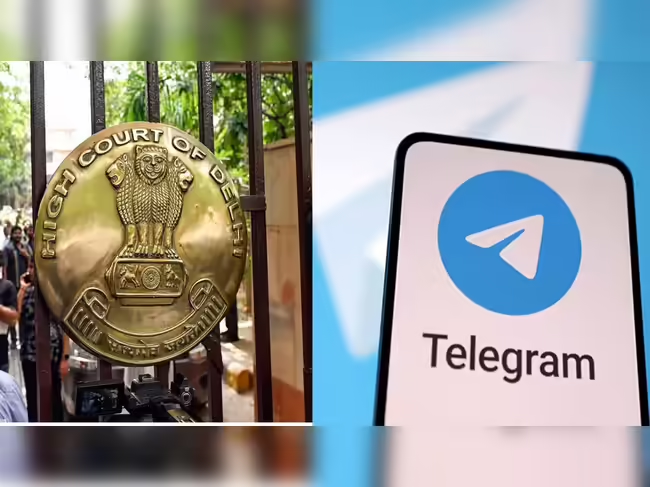
Telegram ban sparks record VPN rush in India as Delhi HC verdict looms today
The week-long suspension was ordered to curb exam-related fraud ahead of the NEET re-test. It has also triggered India's biggest VPN download day in over a year, and reopened the debate over how platform-level restrictions work in practice. The Delhi High Court delivers its verdict today.
4 Min Read


When the government temporarily suspended Telegram early this week, the order set off an unusually sharp consumer response: rather than logging off, many users moved to work around the block.
Within hours of the government announcing the block on Tuesday, VPN downloads surged across the country. App-intelligence firm Appfigures, which shared the data exclusively with TechCrunch, said it was the busiest day for VPN downloads in India since the start of 2025. Downloads of major VPN apps jumped 49% in a single day, from a recent daily average of around 139,000 to 208,000.
Proton VPN downloads on Apple's App Store surged 113%, while Turbo VPN climbed 85%. On Google Play, Proton rose 64% and Turbo VPN 35%. NordVPN gained 41% on the App Store, and ExpressVPN 31% on Google Play. The rush reshuffled the charts almost overnight, with Proton VPN climbing from 18th to fifth in Apple's Utilities category between June 16 and 18, and from eighth to second in Google Play's Tools section.
The early usage data points to the practical challenge of enforcing a platform-wide restriction. Sensor Tower data shows Telegram's daily active users in India actually rose 17% on the day the ban was announced, the app's biggest single-day jump in the country since a major Meta outage in 2021. Cloudflare separately recorded a sharp rise in DNS requests for Telegram domains, which it cautioned can reflect users repeatedly attempting to reach a blocked service rather than successful access.
India's Section 69A blocking regime relies on internet service providers implementing the order at their end, and access can be restored using a VPN. That dynamic is a known feature of online blocking globally, and it helps explain why a restriction can be announced quickly but take longer to fully bite.
The disruption also sent users toward Telegram's competitors. Appfigures said Signal downloads jumped 72% on the App Store and 322% on Google Play, while Viber rose 216%. Telegram-linked app iMe saw one of the steepest moves of all, surging from a daily average of about 827 Google Play downloads to nearly 50,900 on June 16.
The VPN providers themselves corroborated the wave. Proton said daily sign-ups from India ran 120% above baseline on Wednesday, after hourly registrations had already spiked 150% on Tuesday evening. Canada's Windscribe told TechCrunch its India sign-ups peaked roughly 100% above normal, with first-time iOS downloads up around 89%.
The more consequential question now sits with the Delhi High Court, which is due to deliver its verdict.
The restriction was imposed under Section 69A of the IT Act, in force until June 22, with Telegram also directed to disable its message-editing feature until June 30, after the National Testing Agency flagged channels circulating fake papers ahead of the NEET-UG re-exam being written by more than 22 lakh candidates.
The government has defended the measure as a temporary, event-linked step, with the Solicitor General arguing it bears a "logical nexus" to safeguarding the integrity of the re-test, a high-stakes national examination affected by paper-leak allegations.
Telegram has challenged the order as disproportionate, arguing that authorities could have blocked specific channels, bots, or content rather than the whole platform, and that it had already removed channels identified by the authorities. It told the court that more than 150 million Indian users, including businesses, educators and coaching institutes, rely on the service.
The bench, led by Justice Tejas Karia questioned the government how the rights of 150 million users could be restricted because one set of citizens was appearing for an examination, while also acknowledging the seriousness of the exam-fraud concerns the Centre has raised.
For India's digital economy, the stakes extend past a single app and a single exam. The ruling will help define how far the State's emergency blocking powers reach, and how the proportionality test applies when content-level abuse occurs on a platform with a very large legitimate user base, a question of growing relevance to the messaging, fintech and creator businesses that increasingly operate on these services.
Within hours of the government announcing the block on Tuesday, VPN downloads surged across the country. App-intelligence firm Appfigures, which shared the data exclusively with TechCrunch, said it was the busiest day for VPN downloads in India since the start of 2025. Downloads of major VPN apps jumped 49% in a single day, from a recent daily average of around 139,000 to 208,000.
The individual spikes were sharper still.
Proton VPN downloads on Apple's App Store surged 113%, while Turbo VPN climbed 85%. On Google Play, Proton rose 64% and Turbo VPN 35%. NordVPN gained 41% on the App Store, and ExpressVPN 31% on Google Play. The rush reshuffled the charts almost overnight, with Proton VPN climbing from 18th to fifth in Apple's Utilities category between June 16 and 18, and from eighth to second in Google Play's Tools section.
The early usage data points to the practical challenge of enforcing a platform-wide restriction. Sensor Tower data shows Telegram's daily active users in India actually rose 17% on the day the ban was announced, the app's biggest single-day jump in the country since a major Meta outage in 2021. Cloudflare separately recorded a sharp rise in DNS requests for Telegram domains, which it cautioned can reflect users repeatedly attempting to reach a blocked service rather than successful access.
India's Section 69A blocking regime relies on internet service providers implementing the order at their end, and access can be restored using a VPN. That dynamic is a known feature of online blocking globally, and it helps explain why a restriction can be announced quickly but take longer to fully bite.
The disruption also sent users toward Telegram's competitors. Appfigures said Signal downloads jumped 72% on the App Store and 322% on Google Play, while Viber rose 216%. Telegram-linked app iMe saw one of the steepest moves of all, surging from a daily average of about 827 Google Play downloads to nearly 50,900 on June 16.
The VPN providers themselves corroborated the wave. Proton said daily sign-ups from India ran 120% above baseline on Wednesday, after hourly registrations had already spiked 150% on Tuesday evening. Canada's Windscribe told TechCrunch its India sign-ups peaked roughly 100% above normal, with first-time iOS downloads up around 89%.
The more consequential question now sits with the Delhi High Court, which is due to deliver its verdict.
The restriction was imposed under Section 69A of the IT Act, in force until June 22, with Telegram also directed to disable its message-editing feature until June 30, after the National Testing Agency flagged channels circulating fake papers ahead of the NEET-UG re-exam being written by more than 22 lakh candidates.
The government has defended the measure as a temporary, event-linked step, with the Solicitor General arguing it bears a "logical nexus" to safeguarding the integrity of the re-test, a high-stakes national examination affected by paper-leak allegations.
Telegram has challenged the order as disproportionate, arguing that authorities could have blocked specific channels, bots, or content rather than the whole platform, and that it had already removed channels identified by the authorities. It told the court that more than 150 million Indian users, including businesses, educators and coaching institutes, rely on the service.
The bench, led by Justice Tejas Karia questioned the government how the rights of 150 million users could be restricted because one set of citizens was appearing for an examination, while also acknowledging the seriousness of the exam-fraud concerns the Centre has raised.
For India's digital economy, the stakes extend past a single app and a single exam. The ruling will help define how far the State's emergency blocking powers reach, and how the proportionality test applies when content-level abuse occurs on a platform with a very large legitimate user base, a question of growing relevance to the messaging, fintech and creator businesses that increasingly operate on these services.
(Edited by : Tenzin Norzom)
First Published: Jun 19, 2026 10:14 AM IST
Source link