
How Dollar Shave Club uses generative AI to unlock advertising creativity
Chief Brand and Innovation Officer Laura Higgins explains how the grooming brand is evolving its use of generative AI in marketing to increase speed, decrease costs and reassert its voice.



First published on

Dollar Shave Club put itself on the map in 2012 with a $4,000 YouTube video that notched millions of views and established the direct-to-consumer challenger’s irreverent voice. More than a decade later, the brand spent just $400 on an effort that became what the brand claims is the most successful campaign in its history.
The brand on July 1 launched “250 Years. No BS. Still Free,” an ad created by its in-house team using generative artificial intelligence technology that has been at the heart of its advertising efforts in recent months. Dollar Shave Club remains “all in” on using AI to speed up and cut the costs of its marketing, said Chief Brand and Innovation Officer Laura Higgins, who has overseen three ad roll-outs since she joined the company just two months ago.
“Never in any of the older, more traditional, more established companies that I've worked for would we have been able to do this, and I think AI has a lot to do with that,” Higgins said. “It allows the creatives to be creative, it allows the brand managers to be strategic and it takes that minutiae out of their job so that they can really be focused.”
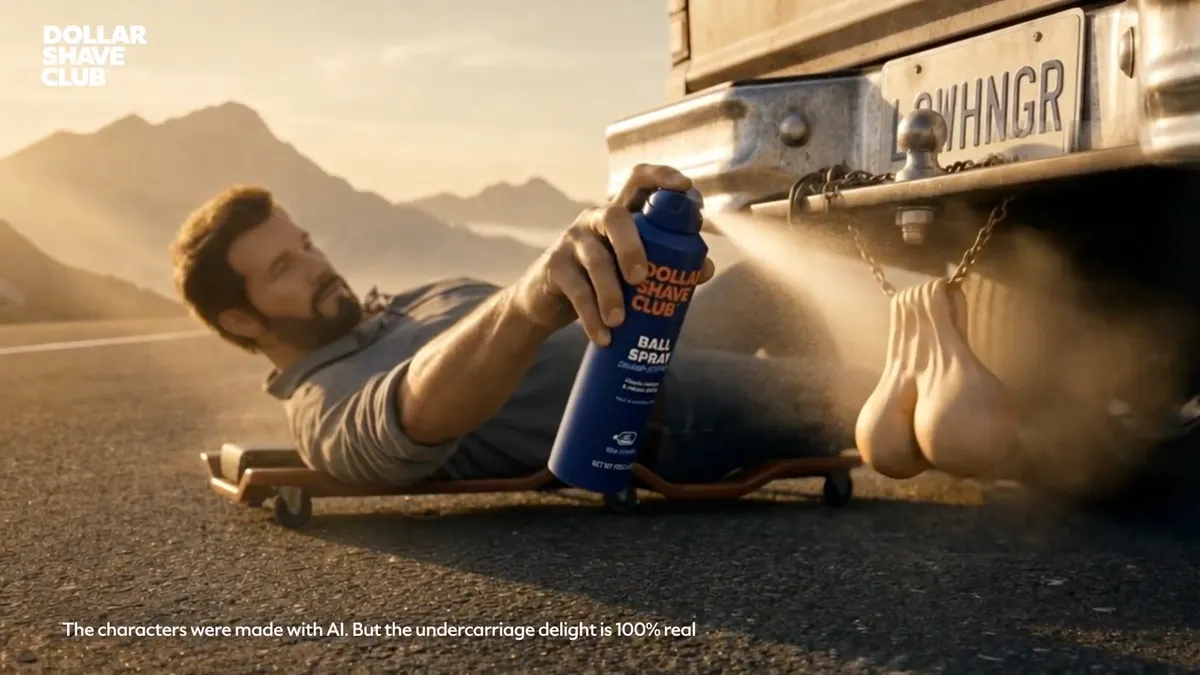
Dollar Shave Club on Tuesday is launching its latest AI-powered campaign in support of its viral Ball Spray product, which previously sold out during a soft launch of its DTC platform without any marketing, but has also faced production issues. “Danglers” includes a 15-second, AI-powered hero video that uses a pair of truck nuts as a stand-in for male anatomy in a variety of outsized scenarios.
“Every day, your danglers go through friction, sweat and grime, and before you know it, you're failing inspection again,” a man says in voiceover, as the truck is rebuffed in bed by a woman. Because of its over-the-top concept, it would not be possible to make the ad with the same speed and cost without AI, Higgins said.
“We have to be really cognizant when we use human actors,” the executive said. “AI enables us to take a cartoony look at things and bring them to life in a way that really lands and lets the consumer understand the joke.”
In addition to “Danglers,” the campaign includes a spot, “Size Matters,” that positions a travel-size bottle of Ball Spray as a lifestyle and fitness hack for things like gym shoes and sweaty clothes. The ad also continues the company’s efforts to recapture its original brand voice, one that was quashed during the years under Unilever ownership.
“We are the original troublemakers. We have to break through and be irreverent and different in order to break through the marketing clutter that is out there,” Higgins said.
AI changes brand, agency remits
Unlike its previous campaigns, “250 Years. No BS. Still Free” was created entirely in-house. Higgins briefed the ad and sent it to the in-house team, who spent three days using AI tools to concept it. The team used AI tools, including Higgsfield and Claude, to create other elements, and the campaign was basically complete a week later.
“We didn't remove the human component of the comedy, but we leveraged a tool to iterate quickly and bring it to life,” Higgins said of the process.
The speed and ease of an AI-powered campaign is evolving how Dollar Shave Club works with Too Short For Modeling, the shop that created some of the brand’s previous AI ads and initially briefed the “Danglers” work. Higgins expects Dollar Shave Club to continue leveraging the shop in the future, but probably not as much as before now that her team has proven what they can do in-house.
While the “Danglers” campaign has the racy, genitalia-centered humor used by Manscaped, the “250 Years” campaign is more in line with Dollar Shave Club’s early ads. The 30-second spot adds Dollar Shave Club — and competitors Gillette and Harry’s — to Revolutionary War paintings, connecting colonial outrage over taxes to modern-day wariness over hidden costs and unwanted extras.
“We had a $2.50 starter kit offer that definitely drew people in, but we actually saw them buying more than just the $2.50 starter kit. They were buying a lot more. So it was the [ad] concept, it was the price point, and then [consumers] came in,” Higgins said of the campaign’s success.
A return to that early brand voice, complete with competitive sparring, could help Dollar Shave Club reassert its brand in a crowded grooming market. While it started as a brand for men, Dollar Shave Club this year made its first push in the women’s grooming space, aiming its “no BS” messaging at a different audience. Along with a brand-level platform campaign that pulls all of its products together due around October, Dollar Shave Club plans to continue innovating.
“As we can continue to grow, what are those products that we just need to call bullshit on again? There are so many products flooding the market right now that are just getting absurd,” Higgins said. “How many sparkly-handled razors do you need?”
Recommended Reading


Source link