

- Consumer Durables and Information Technology
- 3 min read
Price hikes keep budget phone, TV buyers away
Entry-level smartphone and television sales have declined for the first time in over a decade. Successive price increases, driven by memory chip costs, are deterring first-time buyers. Mid-range and premium device demand continues to grow at a faster pace than last year. This shift has prompted companies to reduce their model portfolios across categories. Some manufacturers are re-entering the non-smart TV market to offer lower prices.




Demand for mid-range and premium handsets in contrast is continuing to grow at a faster pace than last year as memory chips make up a smaller share of their production costs, limiting price increases. The prolonged weakness in the entry segment has also prompted companies to prune model portfolios.
According to market researcher Counterpoint Research, smartphone sales in the sub-₹12,000 segment plunged 54% year-on-year during January-May. This compares with a 17% expansion in the ₹12,000-30,000 segment and 6% growth in the premium category priced at more than ₹30,000.
Consequently, the entry-level segment's share of total smartphone sales halved to 14%.
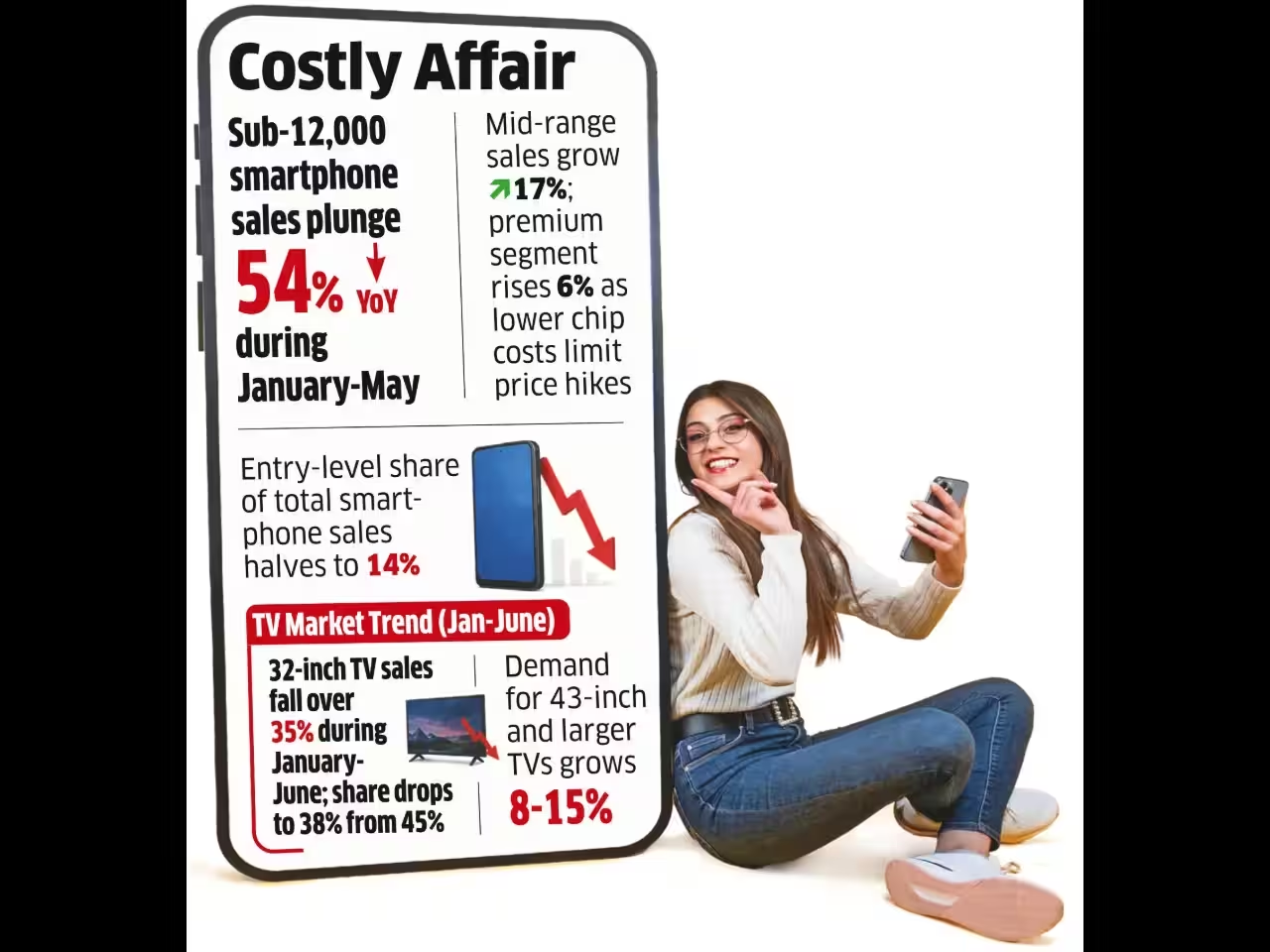
Growth in the mid-range and premium segments accelerated from last year, according to Counterpoint.
The television market is seeing a similar transition. Sales of 32-inch televisions slipped more than 35% during January-June, reducing their share of total TV sales to 38% from 45% a year earlier. In contrast, demand for 43-inch and larger televisions increased 8-15%, according to industry executives citing market tracker data.
"The share of memory chips in the production cost is the highest in 32-inch televisions, followed by 43-inch models, and progressively declines in larger screens such as 55 inches and above," said Pankaj Rana, chief executive at Hisense India. "As a result, price hikes have been relatively modest in larger-screen TVs, allowing demand to remain resilient."
TV prices have gone up by ₹3,000-3,500 on average for 32-inch models and by ₹3,000-5,000 for 43-inch sets. For 50-55-inch models, the increase has been around ₹5,000-₹6,000. Rana said brands have largely absorbed higher costs in the 65-100-inch segment, resulting in little or no price increase.
Memory chip prices have surged two to three times since November-December. A weaker rupee further inflated the cost of imported components.
The number of entry-level smartphone models available in the market declined 17% year-on-year to 71 during January-May, said Prachir Singh, senior research analyst at Counterpoint.
"Consumers are shifting to higher price bands because price increases there have been relatively lower than in the entry segment," said Singh. "Easier affordability through EMI schemes is also driving the shift."
Vijay Sales director Nilesh Gupta said the entry-level segment is shrinking sharply, even in laptops. Models that were earlier available at around ₹35,000 are now selling closer to ₹50,000, while very few smartphones are available below ₹20,000. He estimated entry-level unit sales for the retail chain across categories have declined 7-9% year-on-year.
The pressure on affordability has even prompted some TV makers to re-enter the non-smart TV segment, which they had largely exited four to five years ago. Since non-smart televisions don't require memory chips, they can be priced significantly lower to attract first-time buyers.
"It has been such a difficult year that we are once again foraying into non-smart TVs in 32, 40, and 43-inch sizes," said Avneet Singh Marwah, CEO at Super Plastronics, which sells TVs under the Kodak, Thomson and Blaupunkt brands. "This will bring the price of a 32-inch television below ₹8,000 again."

Source link



Comments
All Comments
By commenting, you agree to the Prohibited Content Policy
PostBy commenting, you agree to the Prohibited Content Policy
PostFind this Comment Offensive?
Choose your reason below and click on the submit button. This will alert our moderators to take actions