- Exclusive
- Auto Components
- 4 min read
AIS cuts import dependence with float glass plant, bets ₹2,700 crore on auto growth
AIS has commissioned a ₹1,400-crore automotive float glass plant in Rajasthan to localise raw material production and reduce import dependence. In an exclusive interaction with ETAuto, Amit Sood outlines the company's expansion roadmap, ₹2,700-crore investment push, and confidence in India's long-term automotive growth.



Highlights
- AIS has invested ₹2,700 crore in its automotive business over the last five years, including a ₹1,400-crore dedicated float glass plant in Rajasthan.
- The new facility now meets nearly 60 per cent of AIS' automotive float glass requirement, significantly reducing import dependence.
- The company expects India's passenger vehicle market to reach 6–7 million units by 2030, driven by premiumisation, localisation and global sourcing opportunities.
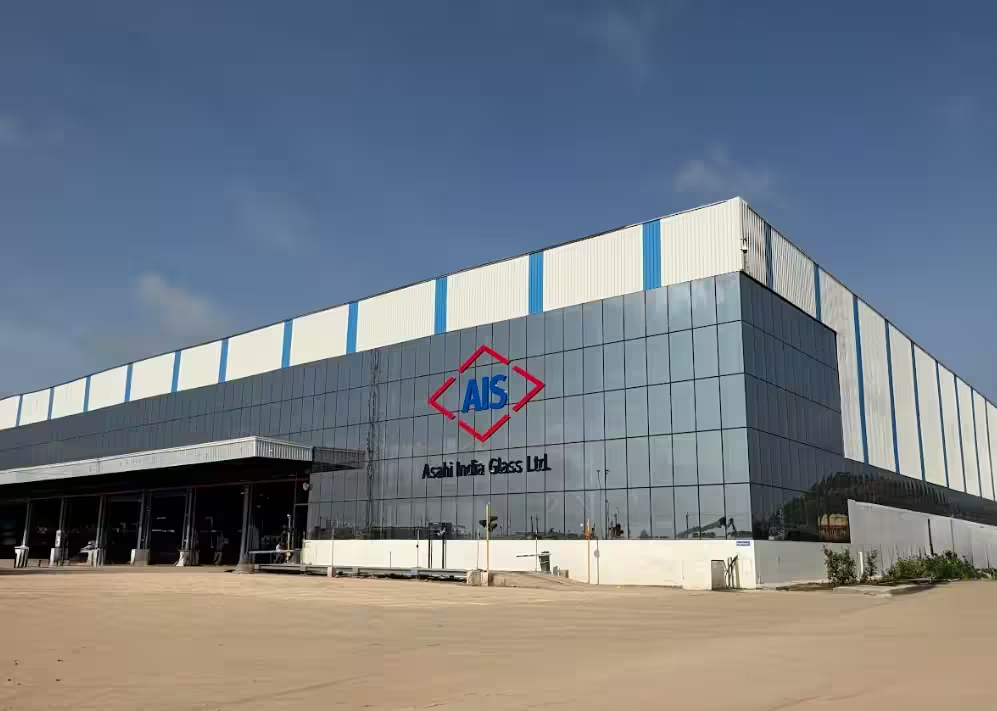
The company's biggest strategic move has been the commissioning of a dedicated automotive float glass facility at Soniyana in Rajasthan, which now supplies nearly 60 per cent of the raw glass required for AIS' automotive operations.
While the plant became operational late last year, its impact is now beginning to reshape the company's supply chain strategy, positioning AIS to cater to growing vehicle production while improving supply security for automakers.
"The objective was not just localisation, but deep localisation," Amit Sood, Senior Executive Director, Sales & Marketing, AIS, told ETAuto. "Today, right from sand and soda ash to the manufacturing process, everything is local. We have built self-reliance into our supply chain," he said.
Until recently, AIS relied heavily on imports of automotive-grade float glass from its parent and technology partner Asahi Glass Corporation's facilities in Thailand and Indonesia. Although the company already operated float glass plants in India, those facilities were primarily geared towards architectural applications rather than automotive-grade production.
However, the Rajasthan facility, dedicated for the automotive business, has changed the context.
Located strategically between AIS' automotive glass plants at Bawal in Haryana and Patan in Gujarat, the dedicated float glass line has a rated capacity of around 700 tonnes per day and feeds the company's two largest automotive manufacturing hubs.
"Our automotive business has now reached a global scale," Sood said. "Today we have the capacity to produce nearly 8.9 million laminated windshields and around 7.6 million tempered car glass sets annually. At this scale, relying entirely on imported raw material was no longer a sustainable strategy."
The new facility currently meets about 60 per cent of AIS' total automotive float glass requirement, while the balance continues to be sourced from overseas suppliers to maintain supply flexibility and OEM approvals.
Localisation over pure cost economics
Interestingly, the localisation decision was not driven by lower manufacturing costs. According to Sood, producing float glass in India remains relatively expensive because of high energy costs. Natural gas, the primary fuel used in float glass manufacturing, costs more than twice as much in India compared with Indonesia, while capital costs are also higher.
Despite this cost disadvantage, AIS believes the strategic benefits outweigh the economics.
"The industry has moved beyond just-in-time manufacturing," Sood said. "You need resilience in the supply chain. Whether it is container shortages or geopolitical disruptions, we now have the confidence to assure our customers because we have our own in-house capability."
The localisation initiative also helps vehicle manufacturers improve domestic value addition (DVA) - an increasingly important consideration under government incentive schemes and localisation requirements for electric vehicles.
The company’s localisation push is part of a much larger investment programme.
AIS has invested around ₹2,700 crore in its automotive business between FY22 and FY26, covering both greenfield and brownfield projects. While the Soniyana float glass plant accounted for roughly ₹1,400 crore, the remaining investments have gone towards expanding processing capacity across existing facilities.
The company plans to increase laminated windshield capacity from the current 8.9 million units to 10.5 million units by FY31, while tempered glass production continues to be ramped up through phased expansions at its Patan plant.
"We have compressed investments that perhaps would have happened over 20-25 years into a five-year period," Sood said. "Going forward, we already have approved plans for additional capacity, although the timing will depend on market growth."
AIS is also pursuing localisation beyond raw materials. Much of the glass processing equipment used in its manufacturing facilities is designed and fabricated in-house through its engineering and R&D teams, reducing capital costs while improving manufacturing flexibility.
Technology to drive value growth
Beyond higher vehicle production, AIS expects the increasing adoption of premium glazing technologies to become another major growth driver.The company already supplies acoustic laminated side glass for Mahindra's latest electric SUVs and has developed capabilities for augmented reality head-up display (AR-HUD) windshields, with supplies expanding to multiple vehicle manufacturers.
Solar-control glass, UV-cut windshields and advanced glazing solutions designed to improve cabin comfort and electric vehicle efficiency are also expected to see wider adoption as OEMs focus on premiumisation and tighter fuel-efficiency norms.
"It is no longer just about volume growth," Sood said. "The value of glass is increasing with every new generation of vehicles."
Betting on Auto Inc’s potential
AIS remains optimistic about the long-term trajectory of India's passenger vehicle market, despite near-term macroeconomic uncertainties.Sood expects the industry to sustain a 6-8 per cent CAGR, taking annual passenger vehicle sales to around 6-7 million units by 2030. New OEM investments, a wider choice of powertrains and increasing technology adoption are expected to underpin that growth.
The company also sees opportunities emerging from global sourcing as international automakers diversify supply chains beyond China.
"India's automotive ecosystem is becoming globally competitive," Sood said. "There is a significant opportunity not only to serve domestic demand but also to become a sourcing hub for global OEMs. That opportunity is still evolving and isn't fully reflected in our current investment roadmap."

Source link