- Exclusive
- Auto Components
- 4 min read
No eviction, only show-cause notice to Rajesh Exports in PLI battery scheme
The MoHI is preparing to issue a show-cause notice to ACC Energy Storage in the next few days. The decision against evicting ACC Energy Storage came after the ministry sought legal opinion on the feasibility of evicting a beneficiary which has bagged its place after a global bidding process.



Highlights
- The Ministry of Heavy Industries will issue a show-cause notice to Rajesh Exports' ACC Energy Storage for missing PLI deadlines but has decided against evicting it from the ₹18,100 crore ACC battery PLI scheme.
- India's ACC battery PLI scheme has achieved only 1.4 GWh of installed capacity out of the 40 GWh awarded, with most beneficiaries missing the January 2025 production deadline.
- The government is considering extending production timelines under the ACC PLI scheme and is preparing a new ₹12,000 crore incentive programme to boost domestic battery component manufacturing and reduce dependence on China.
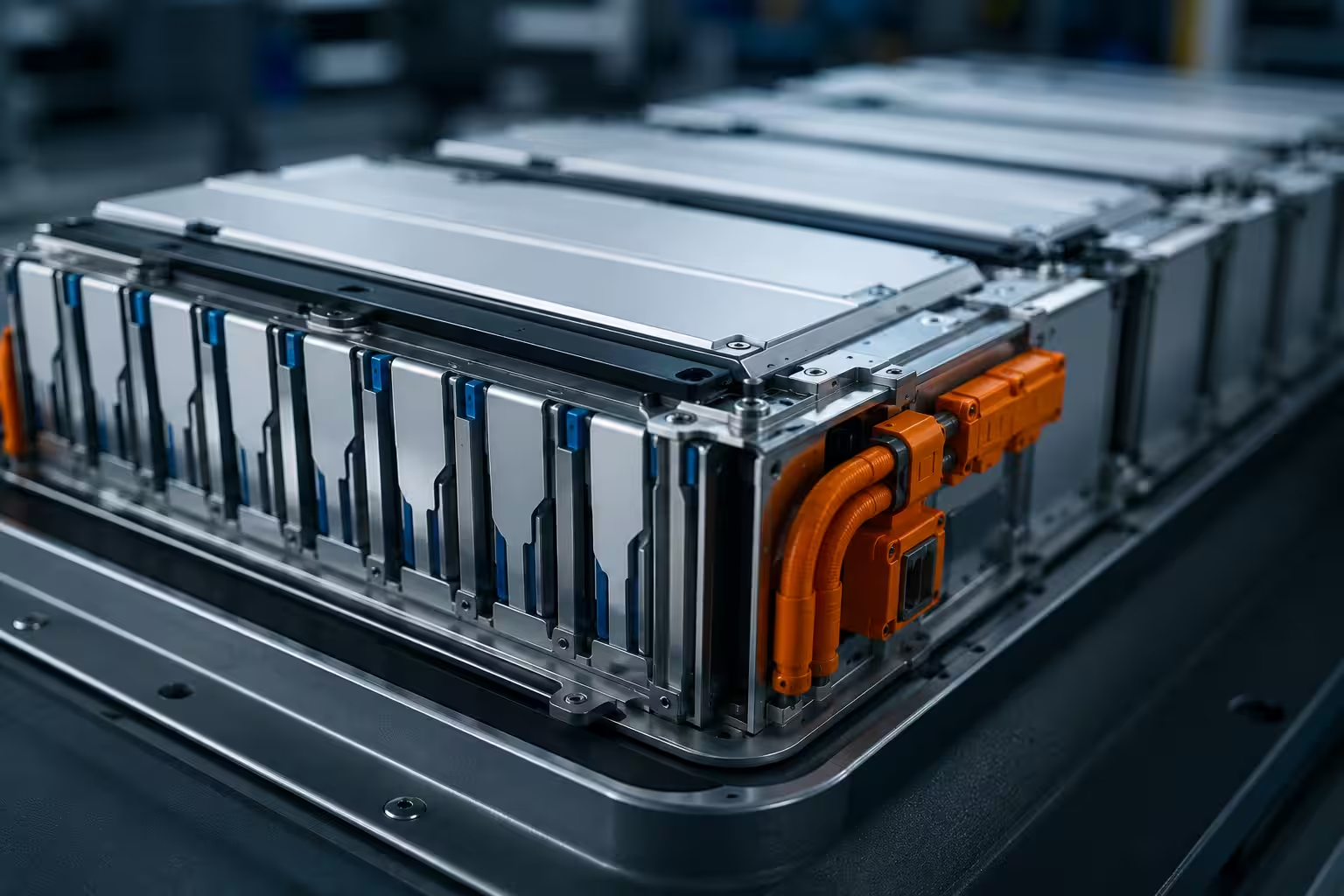
India’s ambition of achieving self-reliance in advanced green energy storage is facing severe headwinds. The flagship ₹18,100 crore Production Linked Incentive (PLI) scheme for Advanced Chemistry Cell (ACC) battery manufacturing continues to face multi-party delays, with most beneficiaries missing critical installation deadlines and one (Rajesh Exports) finding itself embroiled in a probe by markets regulator SEBI.
Now, the Ministry of Heavy Industries is preparing to issue a show-cause notice to ACC Energy Storage Pvt Ltd (a special purpose vehicle of Rajesh Exports, the beneficiary under the scheme) – for non-compliance of capacity installation deadlines. But contrary to earlier indications, the ministry has no plans to evict ACC Energy Storage from the scheme (which was awarded 5 GwH capacity).
The show-cause notice will be issued to the company in the next few days. The decision against evicting ACC Energy Storage came after the ministry sought legal opinion on the feasibility of evicting a beneficiary which has bagged its place after a global bidding process. “Besides, the parent firm of ACC Energy Storage has been indicted only in an interim, not final report by SEBI,” the source said.
Under the rigid terms of the Programme Agreement for the PLI scheme, the government can evict a player for material misrepresentation or fraud if the initial allocation was secured using falsified financial data or hidden regulatory actions. However, acting prematurely on an interim regulatory finding opens the ministry up to intense litigation.
In the order, SEBI has alleged that the SPV (ACC Energy Storage) was used for non-transparent related-party transactions and circular fund routing, citing a same-day round-tripping of ₹147 crore through Elest, another promoter-owned entity. Rajesh Exports has vehemently denied any wrongdoing.
Even outside the case of this single beneficiary, the scheme continues to flounder.
The ministry should undertake an immediate beneficiary-wise review and consider granting a one-time conditional extension of timelines linked to clear milestones where delays are attributable to genuine systemic constraintsParliamentary Standing Committee
The scheme
The PLI scheme initially envisaged creation of 50 GWh domestic Advanced Chemistry Cell manufacturing capacity, of which bids have been concluded for 40 GwH. The government has now also launched a fresh global tender for setting up the remaining 10 GwH capacity but this is earmarked for Grid-Scale Stationary Storage applications only.
The source quoted earlier said existing beneficiaries can also participate in the fresh bidding process except Ola Electric, which has already been awarded the maximum 20 GwH capacity in the earlier rounds.
The PLI ACC Scheme was launched to reduce India’s dependence on imported ACCs by strengthening domestic manufacturing capabilities and incentivising large domestic and international players to establish a globally competitive ACC battery-manufacturing ecosystem in the country.
However, at present, the domestic demand continues to be met largely through imports.
Also, only about 1.4 GWh battery capacity has been installed of the 40 GwH awarded earlier.
A parliamentary panel said in March this year that the ministry should undertake an immediate beneficiary‑wise review and consider granting a one‑time conditional extension of timelines linked to clear milestones where delays are attributable to genuine systemic constraints, with provision for reallocation of unutilised capacities in persistent non‑performing cases.
The 40 GWh capacity was bid out across three key players—Ola Electric, Reliance Industries (via two separate Special Purpose Vehicles), and ACC Energy Storage (Rajesh Exports). The target for starting production was January 1, 2025. As on date, only 1.4 GwH capacity has been installed by a single beneficiary (Ola) and production of just 40,000 cells per month is ongoing. By December this year, Ola is expected to install a total 6 GwH battery capacity while Reliance Industries is expected to “also come on stream” by that time.
EGoM to decide deadline extension
The source quoted earlier said that a meeting of the Empowered Group of Ministers (EGoM) is likely this month, where the Ministry of Heavy Industries would seek extension of the deadline for beneficiaries of the scheme to begin production. What about the built-in penalty programme for breaching the production deadline? Not a rupee has been realised so far.
“We have been sending penalty notices every quarter. The penalties are 0.1 per cent of each beneficiary’s performance bank guarantee per day after the January 1, 2025 deadline. They come to a substantial amount. But the penalties have not been realised, since the request by beneficiaries for timeline extension are pending,” the source said.
A primary reason for this sluggish rollout is a deep supply-chain bottleneck, as structural dependencies have severely disrupted local execution timelines. “The beneficiaries under this PLI scheme have been 100 per cent dependent on China for technology, capital goods, raw materials like Lithium…but China’s embargos in the recent past have made things difficult,” he said.
Component pivot
Recognising that cell manufacturing cannot succeed in a domestic vacuum, the government is drafting a brand-new incentive programme to cut foreign dependency. The proposed ₹12,000 crore scheme for battery components is currently at the inter-ministerial consultation stage.
It aims to subsidise local production of critical raw material building blocks, including cathode active materials, anode active materials and copper foil separators. This scheme is intended to support advanced battery cell manufacturing and ease the raw-material strain for ACC PLI players.

Source link