Chery’s emerging brands signal a late-2026 Canada debut as tariff changes improve the case for imported EVs
Chery’s Omoda and Jaecoo brands have confirmed a Canada launch for late 2026 through a new Canadian website, marking the clearest sign yet that the Chinese automaker is preparing a formal North American market entry.
The Canada launch matters because a January policy change cut Canada’s tariff on qualifying Chinese electrified vehicles to 6.1% within a quota, down from a 100% surtax outside that quota, creating an opening for plug-in hybrids as well as battery EVs.
Chery has not named Canadian models or prices, but its current Omoda and Jaecoo lineup includes the Jaecoo E5 EV, the Omoda E5 EV, and several plug-in hybrids such as the Jaecoo 7 SHS-P and Omoda 9 SHS-P sold in markets including the UK, Australia, and Indonesia.
The move adds to pressure on incumbent automakers in Canada, with BYD also targeting a late 2026 Canadian start and Tesla already selling a Shanghai-built Model 3 there under the quota at C$39,490.
Chery’s Omoda and Jaecoo brands say they’re coming to Canada in late 2026. The teaser site is thin on details, but the timing lines up with a new import regime that lets qualifying Chinese electrified vehicles enter at a 6.1% tariff within quota.
Omoda & Jaecoo confirm Canada launch, and the bigger story is that the company appears set to use Canada’s revised tariff structure to bring in a mix of EVs and plug-in hybrids, not just battery-electric models.
The new Canadian website is mostly a sign-up page. It tells visitors the brands are “coming late 2026,” says the company is building a retail network across Canada, and leaves the dealer locator empty for now. The fine print is the more revealing part: vehicles shown are intended for other markets, and some may not be available in Canada.
That caveat matters because Chery still hasn’t publicly committed to a specific Canadian lineup. But the company’s global portfolio gives a strong read on what it could offer. In markets including the UK, Australia, and Indonesia, Omoda and Jaecoo lean heavily on plug-in hybrids alongside a smaller battery EV range. For Canada, that mix is more than a product decision. It is also tied to trade policy.
Back in January, Canada reduced its tariff on qualifying Chinese EVs to 6.1% within a quota, while vehicles outside the quota still face a 100% surtax. The policy covers up to 49,000 Chinese-made electrified vehicles per year at the lower rate, rising to 70,000 by 2030. Crucially for Chery, that quota includes plug-in hybrids and hybrids. That expands the market beyond pure EVs.
The likely lead product is the Jaecoo E5, also called the J5 EV in some markets. Chery was previously spotted testing Jaecoo E5 prototypes in Ontario on manufacturer plates, and the model is a compact electric SUV with a 60.9 kWh battery, a 155 kW front motor, and 248 miles (399 km) of WLTP range. It starts at £27,505 in the UK and A$36,990 driveaway in Australia.
Still, the spec sheet also shows where these vehicles could run into trouble with more informed buyers. Jaecoo UK lists the E5 at an 80 kW DC charging peak, with 30% to 80% in 27 minutes.
The Omoda E5 follows a similar formula: a 61 kWh battery, a 155 kW motor, and 267 miles (430 km) of WLTP range, with 30% to 80% charging in 28 minutes. UK pricing starts at £33,065. Another candidate is the Omoda 4, a newer EV that launched in Indonesia in July with a 65.05 kWh LFP battery, a 160 kW motor, 553 km of range on the NEDC cycle, and a 119 kW DC charging peak with 20% to 80% in 22 minutes. Pricing for that model hasn’t been published.
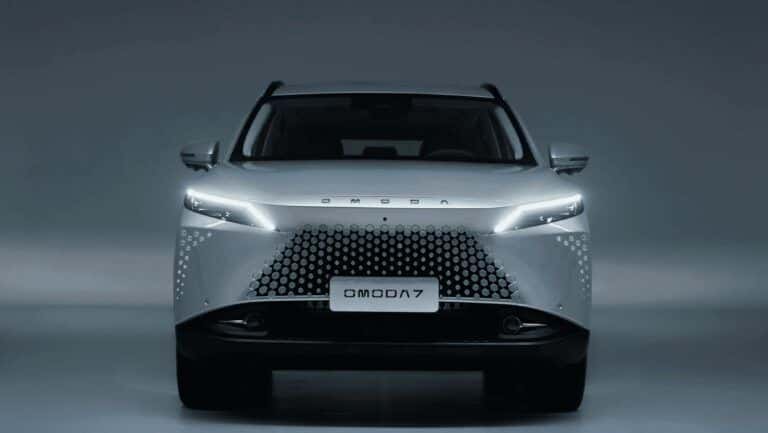
Where Chery looks more distinctive is in plug-in hybrids. The Jaecoo 7 SHS-P pairs a 1.5-liter turbo engine with an 18.3 kWh battery for 56 miles (90 km) of WLTP electric range and 150 kW (204 PS) of power. It starts at £35,170 in the UK, and Australia also gets an AWD version with a second rear motor. The Omoda 7 SHS-P sits just below it with the same 150 kW (204 PS) output, 56 miles (90 km) of electric range, and a £32,005 UK starting price.
At the top end, Chery already has larger electrified SUVs. The Jaecoo 8 SHS-P is a three-row PHEV with six- or seven-seat layouts, three motors, AWD, and a 34.46 kWh battery rated for 83 miles (134 km) of WLTP electric range. It produces 315 kW (428 PS), does 0 to 100 km/h in 5.8 seconds, and starts at £45,500 in the UK. The Omoda 9 SHS-P uses that same 34.46 kWh battery, is rated at 90 miles (145 km) of WLTP electric range, makes 449 PS and 700 Nm from an AWD setup, reaches 0 to 100 km/h in 4.9 seconds, and starts at £44,995.
For US readers, the immediate significance is less about Canada alone and more about what Canada is becoming: a market where Chinese brands can expand while remaining largely shut out of the US passenger-vehicle market. The source material does not support a backdoor US entry claim. But it does show how Chinese automakers are using adjacent markets, trade carve-outs, and electrified SUV formats to build brand awareness close to the US border while Washington keeps a harder line.
That pressure is already building. BYD plans to open 20 Canadian dealerships in its first year and is also targeting a late 2026 start. Tesla, meanwhile, is already using the quota to sell a Shanghai-built Model 3 in Canada at a record-low C$39,490. Those are very different companies with very different regulatory exposure, but together they point to the same shift: Canada is turning into a more contested market for lower-cost electrified vehicles.
Chery says Omoda and Jaecoo have been sold in more than 75 countries and that the company has exported over 1.2 million vehicles in about three years. The UK number is also notable. Omoda and Jaecoo said they registered 6,238 vehicles in August for a 6.62% market share there.
What it means for North American EV competition
The Canadian launch also highlights that policy debates often center on battery EVs only, while the actual product mix is broader. Chery’s lineup shows that Chinese automakers are also exporting crossovers, three-row family SUVs, and plug-in hybrids with substantial electric range.
That matters for North American competition as much as for Canada. Tariffs do not solve product gaps. If consumers in nearby markets respond to relatively affordable electrified SUVs, whether those are BEVs or PHEVs, that becomes a competitive signal. It also raises the odds that more Chinese brands will use Canada, the UK, Australia, and parts of Europe as proving grounds while waiting for regulatory openings elsewhere.
Chery has been laying the groundwork. In May, it filed Canadian trademarks for Omoda, Jaecoo, and several sub-brands. The empty retailer map on the current site suggests the company is still assembling distribution. That is often where foreign launches can slow down after teaser pages go live.
What's next
The next concrete trigger is retailer and model disclosure ahead of the late 2026 launch window. The open questions are basic but important: which vehicles Chery will actually certify for Canada, whether the company leans on the Jaecoo E5 as the first battery EV, and how much of the initial push centers on plug-in hybrids such as the Jaecoo 7 SHS-P and Omoda 7 SHS-P. If BYD and Tesla keep sharpening price expectations in the meantime, Chery’s margin for error on specs, charging, and dealer execution will get tighter fast.
Frequently asked questions
When will Omoda and Jaecoo launch in Canada?
Omoda and Jaecoo have indicated a Canada launch in late 2026 through a new Canadian website. That is the clearest public sign yet that Chery is preparing a formal entry into the Canadian market.
What does the Omoda & Jaecoo confirm Canada launch update actually mean?
It means Chery’s two export-focused brands are moving beyond speculation and signaling a real market plan for Canada. For shoppers and industry watchers, it suggests model rollouts, dealer planning, and regulatory preparation are likely underway.
Which EVs could Omoda and Jaecoo bring to Canada first?
The likely focus is on electrified crossovers and SUVs, since both brands have emphasized EV and plug-in hybrid models in other markets. Final Canadian lineup details have not been confirmed, but SUVs are the most probable starting point.
Why is Canada important for Omoda and Jaecoo instead of the US first?
Canada currently offers a more workable path because a January policy change lowered tariffs on qualifying Chinese electrified vehicles within a quota. That makes Canada a more practical first North American beachhead than the US for these brands.
How do Canada’s EV tariff changes affect Chery’s Omoda and Jaecoo plans?
The policy shift reduced Canada’s tariff on qualifying Chinese electrified vehicles to 6.1% within a quota, compared with a much higher rate outside that framework. Lower import costs can materially improve pricing and make a late-2026 launch more viable.
Is this the start of a broader North American expansion for Chery?
It could be, because Canada often serves as a lower-risk entry point for automakers testing North American demand and compliance requirements. While no full regional rollout has been confirmed, the Canada move is the strongest indication yet of broader ambitions.