Spy photos show Porsche’s upcoming electric roadster using a Tesla NACS plug at a California charging site.
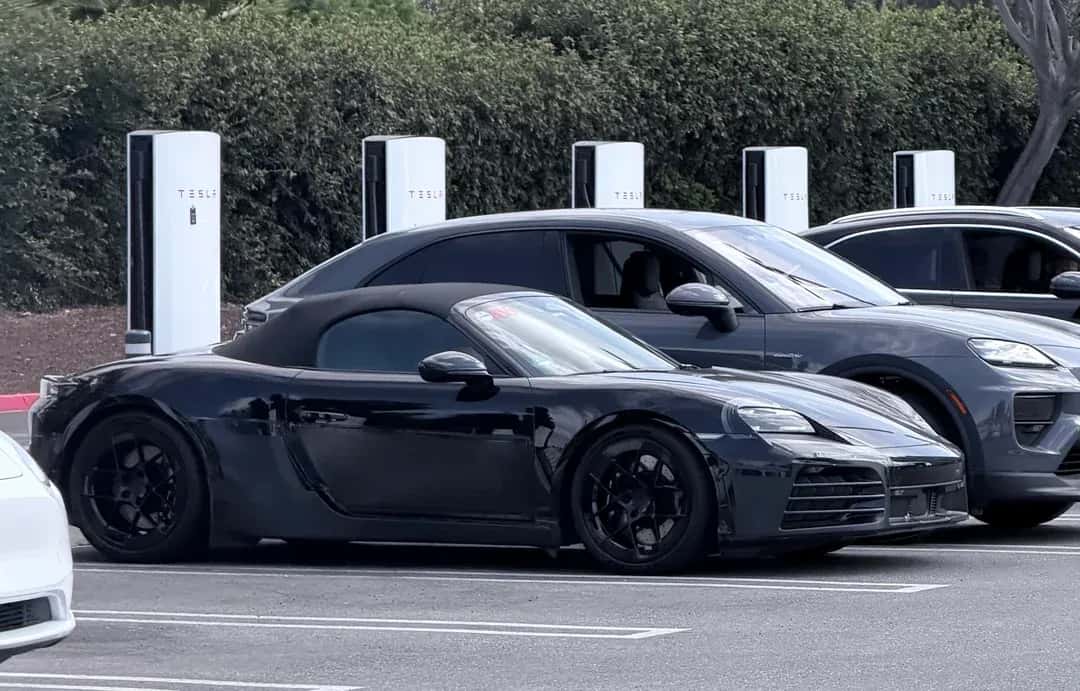
Porsche’s upcoming electric Boxster was photographed charging at a Tesla Supercharger in Carson, California, on September 22, 2026, a sign the company is testing Tesla’s network ahead of the sports car’s expected launch.
The prototype appeared to plug directly into Tesla’s NACS connector without an adapter, based on photos shared from the site, which matters because Porsche’s current EVs typically use a two-port setup with separate charging inlets.
Porsche North America did not announce timing or sales plans for the model and said the vehicle remains under consideration, even as Porsche CEO Michael Leiters said in August that the company will build the electric 718 because it is the best economic solution and should be a strong product.
The sighting adds to a string of recent public tests of the electric 718 Boxster, including a mostly uncamouflaged Nürburgring lap earlier in September, suggesting Porsche’s long-delayed EV sports car is moving closer to production.
Porsche’s electric Boxster has been spotted plugged into a Tesla Supercharger in Southern California. The sighting is notable less for the camouflage and more for the charging hardware: the prototype appears to be using Tesla’s NACS connector directly.
Porsche’s upcoming electric 718 Boxster was photographed at a Tesla Supercharger in Carson, California, adding a new clue about the car’s charging setup and launch progress at a moment when Porsche is still publicly cagey about the model’s timing. For U.S. buyers, the bigger signal is practical: if the production car ships with native NACS, Porsche’s next EV sports car could arrive better aligned with the charging standard that is quickly becoming more common in the American market.
The photos show the soft-top roadster prototype at a Supercharger site near the DoubleTree hotel in Carson, not far from the Porsche Experience Center Los Angeles. According to the images shared online, the charge port sits in the rear center of the vehicle, and the cable appears to connect straight into the car without an adapter. That matters because Porsche’s existing EV approach has been more complicated. Current Porsche EVs typically have two charging ports, with a NACS connector for DC fast charging on one side and a J1772 connector for AC Level 2 charging on the other.
If this prototype reflects production intent, Porsche may be simplifying that strategy. A single rear-mounted inlet could mean the automaker is moving to a one-port NACS setup for both AC and DC charging, at least on the smaller 718 sports cars. That would reduce hardware complexity and remove one of the little annoyances that luxury EV buyers still notice, namely having to remember which side and which port handles which kind of charging.
There is another clue here that goes beyond connector geometry. Porsche EVs have been able to access Tesla Superchargers since last September via adapter support, and Porsche has already been adding NACS ports on newer refreshes, including the 2027 Taycan update referenced in prior coverage. So a Porsche using Tesla’s network is not, by itself, a shock. What stands out is that this appears to be a preproduction Boxster doing live validation on a U.S. Tesla site, likely to make sure the software, charging handshake, port placement and thermal behavior all work in the real world, not just in a lab.
The location makes that look even more deliberate. The Supercharger is down the street from Porsche’s own Los Angeles experience center, where the company already has AC and DC chargers available. Testing at Tesla’s site instead suggests Porsche specifically wanted to validate Supercharger compatibility. The source material also noted that two Porsche employees were inside the car, which points to an engineering test rather than an owner simply topping off a battery.
2025
Porsche previously said the gas-powered 718 Boxster and Cayman would go out of production in 2025, setting up the electric replacement as a high-stakes next act.
That next act has had a messy prelaunch. Porsche has spent the past few years pushing EVs higher up its lineup with the Taycan, electric Macan variants and increasingly powerful electric performance models. The company’s most powerful Porsche ever is now electric, according to prior reporting cited in the source. Yet the 718 line has remained one of the emotional core products for the brand, and one of the toughest to electrify without alienating loyalists who care about weight, sound and balance more than charging curves.
Then came the wobble. As Western automakers pulled back from some EV ambitions and China kept pushing harder, rumors swirled that the electric 718 could be delayed or even shelved. Porsche’s new CEO, Michael Leiters, moved to tamp that down in August, saying in an interview that the company would build the model because it was the best solution economically and would be a fantastic car. That is a useful quote because it frames the decision less as brand theater and more as hard math. Sports cars are halo products, but they still need a business case.
The sighting in California also connects to a recent pattern. Earlier this month, the electric Boxster was seen doing a mostly uncamouflaged lap at the Nürburgring, offering one of the clearest looks yet at the exterior. Now there is a U.S. charging-network test in public. Put those together and the development program looks less like a science project and more like a product that is entering the dull but necessary final miles: fit and finish tweaks, charging validation, software checks and real-world systems testing.
Why the charging detail matters in the U.S.
For American buyers, native NACS support is no longer a side note. It is becoming an expected feature, especially for premium EVs that need to justify a premium price with less hassle than the mass market. Tesla’s network still has the broadest recognition and, in many corridors, the most dependable experience. A Porsche sports EV that can back directly into a Supercharger and plug in without an adapter is simply easier to sell in the U.S. than one that asks drivers to think through compatibility caveats or port-specific workarounds.
Porsche’s prior charging setup made sense during the market’s transitional phase, but it also reflected an in-between moment. The Boxster prototype suggests the company may be ready to stop straddling standards on at least some vehicles. That would put Porsche more in line with where the U.S. market is heading, and with what buyers now expect after a wave of automakers adopted Tesla’s connector strategy. It also hints that Porsche is willing to rethink design orthodoxy. Two charging ports sounded premium on paper. One port that works almost everywhere may be the more premium answer in practice.
There is a brand implication, too. Porsche has been careful not to rush its most iconic sports-car formats into electrification before it could deliver something that still feels like a Porsche. The company clearly knows the scrutiny here is different from what it faced with the Taycan or electric SUVs. A mid-engine sports car replacement that charges seamlessly on the most visible fast-charging network in America removes at least one source of buyer friction. It doesn’t solve the emotional debate over electric roadsters, but it does narrow the practical objections.
Porsche North America, for its part, stayed disciplined. The company did not provide anything new on timing, production or market availability, and the official line remains that the model is still under consideration. That is standard prelaunch language, and in this case probably not worth overreading. Carmakers deny all kinds of things right up until they are ready to present them. What matters more is what the prototype is doing. Plugging into Tesla hardware in California is harder to dismiss than another vague assurance that a program remains alive.
What's next
The next hard signal will be an actual product announcement, not another spy shot. In the meantime, Porsche’s recent sequence of public testing, from the Nürburgring run earlier in September to this September 22 Supercharger stop in Carson, suggests the electric 718 is getting closer to that point. The open questions are now narrower: whether the production car keeps the single rear NACS inlet seen here, and when Porsche stops saying the model is merely under consideration and starts taking orders.
Frequently asked questions
Was the electric Porsche Boxster really seen charging at a Tesla Supercharger?
Yes. Photos shared from Carson, California, show a Porsche electric Boxster prototype plugged into a Tesla Supercharger on September 22, 2026. The sighting strongly suggests Porsche is testing Tesla’s charging network ahead of the model’s expected launch.
Did the Porsche Boxster EV use Tesla’s NACS plug without an adapter?
Based on the published photos, the prototype appears to connect directly to Tesla’s NACS connector rather than using an external adapter. If confirmed, that would be notable because Porsche’s current EV lineup has generally used CCS hardware in the US.
Why does it matter that Porsche’s electric Boxster was charging at a Tesla Supercharger?
It matters because access to Tesla’s network can improve fast-charging convenience and broaden charging options for future Porsche EV owners. It also signals Porsche may be preparing the electric Boxster for North American charging standards that are rapidly shifting toward NACS.
Where was the electric Porsche Boxster spotted plugged in?
The prototype was photographed at a Tesla Supercharger in Carson, California. That location detail is important because US-based charging tests often hint at market-specific hardware or software readiness before launch.
Does this mean the electric Porsche Boxster will launch with NACS in the US?
Not officially, but the charging test points in that direction. A prototype using Tesla’s connector in California suggests Porsche is at least evaluating NACS compatibility for the US version of the electric Boxster.
When is Porsche expected to launch the electric Boxster?
Porsche has not confirmed a final on-sale date in this sighting, but the prototype activity indicates development is moving closer to launch. Charging-network testing in public is often a late-stage sign that production-intent features are being validated.