Fresh capital will back overseas growth and embodied AI for industrial robots built for high-elevation work.
RobotPlusPlus said on September 15, 2026 that it closed a Series C round worth hundreds of millions of RMB, or tens of millions of U.S. dollars, to fund global expansion and embodied AI development.
Qianggang Capital Fund led the Series C round, with GIG Capital Group, Sealand Innovation and Juntong Capital participating, while existing investor Fosun RZ Capital increased its stake, according to the company.
RobotPlusPlus said its hull derusting robots have been deployed at more than 100 shipyards, hold market share above 70%, and have worked on over 10,000 cargo vessels.
The Beijing-based company said it operates in more than 18 countries and counts NOSCO Shipyard, Drydocks World, ST Engineering Marine, Saudi Aramco and Vopak among customers and partners.
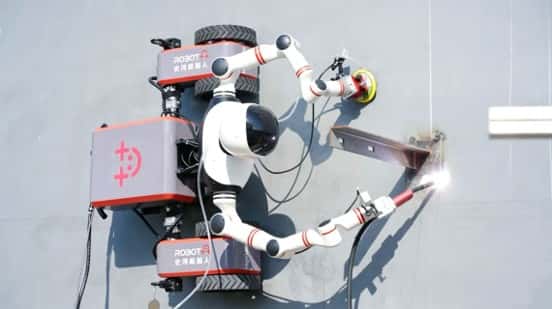
RobotPlusPlus has raised a fresh Series C round by pitching something less flashy than humanoids: robots that scrape rust off ship hulls and take people off scaffolding. The company said the financing was worth hundreds of millions of RMB, or tens of millions of dollars.
RobotPlusPlus raises Series C as industrial robotics investors continue backing systems that already work on real jobsites. The round matters because RobotPlusPlus says it has pushed special purpose robots into commercial use across shipyards, oil and gas sites, wind farms and building façades, where labor is dangerous, expensive and hard to scale.
The Beijing-based company said Qianggang Capital Fund led the financing, joined by GIG Capital Group, Sealand Innovation and Juntong Capital. Fosun RZ Capital, which said it first invested in 2022, increased its stake in the new round.
RobotPlusPlus did not disclose a precise valuation or exact round size. That omission makes clear that the company is emphasizing deployment metrics. In a market crowded with venture-backed robotics companies discussing foundation models, that is a deliberate choice.
Founder and CEO Dr. Hua-Yang Xu said the company has spent more than ten years building special purpose robots that can be deployed at scale, and that the new capital will help bring those systems to more industrial sites globally. Qianggang Capital Fund said RobotPlusPlus had already brought robot fleets to commercial scale and expanded from ship hull derusting into other industrial applications.
That point is the real tell here. Plenty of robotics startups can show a proof of concept. Far fewer can say a single product category has been used at more than 100 shipyards and on over 10,000 cargo vessels, as RobotPlusPlus claimed for its hull derusting robots. For U.S. readers, the closest analog is the recent investor preference for companies selling into inspection, logistics and warehouse workflows, where the return on investment is easier to measure than with general purpose humanoids.
The company said those hull derusting systems improve efficiency by five to six times and cut overall costs by 30% to 50% compared with manual methods. Those are big gains if they hold up under procurement scrutiny. They also explain why buyers in heavy industry may care less about whether a robot looks human and more about whether it can survive salt, grime, height and repetitive work.
Over 2 million operating hours
RobotPlusPlus said its robots have logged more than 2 million operating hours, giving the company a sizable real world data set for training AI models in industrial environments.
RobotPlusPlus said it now operates in more than 18 countries, with customers and partners including NOSCO Shipyard, Drydocks World, ST Engineering Marine, Saudi Aramco and Vopak. For a U.S. audience, that cross-border list matters more than the funding headline. It suggests the company is not selling into one domestic subsidy cycle or one especially friendly industrial buyer, but into a broader set of asset-heavy operators.
There is also a deeper industry angle. Embodied AI has become a catchall term in venture decks, often attached to humanoid robots aimed at manufacturing, warehouses or household chores. RobotPlusPlus is making a narrower argument: industrial AI gets more defensible when it is paired with purpose-built machines doing difficult jobs in constrained settings. In that sense, the company is closer to the field robotics and industrial automation camp than to the humanoid race now drawing much of the consumer attention.
The company said more than 60% of its workforce is in research and development, and that R&D spending has been above 20% of revenue for three consecutive years. That is a striking ratio for a company selling into heavy industry, where service, integration and support can quickly absorb headcount. It also hints at the balancing act ahead. Investors like hard deployment metrics, but robotics companies still have to keep spending heavily to maintain hardware, software and autonomy advantages.
Fosun RZ Capital said the company had built expertise in special purpose robotics and marine applications, and that its move from individual robots to complete system solutions created stronger technical barriers in high risk industrial settings. That language tracks with where much of industrial automation is going. The sticky product is rarely the robot alone. It is the workflow, the software, the fleet management and the data layer wrapped around it.
The background
RobotPlusPlus is arriving at a moment when industrial robotics is splitting into two tracks. One track is capital intensive and highly visible, centered on humanoids and broad labor replacement narratives. The other is quieter and often more commercial, focused on welding, cleaning, inspection, maintenance and material handling in places where labor shortages and safety rules create immediate demand. This deal sits firmly in the second bucket.
That distinction matters in the U.S. market. American industrial buyers, especially in energy, shipping and large site maintenance, have generally adopted autonomy in narrow slices first: warehouse mobile robots, pipeline inspection tools, warehouse picking assistance and software-linked industrial automation. A company like RobotPlusPlus, with robots already used on ship hulls, façades and energy infrastructure, fits that buying logic better than a do-everything machine still chasing a broad use case.
The shipyard angle is especially interesting. Marine maintenance is expensive, highly manual and subject to tight scheduling pressure. If RobotPlusPlus really holds market share above 70% in hull derusting, as the company said, that gives it something many robotics startups lack: a beachhead in a workflow where customers already understand the economics. Once a vendor gets trusted on one difficult, high risk maintenance task, it has a plausible path into adjacent work. Qianggang Capital Fund explicitly pointed to that expansion in its statement.
The operating data could be just as important as the installed base. RobotPlusPlus said its machines have accumulated more than 2 million operating hours, producing real world data that can improve vertical AI models for complex industrial environments. In plain English, that means the company is trying to turn jobsite repetition into a moat. For industrial AI, real world edge cases usually matter more than benchmark scores. Wind, corrosion, uneven surfaces and site-specific constraints are what break robots in the field.
There is still reason for caution. The company did not disclose revenue, margins or how much of its business is recurring versus project-based. It also did not break out how much of the new capital will go to international sales versus research. Those details would matter to investors trying to judge whether this is a hardware company with services attached, a robotics platform company, or something in between.
Even so, the customer list and deployment claims make this more than a generic funding announcement. Hazardous industrial work has become one of the clearest proving grounds for commercial robotics, partly because the economics are simple and partly because the alternative is still people on scaffolding, in harsh weather, doing repetitive maintenance. If you want a real world test of embodied AI, this is about as unglamorous and useful as it gets.
What's next
The next question is whether RobotPlusPlus can turn a strong niche into a broader global platform. After the September 15, 2026 funding announcement, the concrete markers to watch are new deployments outside marine maintenance, deeper expansion in the more than 18 countries where it already operates, and whether the company can keep translating those 2 million operating hours into systems that industrial buyers will standardize on rather than merely pilot.
Frequently asked questions
What did RobotPlusPlus announce in its Series C funding news?
RobotPlusPlus said it closed a Series C round worth hundreds of millions of RMB, equal to tens of millions of U.S. dollars. The company said the new funding will support international expansion and embodied AI development for its working-at-height robots.
Who invested in RobotPlusPlus's Series C round?
Qianggang Capital Fund led the Series C financing. GIG Capital Group, Sealand Innovation, and Juntong Capital also participated, while existing backer Fosun RZ Capital increased its investment.
What will RobotPlusPlus use the Series C money for?
RobotPlusPlus plans to use the capital to expand globally and strengthen research tied to embodied AI. That suggests the company is investing in both overseas market growth and smarter robotic systems for industrial tasks performed at height.
What does RobotPlusPlus make?
RobotPlusPlus develops robots designed for working-at-height applications in industrial settings. These systems are built to help with elevated inspection, maintenance, and other high-risk jobs where automation can improve safety and efficiency.
Why is embodied AI important for RobotPlusPlus?
Embodied AI refers to intelligence integrated into physical machines that can sense, move, and interact with real environments. For RobotPlusPlus, this could improve how its robots navigate complex job sites and perform tasks in hard-to-reach places.
Why does this funding matter for the robotics industry?
The round signals continued investor interest in industrial automation, especially robots that address labor, safety, and efficiency challenges. It also shows that companies building specialized robots for real-world infrastructure and maintenance work are attracting growth capital.