An October 1 reveal could show Tesla’s halo EV borrowing sharp-edged Cybertruck cues after years of delays.
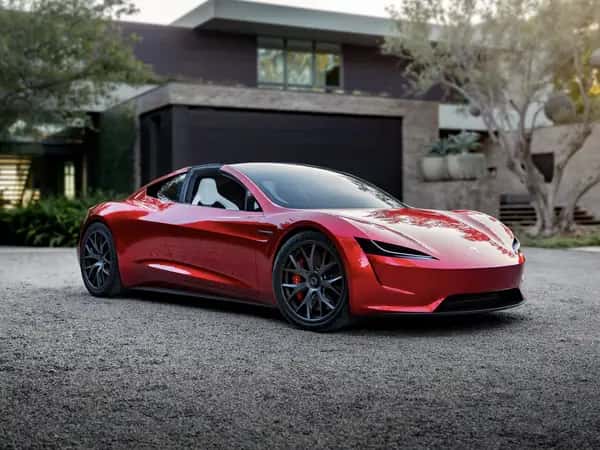
Tesla said it will unveil the new Roadster on October 1, more than eight years after first showing the car in 2017, and a new teaser suggests the production version may adopt the company’s angular “Cyber” design language.
The Roadster was originally pitched in 2017 with a 620-mile range, 0-60 mph in 1.9 seconds, a top speed above 250 mph, seating for four, and a base price of $200,000, while the $250,000 Founders Series sold out, according to the source material.
Elon Musk has tied the Roadster relaunch to a SpaceX package using cold gas thrusters, claiming under-two-second 0-60 mph performance without them and under one second with them, a feature that could make the car more of a demonstration than a practical road product.
The bigger issue for Tesla is execution, not styling: by the source’s count, the Roadster has slipped at least eight times from its promised 2020 production start, and high-profile reservation holders including Marques Brownlee and Sam Altman have already canceled.
Tesla’s new Roadster teaser hints at a sharper, more overtly “Cyber” redesign ahead of an October 1 reveal. That would mark the company’s first full update on the halo EV in years, after a launch that has stretched more than eight years since the 2017 debut.
Tesla’s new Roadster teaser hints at a possible redesign just as the company tries to revive one of its longest-delayed products, and that matters because the Roadster was supposed to show that Tesla could turn EV performance into a halo business, not another concept trapped in development.
The teaser, described in the source material as showing SpaceX cold gas thrusters firing from the rear, lands after Elon Musk promised “radical design changes” to the car. The visual cues reportedly include a full-width light bar and more angular surfacing, a look closer to Tesla’s recent Cybertruck, Cybercab, and Robovan than the low, smooth Roadster concept the company showed in 2017.
That is a notable shift because the original Roadster design was not the problem. Tesla’s issue was shipping. The company unveiled the car with headline specs that still hold up on paper: 620 miles of range, 0-60 mph in 1.9 seconds, a top speed of more than 250 mph, and seating for four, with a base price of $200,000. Tesla also sold out the $250,000 Founders Series, according to the source material, pulling in reservation money from buyers willing to wait for what was pitched as an electric hypercar with everyday usability.
Instead, the wait kept getting longer. The source says production was originally promised for 2020 and has slipped at least eight times. Some well-known reservation holders, including Marques Brownlee and Sam Altman, have already backed out. For a company that still sells an aspirational growth story to Wall Street, that kind of delay matters beyond one niche vehicle. It raises the question of whether Tesla can still turn splashy reveals into real products on the timeline investors are asked to believe.
8+ years
That is how long the Roadster reveal has stretched since Tesla first showed the car in 2017, according to the source material.
The latest twist is the SpaceX package. Musk has said the Roadster will hit 0-60 mph in under two seconds without thrusters and under one second with them, according to the source. On paper, that is exactly the kind of metric Tesla likes to dominate. In practice, it sounds more like a launch-video flex than a serious reason to buy a road car.
Cold gas thrusters may be dramatic, but they also introduce weight, cost, refill needs, and questions around street use. The source says the planned demo has already been scaled back from a car that can “fly” to a brief hover, and that the demo vehicle reportedly will not be street-legal. It also says Tesla plans to run that demonstration remotely with no driver inside because the thrusters are a noise hazard. Those are not small caveats. They point to a system that may be useful for spectacle and branding while adding little to the actual ownership case.
There is a broader business angle here that goes past styling. Tesla has been trying to extend the “Cyber” aesthetic across multiple products, from the Cybertruck to the Cybercab and Robovan. If the Roadster gets the same treatment, Tesla would be signaling that its design identity is now less about broad appeal and more about a unified, highly branded visual system. That can work for a niche halo vehicle. It is riskier when the original Roadster concept was widely seen as one of Tesla’s cleanest designs and when the customer base already put money down for something closer to that version.
The timing is also awkward. The source material also points readers to a separate report saying NHTSA has ordered Tesla to prove its Cybercab is legal to sell, under oath. Those are different vehicles, but the pattern is familiar: Tesla keeps pushing products that are as much regulatory and engineering arguments as they are commercial launches. In the US market, where EV competition is maturing and buyers have more choices, that can cut both ways. Bold claims still generate attention, but novelty alone does not close the credibility gap created by missed deadlines.
There is another reason this reveal matters. The Roadster was never meant to be a volume product like the Model Y. It was meant to be a halo, a machine that made Tesla look years ahead of incumbents and pulled the rest of the brand upward with it. Back in 2017, that strategy looked smart. Legacy automakers were still struggling to make EVs feel desirable. Now, the field is different. High-performance EVs are no longer theoretical, and Tesla is no longer the only company selling speed as a software-defined feature. That makes execution more important than theatrics.
The background
Tesla’s lineup helps explain why the Roadster has become such a sensitive symbol. The Model Y, which arrived in 2020, became the best-selling car in the world, according to the source material. But it was an evolutionary product, not a design leap. Since then, Tesla’s most visible design moves have leaned hard into the “Cyber” theme. The Cybertruck is the clearest example, and the Cybercab and Robovan extend the same visual logic. A redesigned Roadster would suggest Tesla sees that direction not as an experiment, but as the company’s default aesthetic.
That may please Musk loyalists, but it risks colliding with what made the second-generation Roadster compelling in the first place. The original pitch was simple and potent: a beautiful, brutally fast EV that undercut the logic of gas hypercars. The promise was not just speed. It was that Tesla could deliver exotic performance in a package people could imagine actually owning. Adding thrusters and flirtations with hover mode changes that story. It turns a product that once looked like a category-maker into something closer to an engineering stunt.
The source also cites a former Tesla president suggesting the delays may be tied to linking the Roadster’s narrative more closely to SpaceX ahead of a possible merger. That remains a speculative idea, but it does fit one observable reality: Tesla often gets more market attention from reframing old promises than from quietly delivering incremental updates. For founders and investors, that is the real tell. The company has become extremely good at refreshing narratives around products long before those products reach customers.
What's next
October 1 is now the concrete trigger. The key questions are straightforward: whether Tesla shows a production-ready Roadster or another concept-heavy demo, whether the specs still resemble the 2017 promise of 620 miles, 1.9-second 0-60 mph performance, four seats, and a $200,000 base price, and whether the SpaceX thruster package is framed as a sellable option or simply a headline generator. If Tesla cannot answer those points cleanly, the reveal will look less like a launch and more like another reset.
Frequently asked questions
What does Tesla’s new Roadster teaser suggest about the car’s design?
The teaser points to a more angular look that may borrow from Tesla’s Cybertruck-inspired styling. That suggests the production Roadster could move away from the smoother shape shown when it first debuted in 2017.
When is Tesla expected to unveil the new Roadster?
Tesla says it plans to unveil the new Roadster on October 1. That date is notable because the car was first presented more than eight years ago and has faced repeated delays since then.
Why are some people skeptical about a Cyber-style Roadster redesign?
Many fans see the Roadster as a flagship sports car that benefits from a sleek, aerodynamic shape rather than sharp edges. A Cyber-style redesign could make the car look more divisive while raising questions about whether the original vision has changed.
What specs did Tesla originally promise for the Roadster?
Tesla originally said the Roadster would offer a 620-mile range, 0-60 mph in 1.9 seconds, and a top speed above 250 mph. It was also pitched as a four-seat electric sports car with a base price around $200,000.
Has Tesla delivered the Roadster that was announced in 2017?
No, Tesla has not yet delivered the Roadster unveiled in 2017. The model has been postponed multiple times, making each new teaser closely watched by buyers, investors, and EV fans.
Why does the Roadster matter to Tesla if it is a low-volume car?
The Roadster matters because it serves as a halo vehicle that can shape Tesla’s brand image and showcase performance technology. Even in small numbers, it can influence public perception of Tesla’s engineering and design direction.