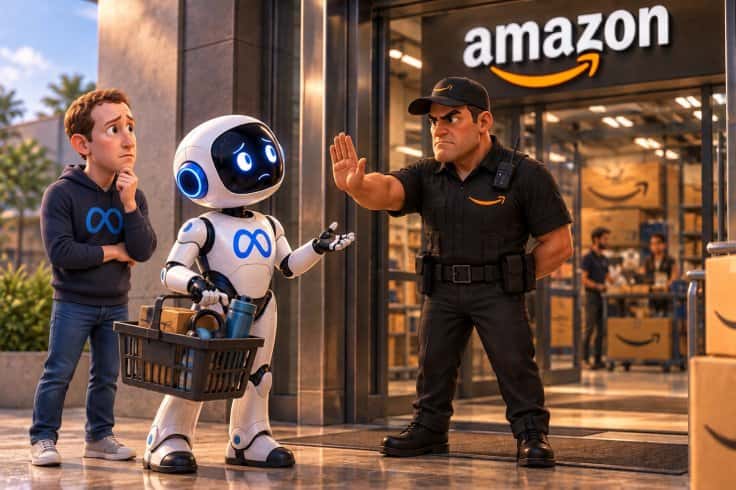
Retail giant cut off Meta’s new AI bot after saying the company refused to remove Amazon from its shopping workflow
Amazon has blocked Meta Platforms’ new Muse AI agent from shopping on Amazon.com, starting Sunday night, after Meta declined Amazon’s request to remove the bot from the experience, according to Amazon spokesperson Lara Hendrickson.
Meta’s Muse, introduced earlier this month, is designed to complete common online tasks such as shopping and booking appointments, but Amazon says third-party apps that make purchases on behalf of users must do so with a service provider’s consent.
Amazon’s move matters because it sharpens a growing fight over agentic commerce in the US, where retailers and platforms are deciding whether outside AI bots can access product listings, pricing, checkout flows, and customer intent.
The block follows Amazon’s broader push against rival shopping agents, including a lawsuit last year against Perplexity AI Inc., and signals that large commerce platforms want to control how AI intermediaries reach consumers before automated buying goes mainstream.
Amazon has blocked Meta Platforms’ Muse AI agent from its retail site. The move cuts off one of the clearest early tests of whether outside AI assistants will be allowed to shop across the web on consumers’ behalf.
Amazon blocks Meta’s Muse AI agent because the company says third-party bots that make purchases for users must do so with a service provider’s consent. The dispute could help set the rules for agentic shopping as tech companies race to put AI assistants between consumers and online storefronts.
Amazon started blocking Muse on Sunday night, an Amazon spokesperson said. Users trying to shop Amazon through Meta’s tool are shown a series of pop-ups saying the activity violates Amazon’s terms of use.
Amazon spokesperson Lara Hendrickson said in an emailed statement that third-party applications that offer to make purchases on behalf of customers from other businesses should operate openly and respect service provider decisions about whether or not to participate. She also said Amazon had asked Meta to remove Amazon from Muse and said an opt-in model is standard for categories such as food delivery apps and online travel agencies.
That framing is doing a lot of work. Amazon is not arguing that agentic shopping is inherently off limits. It is arguing that Amazon, not Meta, gets to decide who can automate against Amazon’s storefront.
Meta introduced Muse earlier this month as an AI agent that can help people complete routine internet tasks, including shopping and booking appointments. Meta did not immediately respond to an email seeking comment.
Amazon, meanwhile, is building automated shopping tools of its own while trying to keep rival bots from freely browsing and transacting on its catalog. That is the strategic tension underneath this fight. If AI agents become the interface consumers trust, the retailer with the inventory may no longer control the customer relationship in the same way.
The stakes go well beyond one blocked bot. In the old web model, Amazon wanted users to begin and end their shopping journey inside Amazon. In the AI model now taking shape, a consumer might start with an assistant, compare options across merchants, and let the bot choose where to buy. That threatens more than transaction volume. It also threatens ad revenue, sponsored placement economics, and the value of owning the homepage.
Sunday night
That’s when Amazon said it began blocking Meta’s Muse AI agent from shopping on Amazon.com.
Amazon has already shown it is willing to litigate the issue. The company last year sued Perplexity AI Inc., saying the startup sought to conceal its shopping agents after Amazon asked Perplexity to remove them. That case has been watched closely because it gets at a simple but unresolved question: when an AI agent acts for a user, is it just another browser, or is it a commercial intermediary that needs permission?
So far, consumer behavior gives Amazon some breathing room. Shoppers are mostly using bots to research products rather than let them make purchases. In practical terms, that means Amazon is unlikely to lose much business by shutting off outside agents for now.
Amazon Chief Executive Officer Andy Jassy said earlier this year that the agentic shopping experience left much to be desired, and that the bots often flubbed pricing or other data. He also said in April that Amazon was having conversations with companies building such tools to try to make the experience better and find something that works for customers and companies.
That comment is revealing in its own right. Amazon is not saying no forever. It is saying not like this. For founders building AI commerce layers, that probably means the winning model is less likely to be a free-ranging scraping bot and more likely to look like a negotiated distribution channel, complete with permissions, economics, and data rules set by the incumbent platforms.
There is a broader US market context here, too. Large consumer internet companies are all trying to avoid becoming interchangeable suppliers to somebody else’s assistant. Meta wants its assistants to do real-world tasks, not just answer questions. Amazon, for obvious reasons, wants AI shopping to happen on terms that preserve Amazon’s control over checkout and merchandising.
For merchants, the picture is mixed. An AI agent that can compare across stores could, in theory, reduce dependence on Amazon and route demand to a brand’s own site or another marketplace. But that only works if agents can access those stores reliably and if platforms don’t wall off inventory, pricing, or transaction flows. Amazon’s move suggests the biggest platforms intend to negotiate that access, not just grant it by default.
The background
Muse arrived at a moment when “agent” has become a common tech industry term. A lot of products pitched as agents are really recommendation layers or task helpers with limited autonomy. Shopping is where the category quickly gets real, because mistakes are visible and expensive. A bad answer in chat is annoying. A bad purchase, or a wrong price, is much worse.
That helps explain Amazon’s posture. Product data changes constantly. Availability shifts quickly. Promotions, third-party seller listings, delivery estimates, and checkout rules are not static fields an outside model can safely memorize. If an AI agent misstates any of that and still completes a transaction, consumers are likely to blame both the bot and the merchant. Amazon appears to be using that operational complexity as both a genuine concern and a strategic shield.
The fight also resembles earlier platform battles over access. App stores, travel aggregators, and food delivery apps all went through versions of this argument: who owns the customer, who can intermediate the transaction, and who pays for the privilege. Hendrickson’s reference to food delivery and online travel was not accidental. Amazon is signaling that agentic commerce should follow the same logic, with explicit participation instead of silent automation.
For Meta, the risk is that assistants capable of taking action become much less useful if important destinations block them. Shopping and booking are among the clearest ways to show consumers that an AI product can save time, not just generate text. If top-tier platforms opt out, then agent builders either need official partnerships or they need to steer users toward smaller and more permissive merchants.
What's next
The next trigger is whether Amazon’s stance hardens into a broader policy that other major commerce and booking platforms copy, or whether Meta and rivals cut opt-in deals that restore access. The Perplexity case and any future enforcement around shopping agents will be watched closely, because they may determine whether AI assistants become true transaction layers or remain mostly research tools for now.
Frequently asked questions
Why did Amazon block Meta’s Muse AI agent?
Amazon said it blocked Meta’s Muse AI agent after Meta declined a request to remove Amazon from the bot’s shopping experience. According to Amazon, the issue centered on third-party automated access to its retail platform.
What is Meta’s Muse AI agent designed to do?
Meta’s Muse AI agent is built to handle common online tasks such as shopping and booking appointments. The tool is part of the broader push to let AI agents complete actions for users instead of just answering questions.
When did Amazon stop Muse from shopping on Amazon.com?
Amazon’s spokesperson said the block began Sunday night. That means Muse lost access to shopping on Amazon.com shortly after the dispute over the bot’s use of the site became public.
Can AI agents use Amazon.com to shop for users?
Amazon has indicated that outside apps and bots cannot freely use its retail site in ways that violate its rules. In this case, Amazon signaled that third-party automated shopping access was not permitted under the experience Meta offered.
Is this an antitrust case between Amazon and Meta?
Based on the reported facts, this is primarily a platform access and policy dispute, not a formal antitrust action. Amazon says it acted because of how Meta’s AI agent interacted with its shopping site.
What does Amazon blocking Muse mean for AI shopping tools?
The move shows that AI shopping agents still depend on retailer permission and platform rules to function smoothly. It also highlights a growing tension between AI assistants that act for users and websites that want tighter control over automated access.