France begins on-road trials of Tesla FSD, a key step for the automaker's push to expand autonomous driving in Europe
France starts tests on Tesla's self-driving tech, and that small bureaucratic phrase carries real weight for Tesla's European ambitions. French Minister of Transport Philippe Tabarot said the country has begun on road testing of two Tesla vehicles equipped with Full Self Driving, or FSD, after months of technical work with the company. That matters well beyond Paris. France is not just another box to tick in Europe, it is one of the region's most important auto markets and a country that had publicly signaled caution as recently as July. If Tesla can get France comfortable, the path to broader regional approval looks less theoretical and more procedural.
The immediate trigger is simple. Tesla provided two FSD-equipped cars to French authorities, and Tabarot said the process had moved into a new testing phase after what he described as a constructive exchange with Elon Musk. France wants to validate both Tesla's submission and the Dutch data on its own roads before it is ready to vote at the bloc level. That is still a long way from a blank check. France had already raised concerns about speed limits and driver attention warnings, and those are not cosmetic product notes.
Tesla's FSD branding has always done more marketing work than regulatory work. The system can accelerate, brake, and steer while a human driver remains ready to intervene, but it is still an advanced driver assistance system, not a fully autonomous product. Regulators know the difference, even if consumers do not always parse it cleanly. The sequence here is worth watching. The Netherlands road authority, RDW, provisionally approved Tesla's system for Dutch roads in April. Belgium, Denmark, Estonia, and Lithuania then moved in the same direction ahead of a bloc-wide vote that could happen as early as next month. For North American readers, the interesting part is not just whether Europe says yes. It is how Europe says yes. The region tends to approve software-mediated vehicle functions through a slower, more standards-driven process than the U.S., where state-by-state rules, federal investigations, and product rollouts often move in parallel. In plain terms, Tesla is trying to convert a patchwork of technical permissions into a continental precedent. That's a big claim. The company has spent years arguing that its vision-based stack and fleet data create a path to autonomy, but regulators keep asking a more old-fashioned question: what exactly happens when the system gets it wrong?
France’s decision to physically audit two FSD-equipped Teslas on its own roads marks the end of the "fast-track" regulatory honeymoon for Tesla in Europe. While the Netherlands (RDW) provided the initial provisional approval in April 2026 allowing nations like Belgium, Denmark, Estonia, and Lithuania to essentially rubber-stamp the software, France is asserting that demographic and political heavyweights will not blindly import a neighboring country's safety conclusions.
By forcing Tesla into localized, on-road testing ahead of the critical October 6 EU-wide vote, Transport Minister Philippe Tabarot is turning a bureaucratic procedure into a sovereign stress test for autonomous software.
The Algorithmic Clash: Human Norms vs. Legal Codes
The friction between Tesla and the French Transport Ministry highlights a fundamental conflict in how AI is trained versus how European traffic laws are enforced.
In his July 2026 objections, Tabarot pinpointed a specific algorithmic behavior: if ambient traffic is moving at 70 km/h in a 50 km/h zone, Tesla’s FSD will naturally match the flow of traffic without requiring explicit driver permission. Because FSD is trained on massive datasets of actual human driving behavior, it acts like a human, it prioritizes traffic flow and situational safety over strict legal speed limits.
French regulators require strict adherence to the codified highway code, regardless of ambient conditions. To pass this on-road audit, Tesla is being forced to engineer a geo-specific, hyper-compliant version of FSD that strictly polices its own speed, fundamentally altering the fluid driving dynamic that Tesla considers its core product differentiator.
The "Supervised" Liability Shield
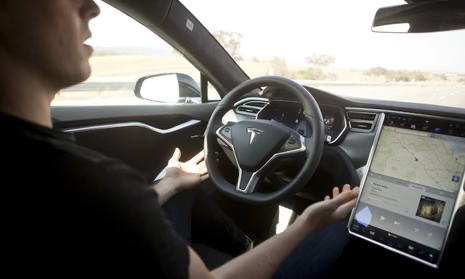
The second major hurdle in the French tests revolves around driver attention in highly complex urban environments, such as roundabouts and unmarked intersections. Despite the "Full Self-Driving" moniker, the system is classified under UN Regulation No. 171 as a Level 2 Driver Control Assistance System (DCAS). This means the human driver retains total criminal and civil liability in the event of a crash. France’s Centre National de Réception des Véhicules (CNRV) is heavily scrutinizing whether Tesla’s interior cabin cameras and steering wheel sensors provide sufficient progressive alerts to guarantee a driver is actually engaged when the software initiates a complex maneuver.
The Recurring Revenue Imperative
For Tesla, unlocking France is a mathematical necessity for its European software margins. With European FSD subscriptions priced at €99 per month, the software represents a critical, high-margin revenue stream at a time when traditional EV hardware margins are compressing.
If Tesla successfully modifies its software to satisfy French auditors by late September, it paves the way for the October bloc-wide approval, instantly expanding its Total Addressable Market to millions of Hardware 4-equipped vehicles across the continent. If France officially vetoes the software, it establishes a fragmented regulatory nightmare where Tesla must maintain completely different software stacks for different European borders. Tabarot's change in tone is notable because it did not come from nowhere. In July, he said the safety trade-offs were not yet sufficient to justify authorization in France, specifically around speed limitation and driver attention alerts. Two months later, the same ministry is now testing the system directly after working with Tesla on adaptations tailored for France.
April: RDW in the Netherlands provisionally approved Tesla FSD for Dutch roads.
Mid to late September: France is aiming to have test results ready ahead of a possible bloc vote next month or in early December.
That timeline is fast by European regulatory standards. It also suggests France does not want to be the holdout that slows a bloc decision without having done its own technical homework. My read is that Paris is trying to avoid two bad outcomes at once: waving through a politically loaded feature too quickly, or appearing reflexively anti-innovation while neighbors move ahead.
Tesla, for its part, needs this. The company is under pressure to prove that software can keep expanding the value of its cars even as EV competition intensifies and hardware differentiation narrows. In that setup, regulatory approval is not just a compliance event. It is a product milestone with direct consequences for subscriptions and investor narrative. There is also a quiet geopolitical layer here. Europe has often been painted as the place where U.S. tech products go to be constrained, audited, or fined. Yet in automotive software, the region can also function as a credibility market. Approval there gives Tesla something useful in North America: a fresh external validation point from a jurisdiction that is not typically accused of being soft on safety.
Still, provisional approval is not operational proof. A system can satisfy a regulator's current threshold and still perform unevenly across weather, road markings, local signage, and driver behavior. France's insistence on testing the software on French roads is not bureaucracy for its own sake. It reflects a basic truth of autonomy programs: edge cases are local. The two-car test setup sounds modest, because it is. But early regulatory evaluations often look exactly like this, narrow fleets, bounded conditions, controlled observation. Founders reading this will recognize the pattern. First you get permission to run the process, then permission to scale the process, and only later do you get something resembling broad commercial freedom.
Another tension sits underneath the headline. Tesla calls the product Full Self Driving, while the minister's language and the underlying approval track treat it as advanced driver assistance. That naming gap has followed the company for years. It matters because regulators care about driver supervision, and consumers often buy software based on implication as much as specification. The French ministry source said the government wants to verify the data provided by both the Netherlands and Tesla, then test the system in domestic conditions before a coming vote. That is an important signal. Europe is not merely importing another country's assessment. It is building a layered record, country by country, before any bloc-wide decision hardens into precedent. There is a broader pattern across mobility tech here. Companies increasingly win not when they launch first, but when they operationalize trust faster than rivals. In autonomous systems, that trust is assembled from road data, regulator engagement, product constraints, and clear handoff rules between machine and human. The companies that treat approval as just legal cleanup usually find out too late that approval is part of the product.
For Tesla, this comes at a sensitive moment in the autonomy race. Rivals have taken different approaches, from geofenced robotaxi deployments to more conservative driver-assistance packaging. Tesla has pushed a wider consumer rollout thesis, betting that data at scale and iterative updates can outperform slower, more contained strategies. That strategy has obvious upside. If Tesla can turn a large installed base into a software upgrade path across multiple markets, it extends monetization without needing a new vehicle cycle each time. Investors like that logic because software revenue is easier to model than unit growth in a maturing EV market. The downside is equally obvious. The broader the deployment claim, the more exposed the company becomes to inconsistencies between branding, user expectations, and regulator tolerance. A single approval process in Europe will not settle the argument over how autonomous FSD really is. It may only sharpen it.
France also appears to be signaling that it expects Tesla to address its concerns rather than simply defend the current version of the product. The ministry source said officials expected the company to be open to resolving those issues, which would allow approval in Europe. That wording matters because it frames the process as conditional engineering work, not ideological alignment with Musk's timeline.
North American automakers and software suppliers should pay attention. Once one major regulatory bloc defines acceptable behavior for supervised automated driving, those definitions have a habit of traveling. Not cleanly, not immediately, but they travel through procurement conversations, insurance assumptions, legal arguments, and customer expectations. This is why the French test is more than a local traffic story. It is part of the commercialization layer of autonomy, the part where bold product rhetoric meets transport ministries, operating constraints, and edge-case documentation. That phase is less glamorous than a launch event, but it is where durable market access gets built. If France signs off after testing in mid to late September, Europe could move one step closer to giving Tesla a meaningful new software market. If it pushes back, the company still learns something useful, namely which technical compromises are now the price of scale.
Either way, the category keeps moving toward a stricter middle ground: more automation, tightly supervised, sold carefully, and approved in increments. Tesla may be the loudest player in that shift, but it is not the only one. The same pressure sits over companies pursuing automated driving through consumer vehicles, fleet software, or controlled autonomy programs.
Frequently asked questions
Is France now testing Tesla Full Self-Driving on public roads?
Yes. French officials have begun on-road testing of two Tesla vehicles equipped with Full Self-Driving, or FSD, after technical work with the company. The tests signal that France is actively evaluating how Tesla's system performs under local regulatory and road conditions.
Why do France's Tesla self-driving tests matter in Europe?
France is a major auto market and an influential regulator inside the European Union, so its decisions can shape broader momentum for advanced driver-assistance systems. If Tesla clears key hurdles in France, it could strengthen the company's case for wider deployment across Europe.
What exactly is Tesla FSD in the France road tests?
Tesla FSD, or Full Self-Driving, is the company's advanced driver-assistance software designed to handle tasks like steering, lane changes, and navigation under driver supervision. Despite the name, it does not make the car fully autonomous and still requires an attentive human driver.
Who announced the Tesla self-driving tests in France?
French Transport Minister Philippe Tabarot said the country had started on-road testing of two Tesla vehicles using FSD. His statement gives the trials added significance because it shows direct government involvement rather than informal private testing alone.
Does France testing Tesla FSD mean it is approved for consumers?
No. Testing on public roads does not automatically mean Tesla FSD has full consumer approval or unrestricted deployment in France. It means regulators are gathering evidence and evaluating safety, compliance, and operational limits before any broader rollout decisions.
Could France's Tesla FSD tests affect US investors and drivers?
Yes. US investors often watch European regulatory moves because they can influence Tesla's growth story, software revenue potential, and international credibility. For US drivers, the tests also offer another data point on how Tesla's self-driving technology is being assessed by major foreign regulators.