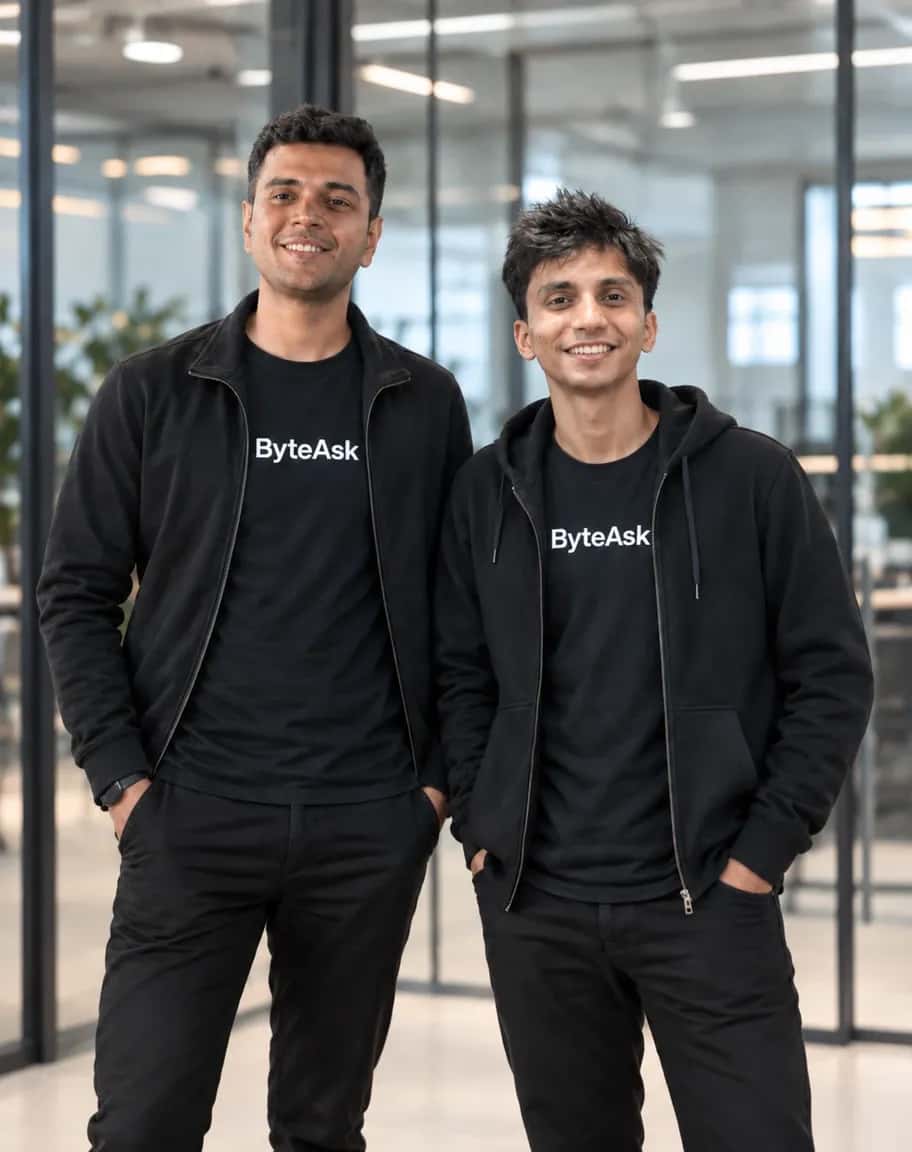
YC and Entrepreneur First back ByteAsk as it targets high-stakes engineering teams in defense and robotics.
AI coding startup ByteAsk raised $1 million in a funding round led by Y Combinator and Entrepreneur First, the company said, giving the San Francisco-headquartered startup early backing as it targets C and C++ software teams in defense, aerospace, robotics, automotive, semiconductors and high-frequency trading.
ByteAsk said it is building AI coding agents specifically for C and C++ developers, a niche the founders argue generic coding copilots handle poorly when reliability, performance and correctness matter most.
ByteAsk, founded in June 2026 by former LawSutra AI cofounders Anirudha Kulkarni and Pratyush Saini, said it will use the new capital to hire engineering and research staff in San Francisco and Bengaluru, invest in GPU compute and training data, and build enterprise-grade security, privacy and on-premises infrastructure.
On ByteAsk’s internal benchmark of real firmware engineering tickets, the startup said its smaller model resolved 89% of tickets versus 61% for the best frontier model tested without the environment, and the company said its weekly active users are doubling week-on-week.
ByteAsk has raised $1 million from backers led by Y Combinator and Entrepreneur First. The startup is going after a less fashionable corner of AI coding, C and C++, where mistakes can be expensive and generic copilots often struggle.
ByteAsk’s pitch is straightforward: while AI coding tools have spread fast across web development, they have been less reliable in systems programming environments that run critical infrastructure and performance-sensitive software. That matters because a large slice of defense, aerospace, embedded systems, semiconductors and high-frequency trading still runs on C and C++.
The company said it was founded in June 2026 and is headquartered in San Francisco, with operations in the US and India. It has also been selected for Y Combinator’s Fall 2026 batch, giving it a familiar Silicon Valley stamp of approval at a moment when investors are still pouring into AI-assisted software development, but are becoming more selective about category overlap.
Anirudha Kulkarni, ByteAsk’s cofounder and CEO, said the founders saw AI changing software development broadly while C and C++ developers were still dealing with the limits of generic coding agents. He said the team wanted to work on a technically difficult problem with global upside, and framed ByteAsk’s approach around context, verification and workflows rather than model output alone.
That last point is worth dwelling on. In enterprise coding, especially in sectors like automotive or trading, the differentiator is usually not raw text generation. It is whether the system understands the codebase, the build environment, hardware constraints, and the verification steps needed before code can ship. Startups that can wrap models in that kind of infrastructure tend to look more defensible than yet another autocomplete layer.
Pratyush Saini, ByteAsk’s cofounder and CTO, said C and C++ still power a huge amount of the world’s critical infrastructure, but the productivity gains seen from AI coding tools have not translated equally to those environments. He said reliability, verification and context matter as much as generation.
That argument also lines up with where the broader market is heading. GitHub Copilot helped normalize AI pair programming for mainstream developers, and startups like Codeium and Cursor pushed the category into a serious product battleground. But a lot of those tools were initially optimized for popular application-layer languages and greenfield workflows, not firmware tickets, memory management edge cases, or highly regulated deployment environments. ByteAsk is effectively betting that verticalization is the next act.
The founders have some startup history here. Kulkarni and Saini previously cofounded legal AI startup LawSutra AI, which was acquired by legal research company Manupatra within four months of launch, according to ByteAsk. Both founders are graduates of IIT Delhi’s computer science program, and they are now trying to apply what Kulkarni described as a lesson from that earlier company: models are only as useful as the surrounding product system.
89%
There’s an obvious caveat to that benchmark. It is internal, and the company did not disclose the test size, the exact competing model, or the evaluation setup beyond saying the frontier model was tested without the environment. Still, if ByteAsk can show even a portion of that gap with customers in production, that would be a meaningful result in a corner of software engineering where hallucinations are far more costly than in a prototype web app.
ByteAsk also said engineers use its product roughly six times more intensively each day than a comparable open-source coding agent, while weekly active users are doubling week-on-week. Those are early-stage startup metrics, and without hard user counts they should be treated cautiously. But they do suggest the company may have found a sharper use case than many horizontal AI coding products, which are now fighting for attention in a crowded market.
The fresh capital will go toward expanding engineering and research teams across San Francisco and Bengaluru, according to the company. ByteAsk also said it plans to invest in GPU compute and training data, while building enterprise-grade security, privacy and on-premises infrastructure for customers in sensitive industries. That spending plan makes sense for the buyers it is chasing, because defense, semiconductor and financial firms typically care as much about deployment control as they do about model quality.
The background
For US enterprise customers, ByteAsk’s focus is timely. A growing number of companies want AI coding assistance, but many are hitting a wall on sensitive codebases that cannot simply be piped through a generic cloud tool. On-premises options and tighter privacy controls have become a bigger selling point across AI software, especially as procurement teams ask where code is stored, how models are trained, and whether proprietary snippets could leak across tenants.
ByteAsk said it will initially focus on large firms in high-frequency trading, automotive and embedded systems before expanding into adjacent markets. That is a narrower wedge than many AI devtool startups choose, but it may be the right one. High-frequency trading firms care obsessively about latency and correctness. Automotive and embedded teams deal with long-lived codebases, hardware dependencies and strict validation requirements. Those buyers are not shopping for novelty. They are shopping for fewer broken builds and faster review cycles.
The company is also developing its own post-training approach for C++, with the aim of releasing one of the first language models specifically post-trained for the language within the next six to eight months, according to the founders. That does not guarantee an enduring moat, especially when larger model labs can move quickly into adjacent specialties. But a specialized post-trained model, paired with workflow and environment integration, is at least a coherent answer to the question many early AI startups now face: why won’t a bigger platform just absorb this?
Nemil Dalal, a visiting partner at Y Combinator, said that what stood out when ByteAsk applied to the accelerator was the founders’ technical expertise and their view that a large group of software developers had been left out by current AI coding tools. Investor endorsements are table stakes in seed-stage AI. More interesting is the specific thesis beneath this one: there is still room to build real companies around underserved developer segments, even after the first wave of coding copilots.
What's next
The near-term test is execution, not branding. ByteAsk said it plans to release its C++ post-trained model within the next six to eight months, and that milestone should show whether the startup can turn early usage and benchmark claims into a product that large US enterprises will actually standardize on. If it can, the company could become part of a broader shift from general-purpose AI coding assistants toward tools built for specific languages, workflows and regulated industries.
Frequently asked questions
What is ByteAsk and why did it raise $1 million?
ByteAsk is an AI coding startup building coding agents for C and C++ developers. It raised $1 million to expand its product and support software teams working in complex, high-reliability industries.
Who invested in ByteAsk’s $1 million funding round?
ByteAsk said its $1 million round was led by Y Combinator and Entrepreneur First. That backing gives the San Francisco-headquartered startup early support from two well-known startup investors.
What does ByteAsk build for C and C++ developers?
ByteAsk is developing AI coding agents designed specifically for C and C++ software teams. The company is focusing on workflows where precision, performance, and legacy codebases matter more than generic coding assistance.
Which industries is ByteAsk targeting with its AI coding tools?
ByteAsk is targeting teams in defense, aerospace, robotics, automotive, semiconductors, and high-frequency trading. These sectors often rely heavily on C and C++ because they need low-level control and high performance.
Why is AI coding for C and C++ considered important?
C and C++ remain critical in systems where speed, hardware access, and reliability are essential. AI tools tailored to those languages could help engineers move faster while working with complex code that general-purpose copilots may not handle as well.
Where is ByteAsk based?
ByteAsk is headquartered in San Francisco. Even at an early stage, it is positioning itself around US and global engineering teams building software for mission-critical applications.