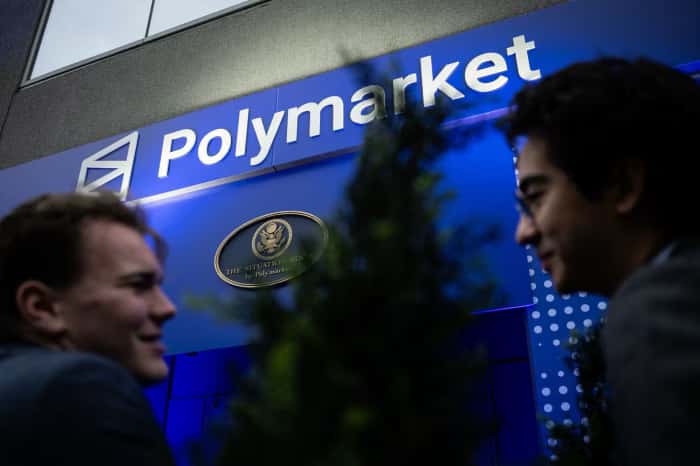
The prediction market platform secured a massive investment from 1789 Capital, linked to Donald Trump Jr., signaling a major shift in the burgeoning and often controversial industry.
The world of prediction markets just got a jolt, and it's not just about the money. Polymarket, a popular platform where users bet on future events, has reportedly reeled in a massive $300 million investment from 1789 Capital, a fund closely associated with Donald Trump Jr. This isn't just a big cash injection; it's a significant development that thrusts the burgeoning, often controversial, industry further into the spotlight, particularly as it navigates a complex and aggressive regulatory environment that could impact how ordinary people interact with these platforms.
Here's what happened: This $300 million investment is part of a larger funding round that sources suggest will total around $1 billion for Polymarket. It signals a substantial vote of confidence from 1789 Capital, which had already committed $200 million to the prediction site in a previous round. The sheer scale of this financing highlights the growing interest and capital flowing into these speculative platforms, despite their precarious legal standing in many parts of the United States.
1789 Capital, where Donald Trump Jr. serves as a partner, has funded other controversial tech-related projects, including the Enhanced Games, a sporting event provocatively dubbed the "steroid Olympics" by some. It was founded by veterans from various tech companies.
The influx of capital into Polymarket comes at a critical juncture for the entire prediction market industry. These platforms have been under intense scrutiny from state governments across the country, many of whom are seeking to impose new regulations or outright ban their use by residents. The core of the conflict often revolves around whether these platforms constitute legitimate financial instruments or simply unregulated gambling, a distinction with significant legal and operational consequences.
Indeed, the regulatory battle is already in full swing. There are currently at least 20 states engaged in litigation against various prediction sites, specifically targeting sports wagers offered on those platforms. This fractured legal situation creates a patchwork of rules and prohibitions, making it challenging for companies like Polymarket to operate uniformly across the nation and for users to understand where and how they can participate legally.
The Regulatory Gauntlet
The federal government, however, has often taken a contrasting view, frequently stepping in to defend the prediction industry from state-level intervention. The previous Trump administration, for instance, argued that the Commodity Futures Trading Commission (CFTC) should be the sole regulator of the industry, effectively preempting state authority. This position frames prediction markets as financial instruments akin to commodities futures, falling under federal oversight, rather than as gambling operations subject to state gaming laws.
The CFTC has actively pursued this stance, going so far as to sue at least nine states that have attempted to regulate the industry themselves. This aggressive federal intervention highlights a fundamental disagreement over the nature of these markets. If prediction markets are treated as commodities, they offer a form of speculative trading on future events, similar to betting on the price of oil or gold, but on everything from election outcomes to scientific discoveries. If they are gambling, they face a much stricter and often prohibitive set of state-by-state laws.
This federal pushback has not gone unchallenged. A coalition of 44 state attorneys general recently pushed back, signing a letter that explicitly argued the CFTC does not possess the authority to regulate sports-related wagers on prediction sites. This broad objection highlights the deep divisions and the powerful interests at play, with states keen to protect their jurisdiction over gambling and consumer protection within their borders. Donald Trump Jr. himself has weighed into this debate, reportedly appearing at an event involving conservative state attorneys general where he characterized the prediction industry as already having "robust oversight" by federal officials, not state attorneys general.
The Weaponization of Capital in the Prediction Market Wars
The $300 million injection into Polymarket by 1789 Capital by anchoring a massive $1 billion funding round that reportedly values the platform at $21 billion, is not just a financial runway; it is a regulatory shield. By aligning with a venture fund where Donald Trump Jr. serves as a partner, Polymarket is aggressively armoring itself against an existential threat: the coordinated crackdown by state-level gaming commissions and attorneys general who view the platform not as a financial exchange, but as an unlicensed casino. This capital influx arrives at the exact moment the prediction market industry is caught in a brutal jurisdictional tug-of-war.
The Federal vs. State Chokepoint
The fundamental battle revolves around how an "event contract" is classified. The Commodity Futures Trading Commission (CFTC) asserts exclusive federal jurisdiction, categorizing these binary contracts as a type of derivative or "swap" rather than a gamble. To bolster this framing, the CFTC recently directed prediction markets to drop sportsbook-style moneylines and odds in favor of pricing contracts strictly in "cents on the dollar," aligning the user interface with traditional commodities trading. Conversely, state attorneys general and tribal gaming interests argue that federal commodities law does not preempt state gambling authority—especially since the Supreme Court struck down the Professional and Amateur Sports Protection Act (PASPA) in 2018, explicitly granting states the right to regulate sports betting. The resulting legal fragmentation is severe:
The State-Level Crackdown: More than 30 lawsuits and regulatory actions are currently targeting prediction markets. Lawmakers in states like Minnesota have pushed bills aiming to criminalize the operation, facilitation, and even the advertising of prediction markets, threatening felony exposure for violators.
Tax and Extinguish: Other states are attempting to regulate prediction markets out of existence through taxation. Illinois, for example, has explored imposing a staggering 50% tax on adjusted gross receipts from prediction market activity tied to the state.
The Sports Betting Proxy War: The most intense friction centers on sports-related event contracts. While betting on an election or an economic indicator might pass as a hedgeable derivative, state regulators argue that allowing users to buy contracts on championship games directly infringes on heavily taxed and regulated state sportsbooks.
The Strategic Value of 1789 Capital
In this hostile environment, the cap table is a political instrument. A $21 billion valuation for a platform operating in such a legally precarious gray area indicates that investors are pricing in a highly favorable regulatory outcome.1789 Capital’s involvement—bringing its total investment to roughly $500 million—provides Polymarket with a direct line to conservative political networks. When state-level enforcement is the primary existential threat, having a partner like Donald Trump Jr., who publicly advocates that these platforms already possess robust federal oversight, acts as a powerful counterweight to aggressive state regulators.
For the broader tech ecosystem, Polymarket's strategy highlights a new playbook for legally ambiguous, hyper-growth sectors. When state-by-state compliance threatens to choke scale, the most effective strategy is to secure massive capital, align with politically influential power brokers, and force a federal preemption that supersedes local laws. The outcome of this strategy will likely determine whether prediction markets evolve into a trillion-dollar institutional asset class by 2030, or are systematically dismantled by state gaming authorities.
Culture Wars and Capital
The investment by 1789 Capital, and Donald Trump Jr.'s visible advocacy, links the platform to a fund known for backing controversial tech-related projects, such as the Enhanced Games.
For Polymarket, securing such significant backing provides substantial capital and a powerful advocate in the regulatory discussions.
The implications for consumers and investors are substantial. The legal ambiguity means that participating in prediction markets can carry significant risks, including potential penalties depending on state law, or even the platforms being shut down or forced to withdraw from certain jurisdictions. For investors, the massive funding rounds signal potential for high returns if the regulatory situation becomes clearer, but also highlight the speculative nature of betting on an industry still fighting for its fundamental right to exist legally in many places. The ongoing legal battles mean that what might be legal for a resident in one state could be illegal for someone just across the border, creating a fragmented and confusing user experience.
My read is that the future of prediction markets in North America will hinge on two main factors: the outcome of these ongoing federal-state regulatory clashes and the industry's ability to clearly differentiate itself from traditional gambling in the eyes of the public and policymakers. The substantial investment in Polymarket, coupled with the high-profile advocacy from figures like Donald Trump Jr., suggests a determined push to establish these platforms as legitimate financial instruments, rather than mere betting sites. This battle is far from over, and its resolution will likely shape not only Polymarket's path but also the broader intersection of speculative tech, finance, and political influence for years to come.
Frequently asked questions
What is Polymarket, and how does it work?
Polymarket is a decentralized prediction market platform where users can bet on the outcomes of future events, ranging from politics to sports and current affairs. Users buy and sell shares representing potential outcomes, with prices fluctuating based on market sentiment, reflecting collective probabilities.
Who reportedly invested $300 million in Polymarket?
Polymarket reportedly secured a $300 million investment from 1789 Capital, an investment fund closely associated with Donald Trump Jr. This significant capital injection positions the platform for substantial growth and expansion within the prediction market space.
What is 1789 Capital, the fund linked to Donald Trump Jr.?
1789 Capital is an investment fund that has garnered attention due to its close ties with Donald Trump Jr., son of former President Donald Trump. While its specific investment thesis isn't fully public, its backing of Polymarket highlights an interest in emerging, potentially controversial, tech ventures.
Why is this $300 million investment in Polymarket considered significant?
This investment is significant because it's one of the largest capital raises in the prediction market space, potentially legitimizing the often-controversial industry. It could fuel Polymarket's expansion, increase its user base, and attract further mainstream attention to decentralized betting platforms.
What are prediction markets, and why are they controversial?
Prediction markets are platforms where individuals trade contracts based on the outcome of future events, essentially betting on probabilities. They are controversial due to regulatory ambiguity in various jurisdictions, concerns about market manipulation, and ethical debates over incentivizing speculation on sensitive topics.
What impact might this investment have on the prediction market industry?
The reported $300 million investment in Polymarket could significantly accelerate the growth and mainstream acceptance of the prediction market industry. It may encourage other venture capitalists to explore similar platforms, while also intensifying regulatory scrutiny around these burgeoning, often unregulated, financial instruments.