10 Games Too Many Players Uninstalled Before They Got Good


RPGs and action-adventure games are what he’s most experienced in, but Ben has great knowledge of most types of games. This is why he has been able to write hundreds of video game guides since 2019, along with numerous gaming lists. For each guide, he conducts extensive playtesting to ensure accuracy and that all relevant information is included.
Ultimately, games should be judged by the entire adventure they offer. However, that isn't always how it goes. You can't help but form opinions on a game within the first few hours of playing it.
Some people even give up on a title and uninstall it if it doesn't grab their attention quickly enough. This is understandable, but it does mean you're at risk of missing out on some fantastic games. Here are some examples of titles that are great, even though they have weak openings.
Wolfenstein: The New Order

The early stages of Wolfenstein: The New Order are set in the midst of World War 2, as you're fighting in the trenches against the Nazis. Since there have been countless FPS games set in WW2, this section of the game feels a bit unoriginal.
Things don't really start picking up until time jumps ahead and you're in the 1960s. Even then, the game is still only okay until you get the resistance together and start learning that the characters are deeper than they initially seem, particularly the protagonist B.J Blazkowicz.
Red Dead Redemption 2

Red Dead Redemption 2 is widely regarded as one of the best games of its generation. But it's fair to say that it takes some time to get going. Before you're free to explore the Wild West, you are stuck on a snowy mountain, doing fairly rudimentary missions, alongside a bunch of people you don't know yet.
So, the sequence can be a bit of a slog, and it has turned people off the game. Once you power through it, you get to start doing more exciting missions and learn more about the characters. Interestingly, on a second playthrough, the prologue is actually alright because the interactions between the characters are more captivating once you already know who they are.
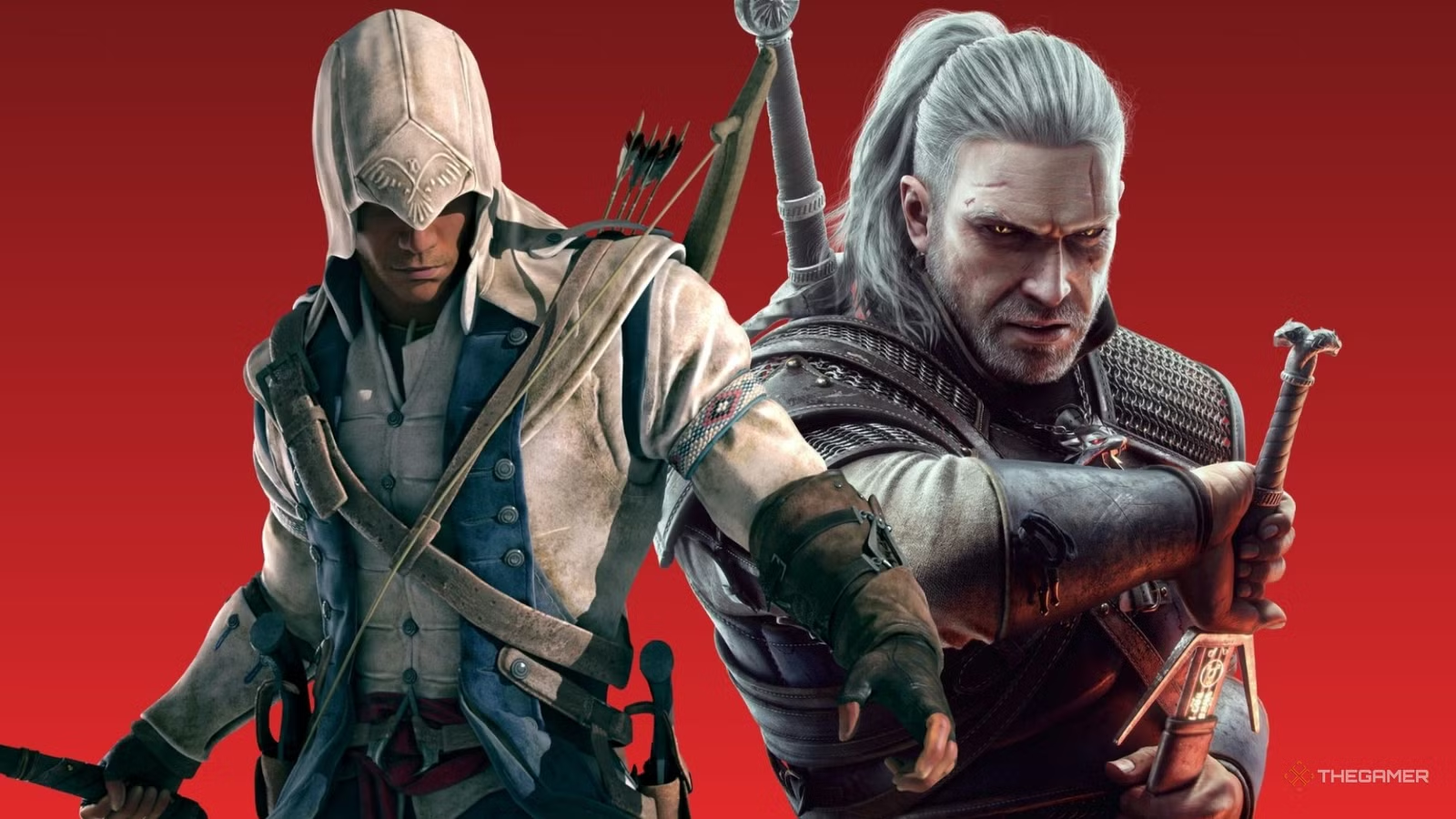
Assassin's Creed 3

Assassin's Creed 3 has a strange opening few hours. At the start, you play as Haythem Kenway for a while, as you learn the mechanics of the game. This builds nicely until you switch to the actual main character, his son, Connor. He's just a kid, so now you have to watch him grow up. It feels so slow compared to the Haythem missions.
The sequence wouldn't actually be as bad if the game started with it. But by the end of Haythem's sequence, you're ready for the game to open up, not get more linear and tutorial-heavy. It really hurts the pace of the game and likely drives some people away.
Pokemon Sun And Moon

Pokemon games aren't known for being fast-starting ones. The early hours are always spent introducing you to the concept of Pokemon in general, combat mechanics, and how to catch more Pokemon. Modern games like Sun and Moon have made things even worse by including a lot more cutscenes and dialogue.
Sometimes plenty of cutscenes at the start of games can be exciting, but Pokemon is hardly a narrative-focused series. So, the scenes aren't exactly riveting. Once you get past all that, though, and the many tutorials, Sun and Moon is a fun Pokemon adventure.
Spec Ops: The Line

In the early hours of Spec Ops: The Line, you will be forgiven for believing that you're playing a fairly average third-person military shooter. Therefore, it's forgivable if you quit at that point. Yet, when you play longer, you begin to discover that there is more to this game than it initially seems. The shooting mechanics remain average, but the characters and story get more compelling.
The horrible events unfolding throughout the adventure slowly begin to affect the main character's mind. As a result, the game starts messing with your brain a bit, too. It's actually more effective because the game just feels like a standard shooter at first, meaning you don't see the strangeness coming.
Yakuza 3

All of the Yakuza (aka Like A Dragon) games are great, but Yakuza 3 doesn't get off to a strong start. You play as the series' protagonist and former Yakuza member, Kiryu, who has left his previous life behind and is now running an orphanage.
Because of that, the first few hours of the game aren't very action-packed, nor are there many big story moments. Instead, you're just helping out the orphans by completing some fairly mundane missions. It's clearly an attempt to establish what Kiryu's life is now like. However, it drags on a bit too long, and the game doesn't begin to get interesting until you leave the orphanage.
The Witcher 3: Wild Hunt

The storytelling of The Witcher 3 is typically cited as the best part of the game. Unfortunately, that doesn't really get going until you leave the prologue area known as White Orchard. While here, you just go about your monster-hunting business.
It's fine, but this section of the game isn't why many consider The Witcher 3 to be an iconic RPG. Once you get out of White Orchard, you meet some of the main characters and learn about your job to find Ciri. The story really kicks into gear at this point.
Heavy Rain

Heavy Rain is a thrilling narrative adventure game revolving around a compelling mystery. It doesn't begin in a very compelling way, though. This is because before the story kicks in, you simply control a suburban dad named Ethan, who needs to go about his daily duties.
You brush your teeth, shave, have a shower, get dressed, and do various other mundane things. In the process, you're taught the basic mechanics of the game, but it isn't exciting. It's a very dull stretch of the game that is easy to give up on. The title doesn't really get entertaining until the mystery picks up.
Metal Gear Solid 5: The Phantom Pain

Most Metal Gear Solid games have strong and exciting prologues that set up the rest of the story. However, the narrative of Phantom Pain was set up in MGS5: Ground Zeroes, which is technically a separate game.
So, Phantom Pain begins with you waking up in a coma. Then, when you actually have the ability to move, your legs don't work very well, meaning you keep falling down. After this, you crawl around in a very linear, hand-holding section as you make it through the rest of the intro. It's very slow, and the gameplay doesn't reflect the quality of the rest of the game.
Driver

The original Driver game on the PS1 has one of the most infamous intros in gaming history. Right at the start, you get a list of things you need to accomplish: burnout, handbrake, slalom, 180°, 360°, reverse 180°, speed, brake test, and lap. You don't get told how to do any of these things, but you have to do them all in 60 seconds.
While there are instructions on how to do everything in a hidden menu, most people don't find that. Instead, they fail a bunch of times and quit the game. Sadly for them, the game actually gets really good after this very frustrating sequence.
Source link