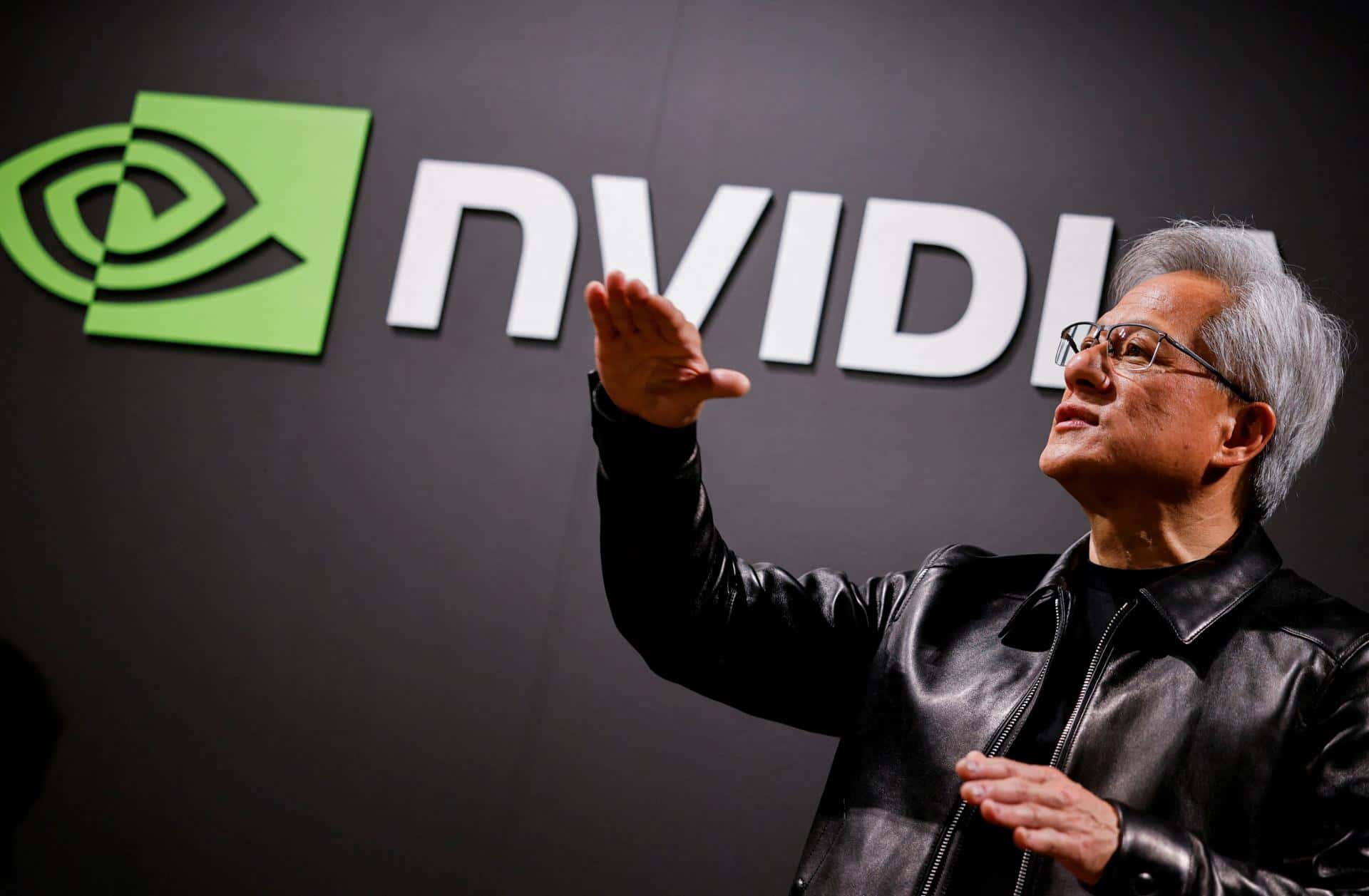
Nvidia’s CEO says AI systems, enterprise demand, and full-stack infrastructure can drive another year of breakout growth
Nvidia CEO Jensen Huang said the company could grow revenue by 70% year over year next fiscal year, extending its AI infrastructure run.
The company sits in the AI and enterprise infrastructure stack, with Huang arguing Nvidia now sells full systems, not just chips, and that one connected GPU system can cost $8.5 million.
Huang cited broad demand across customers and partners including Amazon, Microsoft, Google, Anthropic, and OpenAI, while also pointing to 27% month-to-month sales growth for one Blackwell-based system.
Nvidia also defended scrutiny around its startup investment strategy, with Huang saying the company has visibility into $100 billion worth of contracts before backing companies.
For startups building on AI, the takeaway is straightforward: Nvidia’s growth thesis is really a demand thesis for data centers, cloud capacity, and AI-native software spending.
At a time when many founders are asking whether AI infrastructure demand has peaked too early, Nvidia CEO Jensen Huang is making the opposite case. Nvidia, the AI chip and computing giant founded in 1993, said it could grow revenue by 70% next year, a projection Huang reiterated this week as he laid out why he believes demand for the company’s systems will remain elevated well into the next cycle. The statement matters beyond Wall Street because Nvidia has become a core supplier to hyperscalers, AI labs, neoclouds, and startup ecosystems that now shape how AI products are built and funded globally.
The sharpest part of Huang’s argument is that Nvidia should no longer be analyzed like a component vendor. He said many people still think Nvidia builds a chip, when in practice the company is shipping much larger integrated systems tied together with NVLink, power, cooling, networking, and software. Huang said one GPU is no longer a $399 gaming part but an $8.5 million system with 2 million parts and 250,000 kilowatts, which is a useful framing because it shifts the debate from semiconductor competition to full-stack infrastructure lock-in. Huang said Nvidia runs every model and serves every major lab, including Anthropic, OpenAI, Google, and open-weight model providers.
Huang said analysts expect Nvidia to end its current fiscal year at about $400 billion in revenue. If the company grows 70% next year, that would imply around $680 billion in revenue.
He also pointed to current order momentum to support that confidence. A computer system combining 36 Grace CPUs with 72 Blackwell GPUs is seeing 27% month-to-month sales growth, according to Huang. That detail is more revealing than a headline growth forecast because it suggests demand is shifting from experimental AI buying to scaled procurement of complete compute clusters, the kind of purchasing behavior usually seen only when customers have conviction on near-term deployment.
There is a second layer to Nvidia’s pitch, and this is where the startup angle becomes more interesting. Huang argued that Nvidia now has unusual visibility into the AI economy because the company works across suppliers, OEMs, neoclouds, cloud providers, AI-native startups, and data center builders. He said Nvidia is tracking every single gigawatt of land, power, and shell around the world, referring to the shell of a data center building before it is fitted with computing gear. My read is that this is less a claim about market share and more a claim that Nvidia can see capex formation before revenue shows up on the income statement.
That matters for regions where the AI buildout has looked more fragmented than in the U.S. or China. Startups may not buy frontier-scale clusters outright, but they are increasingly downstream consumers of the same capacity through cloud credits, inference platforms, and enterprise AI tooling. If Nvidia is right that demand remains structurally strong, then SaaS and AI startups may keep benefiting from access to rented compute even if they cannot own the infrastructure themselves. If Nvidia is wrong, the correction will likely first show up in cloud pricing, GPU availability, and startup burn discipline.
The Full-Stack Lock-In
Jensen Huang’s projection of 70% year-over-year revenue growth is a deliberate reframing of Nvidia’s core identity: it is no longer a merchant semiconductor vendor; it is a closed-loop infrastructure monopoly. By shifting the pricing narrative from a standalone GPU to an $8.5 million integrated Blackwell-based system, Huang is making a profound strategic declaration. The battleground for AI dominance is no longer waged purely at the silicon level. It is fought across power density, NVLink networking, and cooling architecture. This full-stack integration creates an almost insurmountable moat, forcing hyperscalers and neoclouds to absorb Nvidia’s gross margins across the entire data center bill of materials.
CapEx Telemetry as an Unfair Advantage
Huang’s defense of Nvidia's aggressive startup investment strategy reveals the company’s true structural edge: unprecedented telemetry into global capital expenditures. When Nvidia claims line-of-sight into $100 billion worth of enterprise contracts, it confirms that its venture arm is not operating as a traditional financial investor. Instead, Nvidia is effectively securitizing future compute demand. By backing AI-native startups that possess guaranteed hardware procurement pipelines, the company acts as a macroeconomic coordination layer. It spots enterprise budgets hardening, deploys capital to accelerate that demand, and captures the resulting infrastructure spend.
The Downstream Reality for Founders
For the broader venture ecosystem, Huang’s demand thesis carries a sobering reality. If Nvidia’s growth trajectory holds, it confirms that the overwhelming majority of economic value in the current AI cycle is still accruing at the foundational compute layer. For application-layer startups, this means unit economics will remain permanently tethered to upstream cloud pricing and GPU availability. In a market where a single infrastructure provider dictates the cost structure of every downstream API call, operational efficiency and burn discipline will dictate survival long before model capability does.
Why It Matters
The most useful way to read Huang’s comments is not as a defense of Nvidia’s stock multiple but as a map of where value is concentrating in AI. Over the last two years, much of the startup conversation has centered on models and applications. Yet the companies capturing the deepest economic control are still the ones that sit underneath those layers, whether through chips, systems, networking, or cloud distribution. Nvidia’s claim that it is a foundational platform of the AI ecosystem is not just branding. It reflects the reality that model builders, cloud providers, and enterprise software startups are all still dependent on the same infrastructure rails.
That dependence also explains why scrutiny around Nvidia’s investment model has intensified. The company has invested in startups that go on to buy Nvidia hardware, prompting comparisons to circular financing structures that have historically ended badly in tech. Huang’s response was blunt. He said Nvidia puts in a little bit of money and a lot comes back, adding that he has seen $100 billion worth of such contracts and does not want to take risks without real revenue visibility. Huang said Nvidia first makes sure these companies have real contracts generating revenue from customers before making those bets.
Key figures from Huang’s case: $8.5 million for one connected GPU system, 2 million parts, 250,000 kilowatts, 27% month-to-month sales growth for one Blackwell-based system, and $100 billion worth of contracts reviewed in connection with startup demand.
I think this is the part many startup operators should watch most closely. Nvidia is effectively saying it is not just selling into demand, it is helping shape demand where it sees committed enterprise spending. That has implications for the venture market too. If infrastructure vendors can identify where enterprise AI budgets are hardening, capital may keep flowing toward startups closest to procurement and production use cases, not just toward those with the biggest model claims.
What’s Next
There is still a real counterargument, and Huang himself indirectly acknowledged it. A large share of current AI demand comes from AI-native startups that are raising huge amounts of capital and spending a significant portion of that on AI usage. Over time, those companies are likely to become more efficient with infrastructure and tokens. When that happens, the growth rates that look normal in this phase may not remain normal. History says every dominant computing layer eventually faces pricing pressure, product substitution, or architectural change.
Still, Nvidia’s near-term position looks stronger than the usual disruption script suggests. The company is not only competing with custom chips from Amazon, Microsoft, and Google, but also selling into the broader ecosystem that surrounds them. It is tied to memory suppliers, data center buildouts, AI labs, and startup customers at the same time. For many regions where most AI companies are still application-first businesses sitting on top of global infrastructure, Huang’s thesis translates into one immediate reality: the AI product cycle remains tied to the economics of upstream compute, and Nvidia still has more influence over that equation than almost any other company in tech.
That is why Jensen Huang explains why Nvidia will keep growing in terms that are bigger than a single earnings year. He is arguing that Nvidia has become a coordination layer for the AI economy, with visibility into supply, demand, and deployment that few others can match. Whether that lasts for several years is an open question. For the next year, though, his case rests on something concrete: orders are still growing, systems are getting larger, and the buyers that matter are still spending.
Frequently asked questions
Why does Jensen Huang think Nvidia will grow 70% next year?
Jensen Huang says Nvidia can keep growing because demand is expanding beyond chips into full AI systems and infrastructure. He argues that cloud providers, enterprises, and global partners are still investing heavily in AI data centers.
What did Jensen Huang say Nvidia sells now besides chips?
Huang said Nvidia is no longer just selling semiconductors but complete connected computing systems. That matters because full-stack infrastructure carries much higher value per deployment than individual GPUs alone.
How expensive is an Nvidia AI system, according to Jensen Huang?
Huang said one connected Nvidia GPU system can cost about $8.5 million. That price point shows why even a modest increase in system deployments can translate into major revenue growth.
Who is driving demand for Nvidia’s AI infrastructure?
Huang pointed to broad demand from major cloud companies, enterprise customers, and ecosystem partners. Large buyers such as Amazon and Microsoft help support Nvidia’s view that AI infrastructure spending remains strong.
Is Nvidia’s projected 70% growth tied only to AI hype?
No, Huang’s argument is based on actual infrastructure build-outs, not just market excitement. He says companies are making long-term capital investments in data centers, networking, and accelerated computing.
Why is Nvidia’s business model stronger if it sells full systems?
Selling full systems gives Nvidia more revenue per customer and embeds its technology deeper into AI deployments. It also makes the company harder to replace because customers rely on its chips, software, networking, and integrated platforms together.