Why electricity has become the world's most valuable commodity in the age of AI
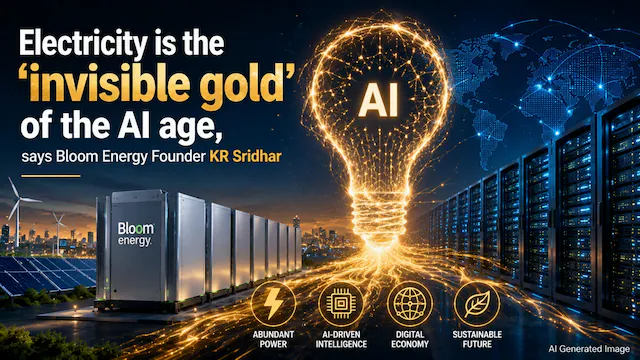
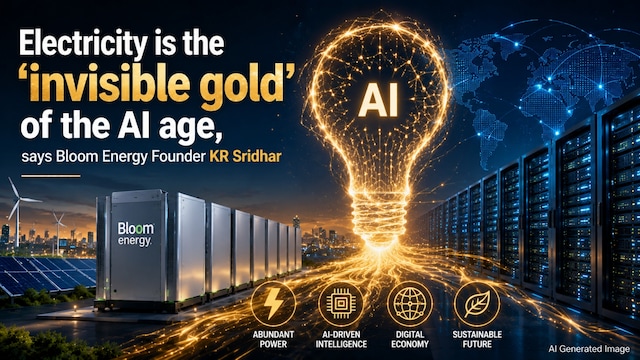
Artificial intelligence is transforming electricity into the world's most valuable resource, according to Bloom Energy founder KR Sridhar. Calling power the “invisible gold” of the AI age, he said the rapid growth of data centres and advanced AI chips is driving an unprecedented surge in electricity demand, making reliable and affordable power critical to economic growth and technological leadership.
3 Min Read


Electricity has become the most valuable commodity in the era of artificial intelligence, according to KR Sridhar, Founder, Chairman and CEO of Bloom Energy, who said AI is fundamentally changing the role of power in the global economy.
In an exclusive interview with CNBC-TV18, Sridhar said AI has accelerated a transition that Bloom Energy had anticipated a quarter century ago, with electricity becoming the backbone of a digital world.
He said AI is creating a new industry where intelligence itself is being manufactured, with electricity and data serving as the key inputs.
"For the first time in human history, we are manufacturing intelligence as a product, as a commodity. That's amazing," he said.
According to Sridhar, the surge in computing requirements is leading to an unprecedented rise in electricity consumption. A server rack that previously consumed power equivalent to around 20 Indian homes now uses electricity comparable to more than 300 homes. Future generations of AI chips could require as much power as 2,000 to 3,000 homes for a single rack, he said.
The Bloom Energy chief said the company had built its technology platform with the digital era in mind, allowing electricity to be produced directly where it is consumed rather than relying on conventional power generation and transmission systems.
He said Bloom's fuel-cell technology eliminates several conversion stages found in traditional power infrastructure and provides direct-current architecture suited for AI data centres.
"From a data centre and AI perspective, there is not a solution in the world — even on the horizon — that comes anywhere close to where we are today," he said.
Sridhar said Bloom's systems can achieve overall efficiency of more than 90% when waste heat is used for cooling, compared with around 30%-35% utilisation in conventional setups.
He added that carbon capture and sequestration could eventually allow the company to deliver power with no carbon emissions while maintaining reliability.
"It is not an argument between the environment and the economy. We don't believe in 'or'; it's 'and' — good for the environment and good for the economy," he said.
Despite concerns about massive spending on AI infrastructure, Sridhar said the long-term trajectory remains intact because investments are being driven by companies with strong balance sheets.
"There may be bumps, but is this trajectory headed upward? Absolutely. This genie is not going back into the bottle. The AI genie is not going back into the bottle," he said.
Sridhar said electricity has become as essential to modern life as food, water and shelter, adding that abundant and affordable access to power would determine future opportunities for billions of people.
In an exclusive interview with CNBC-TV18, Sridhar said AI has accelerated a transition that Bloom Energy had anticipated a quarter century ago, with electricity becoming the backbone of a digital world.
"We used to call oil liquid gold. Electricity in this age is the invisible gold," Sridhar said.
He said AI is creating a new industry where intelligence itself is being manufactured, with electricity and data serving as the key inputs.
"For the first time in human history, we are manufacturing intelligence as a product, as a commodity. That's amazing," he said.
According to Sridhar, the surge in computing requirements is leading to an unprecedented rise in electricity consumption. A server rack that previously consumed power equivalent to around 20 Indian homes now uses electricity comparable to more than 300 homes. Future generations of AI chips could require as much power as 2,000 to 3,000 homes for a single rack, he said.
The Bloom Energy chief said the company had built its technology platform with the digital era in mind, allowing electricity to be produced directly where it is consumed rather than relying on conventional power generation and transmission systems.
He said Bloom's fuel-cell technology eliminates several conversion stages found in traditional power infrastructure and provides direct-current architecture suited for AI data centres.
"From a data centre and AI perspective, there is not a solution in the world — even on the horizon — that comes anywhere close to where we are today," he said.
Sridhar said Bloom's systems can achieve overall efficiency of more than 90% when waste heat is used for cooling, compared with around 30%-35% utilisation in conventional setups.
He added that carbon capture and sequestration could eventually allow the company to deliver power with no carbon emissions while maintaining reliability.
"It is not an argument between the environment and the economy. We don't believe in 'or'; it's 'and' — good for the environment and good for the economy," he said.
Despite concerns about massive spending on AI infrastructure, Sridhar said the long-term trajectory remains intact because investments are being driven by companies with strong balance sheets.
"There may be bumps, but is this trajectory headed upward? Absolutely. This genie is not going back into the bottle. The AI genie is not going back into the bottle," he said.
Sridhar said electricity has become as essential to modern life as food, water and shelter, adding that abundant and affordable access to power would determine future opportunities for billions of people.
(Edited by : Prashant)
Source link