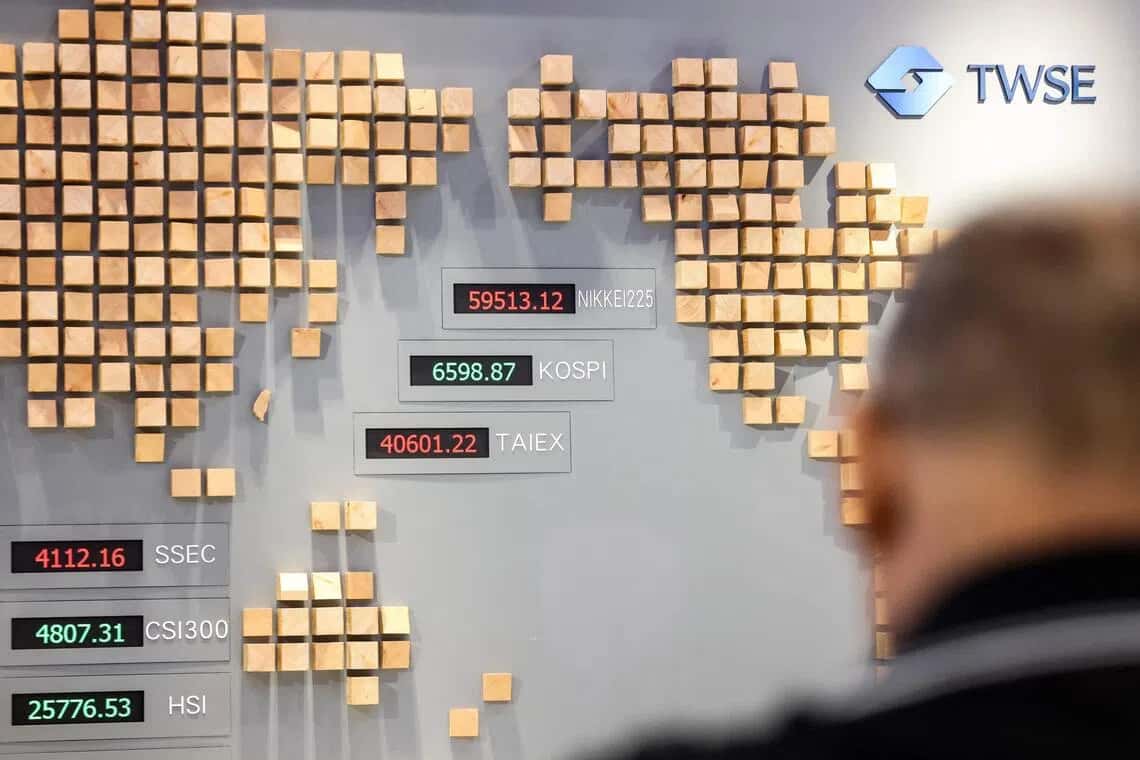
Taipei uses chip leverage to position itself as a trusted AI supplier as allies seek broader access to advanced semiconductors.
Taiwan used a major trade show last week to position itself as a democratic and reliable supplier to the AI economy as allies press for wider access to advanced chips.
The story sits squarely in the semiconductor sector, where Taiwan’s manufacturing dominance is increasingly being used as geopolitical and commercial capital.
The pressure point is not funding but allocation, with allies seeking a larger share of AI compute and chip capacity.
Taipei’s next move is likely to center on tighter cooperation with like minded economies while still protecting the strategic edge that gives it influence in the first place.
Taiwan, the global center of advanced semiconductor manufacturing, is turning chip supply into a form of statecraft just as demand for AI infrastructure begins to outstrip the willingness of governments to treat chips as a purely commercial product. At a major trade show last week, Taiwan presented itself as a dependable democratic partner for the AI era, a message aimed at allies that want more access to critical semiconductors without deeper exposure to supply chain risk. The move matters because Taiwan is not merely another hardware exporter, it is the manufacturing base on which much of the AI stack now rests. Built over decades through ecosystem development rather than startup speed alone, Taiwan’s semiconductor complex has become the rare technology asset that carries both pricing power and diplomatic weight.
The notable part is not that Taiwan is asserting itself. It is that it now has to do so while being asked to share more of the gains from an AI boom built on capacity that remains scarce. Countries aligned strategically with Taipei and Washington increasingly want a bigger piece of the compute chain, whether through access to advanced chips, co-development, packaging, testing, or local assembly. In practical terms, this creates a difficult balancing act. Taiwan wants to be seen as open and collaborative, but not so open that it weakens the very concentration of know how and manufacturing discipline that gives it global relevance.
That tension is already visible across Asia. For countries in South and Southeast Asia, the AI opportunity is not just about building models, it is about capturing pieces of the hardware, data center, and electronics value chain before the ecosystem hardens around a small set of established hubs. Taiwan’s message to partners is effectively this: it remains willing to cooperate, but cooperation will happen on terms that preserve its strategic centrality. That is a rational position. When an ecosystem sits at the heart of a constrained market, it does not dilute its moat casually.
The absence of startup style metrics such as fresh funding, valuation, or investor syndicates does not make this any less relevant to the venture and tech ecosystem. In fact, it sharpens the point. This is one of those stories where geopolitical positioning is upstream of venture outcomes. Founders building AI infrastructure, data centers, robotics, industrial software, or edge computing across South and Southeast Asia will all feel the effects of who gets supply priority, who gets packaging support, and which governments are treated as trusted long term partners in the semiconductor chain.
There is also a second layer here that much of the broad coverage tends to miss. Taiwan is not just defending share, it is defending narrative. In AI, narrative matters because governments are now active buyers, subsidizers, and gatekeepers. By emphasizing reliability and democratic alignment, Taiwan is trying to differentiate itself from a pure cost or volume argument. That matters to countries reassessing concentration risk after years of supply chain shocks, export controls, and a more openly strategic technology order.

The Weaponization of the Silicon Shield
Taiwan’s messaging at SEMICON Taiwan is a masterful evolution of its "Silicon Shield" doctrine. Historically, Taipei relied on its indispensable manufacturing base as a passive deterrent against regional aggression. Now, as global demand for AI compute vastly outstrips advanced packaging capacity, Taiwan is weaponizing that scarcity. By explicitly gating its semiconductor supply behind the rhetoric of "democratic alignment," Taipei is forcing Western and Asian allies to actively underwrite its national security in exchange for hardware allocation.
The Geopolitical Tiering of Compute
This shift moves the semiconductor market away from a free-market capital allocation model into a strict geopolitical tiering system. For enterprise buyers, hyperscalers, and sovereign AI initiatives across India and Southeast Asia, this means CapEx alone is no longer enough to secure priority access to the AI stack. Procurement is now fundamentally tied to statecraft. If a nation is not viewed as a core strategic ally, its native tech ecosystems will be systematically starved of the highest-end silicon and advanced packaging support.
The Edge Strategy for Peripheral Hubs
Consequently, the opportunity for emerging Asian tech hubs is not in displacing Taiwan—an impossible feat given its multi-decade integration of design, equipment, and fabrication—but in aggressively capturing the secondary layers of the AI supply chain. Startups and governments in India and Southeast Asia must focus on high-margin power systems, thermal management infrastructure, outsourced semiconductor assembly and test (OSAT) facilities, and specialized data center software. Taiwan has clearly signaled it will fiercely defend the atomic center of AI compute; the rest of the world must now compete to monetize its orbit.
Why It Matters
My read is that Taiwan’s chip diplomacy is becoming less about persuasion and more about structured scarcity. For the past few years, countries have spoken about supply chain resilience as if it were mostly a diversification exercise. It is not. In semiconductors, resilience still runs through a handful of chokepoints, and Taiwan remains the most important of them. When Taipei signals that it is a trusted supplier, it is also signaling that trust is now a condition of access, not just a diplomatic courtesy.
This has clear implications for South and Southeast Asia. India wants to build a semiconductor manufacturing base and has spent the last few years pushing policy incentives, assembly ambitions, and ecosystem partnerships. Southeast Asian economies, especially those with strength in electronics manufacturing and backend operations, want a larger role in packaging, testing, and AI hardware supply chains. Taiwan’s stance suggests there will be openings, but not a wholesale redistribution of the highest value layers. The center of gravity is still likely to stay in Taiwan for the foreseeable future, even as peripheral capacity and strategic partnerships spread outward.
That is why this story should be read alongside three wider developments. First, the AI boom has made semiconductor allocation a boardroom issue for every serious cloud, model, and enterprise software company. Second, export controls and industrial subsidies have turned national alignment into a practical variable in tech planning. Third, countries across Asia are trying to move up from electronics manufacturing into more defensible positions in chips and AI infrastructure. Taiwan sits in the middle of all three currents.
The comparison set is instructive. The US has tried to rebuild domestic chip capacity through incentives and strategic pressure. Japan has pushed to revive parts of its semiconductor base through public private coordination. South Korea continues to operate from strength in memory and advanced manufacturing. Taiwan is taking a different route. It is not simply competing on incentives or volume, it is using trust and indispensability at the same time. That is a stronger hand than many policymakers elsewhere would like to admit.
What’s Next
The next phase is likely to be less about slogans and more about controlled partnership. Allies will keep pressing Taiwan to share more of the AI upside, whether through investment, technology collaboration, or local ecosystem development. Taipei, in turn, will probably widen cooperation where it reinforces political support and supply chain resilience, while keeping the deepest concentration of expertise protected. That is how mature industrial powers behave when they know their advantage is hard won and difficult to replicate.
For startup founders and investors in this region, the takeaway is straightforward. AI opportunity will not be captured only at the application layer. It will also accrue to companies that sit near the physical stack, power systems, cooling, semiconductor design tools, industrial automation, testing, packaging, and specialized infrastructure software. Taiwan’s latest positioning makes that chain more visible. It also makes clear that access to the most strategic part of that chain will be mediated by politics as much as by price.
In that sense, the story is larger than a trade show appearance in Taipei. It marks a shift from semiconductor dependence being treated as an awkward fact to being used as an explicit instrument of alignment. That trend will shape decisions far beyond Taiwan, from Indian semiconductor policy to Southeast Asia’s electronics ambitions to how AI companies think about capacity risk. Comparable pressure points are already visible across the broader chip ecosystem, though each enters the moment from a different position. Taiwan’s advantage today is that it remains the one node almost everyone needs, and that makes its diplomacy unusually credible.
Frequently asked questions
Why is Taiwan using chip diplomacy right now?
Taiwan is using chip diplomacy because its semiconductor industry is central to the global AI economy. By highlighting itself as a reliable democratic supplier, Taiwan is trying to strengthen alliances while responding to growing pressure to share access to advanced chips.
What does chip diplomacy mean in Taiwan’s case?
In Taiwan’s case, chip diplomacy means using its dominance in advanced semiconductor manufacturing as strategic leverage in trade and foreign policy. It lets Taiwan deepen ties with allies that depend on its chips for AI, defense, and high-performance computing.
Why are US allies asking for more access to Taiwan-made AI chips?
US allies want broader access because advanced chips are essential for building AI infrastructure, training models, and supporting cloud and defense systems. The issue is less about money and more about limited supply and who gets priority allocation.
How does Taiwan benefit from promoting itself as a trusted AI chip supplier?
Taiwan benefits by reinforcing its value to democratic partners and making itself harder to sideline in global tech policy. That positioning can improve trade leverage, attract investment, and strengthen political support during periods of regional tension.
What role do trade shows play in Taiwan’s semiconductor strategy?
Major trade shows give Taiwan a global stage to signal reliability, innovation, and capacity to customers, investors, and governments. They also help frame Taiwan not just as a manufacturer, but as a strategic partner in the AI supply chain.
Could Taiwan’s chip diplomacy reshape the global AI supply chain?
Yes, Taiwan’s chip diplomacy could influence how advanced semiconductors are allocated among allied economies. If successful, it may push companies and governments to build AI partnerships around trusted suppliers, resilience, and geopolitical alignment.