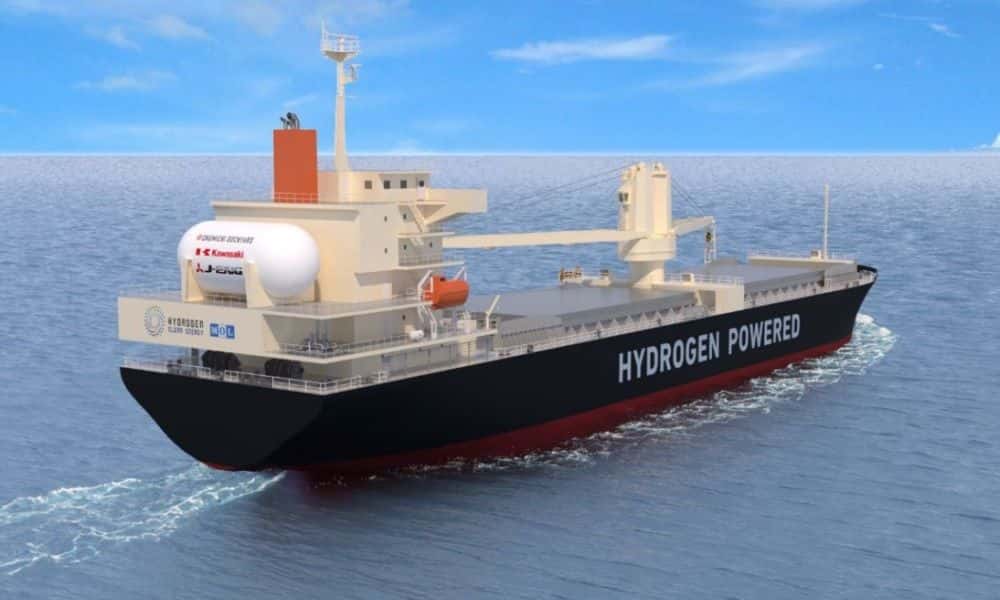
Newlight says a retrofit saved a bulk carrier $500,000 a year over an 8,500-nautical-mile commercial route.
Hydrogen is getting a real commercial test in shipping, and the early numbers are hard to ignore. A maritime energy company called Newlight says its hydrogen-hybrid retrofit helped a bulk carrier cut fuel use by 24% over an 8,500-nautical-mile voyage from Singapore to Ghana, a result that matters because fuel is one of the biggest costs in global shipping, and those costs eventually show up in what consumers pay.
Here’s why this stands out right now: this was not a lab demo or a short harbor run. The system was installed on a working 199-meter, 57,038-DWT Lomar Shipping bulk carrier, paired with its existing marine diesel engine, and used on a real commercial trip, which is the kind of proof shipowners and financiers usually want before they take retrofit technology seriously.
Newlight said the voyage also delivered a 28% reduction in CO2 emissions and a 22% decrease in carbon monoxide emissions. The company is framing the system as an add-on rather than a full replacement, which is a practical distinction in an industry that cannot easily swap out expensive ships overnight.
The setup works by feeding a controlled amount of hydrogen into the combustion process of a conventional marine diesel engine. A real-time controller adjusts the hydrogen flow based on operating conditions like engine load and speed, with the goal of extracting more usable energy from each combustion cycle. In plain English, the company is trying to make the diesel engine burn smarter, not asking shipowners to abandon it all at once.
That matters because shipping is full of long-lived assets. A large vessel can stay in service for decades, and replacing it with an alternative-fuel ship usually means a major capital decision, a long wait at the shipyard, and a bet on fuel infrastructure that may not be available on every route.
Newlight says its retrofit can be installed in one to two weeks and does not require drydock. For operators, that is the kind of detail that can matter as much as the emissions math. Less downtime means less lost revenue, and in shipping, idle days quickly become expensive days.
The CapEx Arbitrage of Maritime Decarbonization
This analysis correctly identifies the core mechanism driving heavy-industry climate tech: adoption moves fastest when decarbonization is packaged as an operational efficiency upgrade rather than a hardware replacement. Newlight’s hydrogen-hybrid retrofit is a textbook example of "brownfield" innovation—improving existing infrastructure instead of waiting for a utopian "greenfield" future.
For enterprise shipping operators, this boils down to Capital Expenditure (CapEx) arbitrage. The global fleet is dominated by vessels with 20- to 30-year lifespans. Forcing an operator to scrap a mid-life bulk carrier and commission a $40 million to $60 million zero-emission newbuild destroys their balance sheet.
By contrast, Newlight's retrofit can be integrated while the vessel remains in the water, entirely bypassing the multi-week, multi-million-dollar opportunity cost of drydocking. With estimated annual savings of $500,000 and a payback period under 18 months, the retrofit transforms decarbonization from a compliance tax into a yield-generating asset.
The "Dual-Fuel" Safety Net
The strategic brilliance of this specific architecture is its failure mode. A purely hydrogen-powered vessel is geographically tethered to ports with mature hydrogen bunkering infrastructure—a massive operational constraint in global tramp shipping (where bulk carriers go wherever the cargo dictates).
Because the Newlight system injects a controlled hydrogen proportion into the existing diesel combustion process via an AI-guided controller, the vessel retains 100% of its legacy capability. If the Lomar bulk carrier arrives in a port with zero hydrogen supply, the system seamlessly reverts to burning pure Heavy Fuel Oil (HFO). This eliminates the infrastructure dependency risk that has paralyzed fleet operators from committing to alternative fuels.
The Regulatory Catalyst
While the 24% reduction in fuel consumption drives the pure operating margin, the 28% reduction in CO2 emissions is arguably more valuable defensively.
The maritime sector is currently facing a regulatory squeeze. With the inclusion of shipping in the EU Emissions Trading System (ETS), carbon penalties are now adding approximately €1.3 million in annual operating costs for a typical large vessel. By shaving over a quarter off a ship's carbon footprint, a retrofit system acts as a direct hedge against escalating carbon taxes and ensures aging vessels remain compliant with the International Maritime Organization's (IMO) tightening emission frameworks.
Explore how fluctuations in fuel prices and carbon taxes impact the payback period of a hydrogen-hybrid retrofit:
Why this matters
The broader business case is where this story gets interesting. Newlight projects annual savings of roughly $500,000 for similar ships and says the payback period could come in below 18 months. That is a striking number, not because projections always hold, but because shipping companies tend to adopt climate tech faster when it looks like cost reduction with a compliance benefit attached.
Shipping moves more than 80% of global trade by volume, according to the source material, and fuel can account for roughly half of a vessel’s operating expenses. That means a technology that trims fuel use without forcing a full fleet replacement hits the industry in the one place that usually drives action fastest: the operating margin.
For North America, this is bigger than one voyage on another trade lane. US and Canadian ports, cargo owners, and logistics companies are under pressure to lower the carbon footprint of supply chains, but they are also dealing with stubborn cost inflation and volatile energy prices. A retrofit that can work on existing vessels offers a more near-term path than waiting for every port to build out new fuel systems for methanol, ammonia, or fully hydrogen-powered ships.
My read is that the most overlooked angle here is not the hydrogen itself. It is the retrofit thesis. Climate technology often gets pitched as replacement technology, but in heavy industry, the winners are often the products that slip into existing systems with minimal disruption. That is as true in factories and data centers as it is at sea.
There is also a financing angle. A technology that can be added to an operating vessel in one to two weeks, with no drydock, is easier to underwrite than a wholesale propulsion change. Investors and lenders like assets that keep earning while they decarbonize, and shipowners prefer solutions that do not force them into a binary choice between legacy diesel and a future fuel market that is still developing.
What happens next
Newlight says it now has agreements covering 12 vessels across several shipping companies, with broader fleet deployments planned for next year. The company has also received regulatory approval from RINA, a classification society whose role is essentially to certify whether maritime equipment meets technical and safety standards. That approval does not guarantee market adoption, but it removes one of the early barriers that often slows marine innovation.
The next challenge is scale and consistency. One successful long voyage is meaningful, but shipowners will want to know whether the same performance holds across different ships, engine types, weather conditions, cargo loads, and routes. Shipping technology has a habit of looking persuasive on a pilot and much messier in fleet-wide reality.
Still, the timing is good for a company making this pitch. The maritime sector is searching for lower-emissions options that do not depend on a single fuel winner emerging immediately. Batteries work well in some short-sea routes, but not every vessel can electrify. Ammonia and methanol have momentum, but infrastructure and vessel readiness remain uneven. LNG helped some operators cut certain emissions, but it has not ended the search for a more durable long-term answer.
That is why hybrid approaches are drawing fresh attention. Instead of waiting for a perfect zero-emissions vessel architecture, shipowners can pursue incremental gains that stack up over time. A 24% reduction in fuel consumption on one vessel does not solve shipping’s climate problem, but if similar results prove repeatable across a portion of the global fleet, the cumulative effect could be material.
This also fits a wider pattern across industrial decarbonization. Companies are increasingly selling efficiency layers on top of incumbent systems, not just brand-new hardware. In transport alone, there has been rising interest in dual-fuel engines, alternative marine batteries, and low-carbon liquid fuels that preserve some compatibility with existing equipment. The logic is straightforward: if the installed base is enormous, the retrofit opportunity is enormous too.
There is a startup lesson here as well. Founders building for heavy industry often get told to pursue moonshots, but the more durable businesses are sometimes built around ugly, operational problems that save customers money immediately. Newlight’s bet appears to be that decarbonization in shipping will be adopted not only as a moral or regulatory necessity, but as an efficiency product. I think that is a sharper commercial position than many climate startups manage.
Other developments in maritime and transport energy point in the same direction. There has been stronger attention on marine battery systems designed for safety and density, continued investment in hydrogen systems beyond road transport, and renewed work on lower-carbon fuels that can extend the life of existing engines rather than eliminate them. Different technologies will fit different vessel classes, but the common thread is clear: the industry is trying to lower emissions without freezing operations.
That does not mean hydrogen-hybrid retrofits will become the default answer. Fuel supply remains a practical constraint, and Newlight itself is emphasizing that operators can continue using diesel if hydrogen is unavailable. That flexibility is a commercial strength today, though it also shows how early this market still is. The transition is not linear when the supporting infrastructure is incomplete.
For cargo owners, retailers, and consumers in North America, the immediate takeaway is simple. If shipping companies can cut fuel use on long voyages without taking vessels out of service for long periods, that can help cushion freight costs while also lowering emissions. In a supply chain economy, efficiency at sea rarely stays at sea.
The real test now is repetition. If the company can deliver similar performance across those 12 vessels and different operating conditions, this starts to look less like a promising pilot and more like a category worth watching. Shipping does not change fast, but when economics and regulation start pulling in the same direction, adoption can move quicker than skeptics expect.
Frequently asked questions
How much fuel did the hydrogen-hybrid ship save on the voyage?
Newlight said its hydrogen-hybrid retrofit cut fuel use by 24% on an 8,500-nautical-mile trip from Singapore to Ghana. That makes the result notable because it came during a real commercial voyage, not a lab test or short trial.
How much money could the hydrogen-hybrid retrofit save a ship each year?
According to Newlight, the retrofit could save about $500,000 annually per vessel. The estimate matters because fuel is one of the largest operating costs in global shipping, so even modest efficiency gains can have a big financial impact.
Why does a 24% fuel cut matter for the shipping industry?
A 24% reduction is significant because shipping companies spend heavily on bunker fuel, and those costs ripple through global trade. Lower fuel burn can improve margins, reduce exposure to fuel-price swings, and help operators meet tougher emissions targets.
Was the hydrogen-hybrid system tested on a real commercial route?
Yes. Newlight said the system was used on a bulk carrier traveling roughly 8,500 nautical miles from Singapore to Ghana, giving the claim real-world commercial context. That makes the result more credible than a short demonstration under controlled conditions.
What is a hydrogen-hybrid ship retrofit?
A hydrogen-hybrid retrofit adds hydrogen-based power technology to an existing ship instead of building a brand-new vessel from scratch. In practice, the goal is to reduce conventional fuel consumption while improving efficiency on long voyages.
Could hydrogen-hybrid retrofits spread across more cargo ships?
They could if the savings hold up across more vessels and routes. Shipowners will likely look at fuel economics, retrofit costs, maintenance needs, and hydrogen supply before deciding whether the technology can scale commercially.