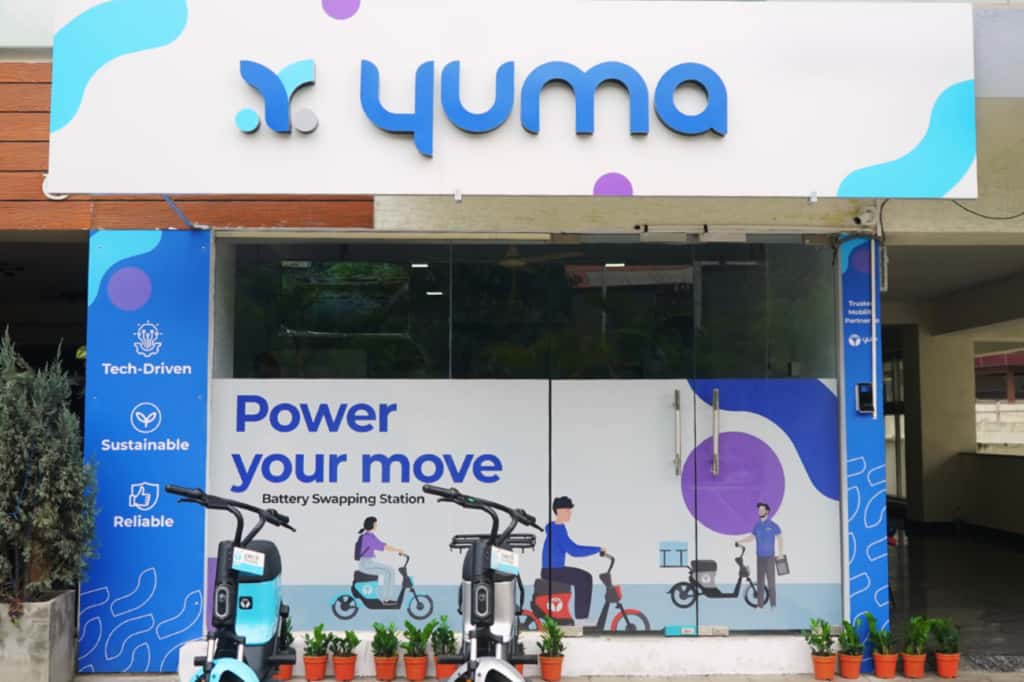
Indian EV battery swapping network Yuma Energy secured $35 million from Magna International to aggressively expand its infrastructure across India.
Yuma Energy Raises $35 Million From Magna To Power Up India's EV Battery Swapping Network
Yuma Energy, an Indian EV battery swapping network, secured $35 million in Series A funding.
The investment comes from Magna International, a global mobility technology company.
Yuma Energy plans to expand its battery swapping infrastructure across India, targeting EV users, fleet operators, and OEM partners.
The company aims to achieve EBITDA-positive operations by FY27, signaling a push towards sustainable growth.
This funding highlights the increasing investor confidence in India's EV charging and battery swapping ecosystem.
Yuma Energy, an emerging player in India's electric vehicle (EV) battery swapping infrastructure, has successfully raised $35 million in its Series A funding round. This substantial investment comes from Magna International, a global mobility technology company. The capital infusion is earmarked to significantly scale Yuma Energy’s operations and solidify its position within the rapidly expanding EV sector. The fresh capital will support Yuma Energy's next phase of strategic growth, focusing on a multi-pronged expansion strategy. This includes broadening its battery swapping network across more cities, diversifying its customer base to encompass individual EV users, large fleet operators, and strategic OEM partners, and further strengthening its underlying infrastructure and technology platform.
Such an expansion is critical for addressing the persistent range anxiety and charging time concerns that often hinder wider EV adoption in India. Yuma Energy has already established a significant footprint in the Indian market, having completed over 60 million battery swaps to date. Its operational network is powered by more than 100,000 batteries, supported by over 2,500 charging units, and accessible through more than 400 touch points spread across 18 cities. Muthu Subramanian, MD & GM, Yuma Energy, articulated the company’s vision, stating, "This investment is a strong vote of confidence in Yuma Energy’s mission to make battery swapping the backbone of electric mobility in India. Crossing 60 million swaps was a defining moment, and we’re accelerating our infrastructure rollout and deepening our partnerships with Fleets & OEMs to make swapping the default choice for every electric two- and three-wheeler on Indian roads."
Funding Snapshot:Yuma Energy secured $35 million in Series A funding from Magna International, signaling strong investor belief in the EV battery swapping sector.
The Broader Play in India's EV Ecosystem
The investment in Yuma Energy reflects a crucial trend in India's clean mobility transition. Battery swapping is increasingly viewed as a viable solution, particularly for the two-wheeler and three-wheeler segments that dominate India's urban commute and last-mile logistics. These segments benefit immensely from the quick turnaround times offered by swapping, minimizing vehicle downtime and maximizing operational efficiency for commercial fleets. The Indian government has also recognized the potential of this model to accelerate EV adoption by delinking battery costs from vehicle purchases and establishing interoperable standards.
This strategic funding from Magna International, a global leader in automotive components, also demonstrates the growing interest from international players in India's EV infrastructure market. The collaboration between Yuma Energy and Magna is expected to deepen partnerships with fleet operators and original equipment manufacturers (OEMs), expanding access to reliable and high-uptime battery swapping infrastructure. This collaboration could potentially set new benchmarks for efficiency and integration within the EV value chain, moving beyond just charging stations to a more dynamic energy solution.
Magna International's $35 million Series A injection into Yuma Energy represents the industrialization of India's Battery-as-a-Service (BaaS) sector. While traditional EV plug-in charging faces structural bottlenecks and long dwell times in densely populated Indian cities, battery swapping has emerged as the most viable solution to decouple battery costs from vehicle purchases for high-frequency commercial two- and three-wheelers.
The "Captive Demand" Advantage
What separates Yuma Energy from pure-play infrastructure startups is its structural origin. Originally formed as a joint venture between shared mobility platform Yulu and Magna, Yuma entered the market with a built-in "Customer Zero". By powering Yulu's massive electric fleet, Yuma guaranteed the baseline swap volume required to justify heavy upfront capital expenditures. Having surpassed 60 million swaps, Yuma is now utilizing this Series A funding to transition from a captive network to an open-access platform, explicitly targeting third-party original equipment manufacturers (OEMs) and last-mile delivery operators.
Vertical Integration: The Grinntech Acquisition
A critical and strategic component of this growth phase is Yuma's concurrent acquisition of battery technology startup Grinntech.
Controlling the Tech Stack: By bringing battery technology and manufacturing capabilities in-house, Yuma is shifting away from reliance on third-party battery vendors.
Margin Expansion: Vertical integration is essential for Yuma to hit its aggressive target of EBITDA-positive operations by FY27. Controlling the intellectual property allows for better thermal management, optimized charging cycles, and extended battery lifespans which dictates the core unit economics and profitability of the BaaS model.
The BaaS Competitive Landscape
Yuma's expansion places it in a fierce battle for real estate and OEM partnerships against well-funded incumbents:
Battery Smart: Operating a rapidly scaling, partner-led model.
Sun Mobility: Leveraging legacy joint ventures and extensive commercial real estate footprints.
Gogoro: The Taiwanese swapping behemoth, bringing massive global scale and deep pockets to the Indian market.
For Magna, a global automotive tier-one supplier, backing Yuma is a strategic hedge. As global automotive value chains transition from internal combustion to electric, Magna is securing a foundational stake in the energy distribution layer of one of the world's fastest-growing two-wheeler markets.
Charting Future Growth and Market Dynamics
Yuma Energy's stated goal of achieving EBITDA-positive operations by FY27 is a significant target, indicating a clear path toward financial sustainability in a capital-intensive sector. This focus on profitability, alongside aggressive expansion, is critical for demonstrating the long-term viability of the battery swapping model. My read is that this investment not only provides the necessary capital for Yuma's immediate expansion but also validates its business model, potentially attracting further investment and partnerships in the future.
The ability to integrate with various EV models and attract diverse customer segments, from individual riders to large-scale delivery fleets, will be important for Yuma Energy to maintain its competitive edge. The Indian EV market is rapidly evolving, with several players also vying for market share in the battery swapping and charging space. The competition is intense, but also indicative of a robust and growing demand for efficient EV energy solutions. Yuma Energy's partnership with a global giant like Magna International could provide it with a distinct advantage in terms of technology, manufacturing expertise, and broader market access, enabling it to better address the complexities and utilize the immense potential of India's electric mobility revolution.
Frequently asked questions
Who invested in Yuma Energy's latest funding round?
Magna International, a global mobility technology company, invested $35 million in Yuma Energy's Series A funding round. This significant investment highlights Magna's commitment to advancing electric vehicle infrastructure.
How much capital did Yuma Energy raise?
Yuma Energy successfully raised $35 million in its recent Series A funding round. This capital infusion is earmarked for the substantial expansion of its battery swapping network across India.
What is Yuma Energy's primary business model?
Yuma Energy operates as an Indian EV battery swapping network, providing quick and convenient battery exchange services for electric vehicle users. This model aims to reduce range anxiety and accelerate EV adoption.
Where will Yuma Energy use the newly raised funds?
The $35 million raised will be used to expand Yuma Energy's battery swapping infrastructure across India. This expansion targets a broader base of EV users and fleet operators, enhancing accessibility nationwide.
What is Magna International's role in the EV ecosystem?
Magna International is a global mobility technology company that invests in and develops solutions for the automotive industry, including electric vehicle technologies. Their investment in Yuma Energy underscores their strategic interest in sustainable mobility solutions.
Why is battery swapping important for EV adoption in India?
Battery swapping offers a faster alternative to traditional charging, addressing concerns about charging times and infrastructure availability in India. It also reduces upfront costs for EV buyers by separating the battery ownership from the vehicle.