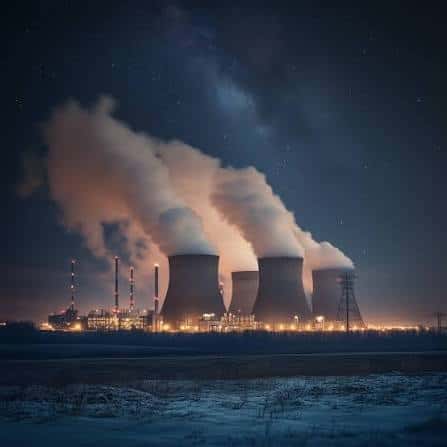
Bill Gates-backed TerraPower reveals its innovative nuclear reactors with integrated energy storage, offering a strategic edge for powering demanding AI data centers.
TerraPower's Nuclear Reactor Offers Strategic Edge for AI Data Centers
TerraPower plans to announce its inaugural data center project this year.
The Bill Gates-backed company's nuclear reactors feature energy storage capabilities, providing an advantage for data center power delivery.
New small modular reactors aim to reduce capital expenditures, but widespread implementation could take a decade or more.
TerraPower, a nuclear energy startup founded by Bill Gates, plans to announce its initial data center power project this year. This development positions the company as a key player in addressing the growing energy demands of artificial intelligence (AI) infrastructure. The upcoming data center project marks a significant step for TerraPower. TerraPower's reactors possess a distinct advantage over competitors in the pursuit of data center contracts. This strategic benefit stems from their integrated energy storage capabilities, which allow for a more flexible and reliable power supply. The integration of such technology is increasingly critical for tech companies managing vast digital infrastructures.
The Expanding Digital Footprint and Energy Demands
The proliferation of AI and advanced machine learning models has dramatically increased the energy consumption of data centers globally. These facilities form the backbone of the modern digital economy, supporting everything from social media platforms and streaming services to enterprise cloud solutions and the rapidly expanding creator economy. The relentless growth in data processing and storage requirements necessitates a stable, high-capacity, and increasingly sustainable power supply. This escalating demand has prompted major technology companies to seek innovative energy solutions. Tech giants, including Microsoft, Google, and Amazon, have actively invested in various energy initiatives to power their expanding data center networks. Their strategic focus extends beyond simply consuming energy to actively participating in its generation and distribution. This proactive approach aims to secure reliable power, mitigate operational risks, and align with ambitious corporate sustainability goals. The consistent availability of power is a critical factor for maintaining user experience and trust across global digital services.
TerraPower's Strategic Advantage in a Shifting Market
TerraPower's Natrium reactor design offers a unique solution for data centers, addressing some of the inherent challenges of traditional nuclear power. Nuclear reactors generally perform most efficiently when operating at their maximum output. In the United States, nuclear power plants generate near maximum power almost all the time. However, conventional reactors are slow to adjust their output.
Traditional nuclear reactors can adjust their total rated power output slowly.
This inflexibility poses a challenge for integrating with variable renewable energy sources like wind and solar. New small modular reactors (SMRs), which many startups are developing, offer faster response times. SMRs can adjust their output by a certain capacity per minute. Despite these improvements, running reactors at reduced capacity diminishes profitability, a significant concern given nuclear power's high capital expenditures.
Nuclear power plants typically have high capital expenditures among all generating technologies.
TerraPower's Natrium system incorporates a molten salt energy storage component. This allows the reactor to maintain a consistent output while the energy storage system can absorb excess power or discharge it when demand peaks or renewable generation is low. This innovative design positions TerraPower to offer a stable, dispatchable power source that can also complement intermittent renewable grids. For data centers, this translates into a more resilient and potentially more cost-effective energy solution over the long term, supporting the brand narrative of sustainability.
The Road Ahead: Powering the Next Generation of Digital Platforms
The strategic integration of nuclear power with energy storage, as demonstrated by TerraPower, represents a significant shift in how tech companies plan their core infrastructure. My read is that this move highlights a foundational element for the next generation of digital experiences and AI-driven content platforms. The reliability and clean energy credentials offered by such solutions are not just operational necessities but also powerful brand assets in an increasingly environmentally conscious market. As the demand for AI computations continues its exponential trajectory, securing dedicated, resilient power sources becomes a critical competitive differentiator. This trend underscores a broader market context where tech companies are no longer passive consumers of energy but active participants in shaping the future of global power grids. The ability to guarantee consistent, high-capacity power without relying solely on traditional fossil fuels offers a compelling value proposition for companies like Meta. Mass manufacturing of SMRs is anticipated to eventually lower capital expenditures, but this benefit is still a decade or more away. Early adoption by leading tech firms, despite initial higher costs, signals a strong commitment to long-term operational resilience and sustainability goals, which resonate with global consumers and regulatory bodies.
The Nuclear Battery: TerraPower's Data Center Pivot
The marriage of advanced nuclear energy and AI infrastructure is no longer a theoretical concept; it is an urgent industrial mandate. TerraPower’s impending announcement of a dedicated data center project exposes the harsh reality of the generative AI boom: the grid, in its current state, cannot support the compute demands of the future. For hyperscalers, the ultimate bottleneck to training next-generation foundational models is no longer just securing GPUs, it’s securing gigawatts as well. Data centers require uninterrupted, massive baseload power, making intermittent renewables like solar and wind inherently insufficient without grid-scale battery backups.
This is where TerraPower’s Natrium reactor presents a massive strategic moat. Traditional nuclear reactors are incredibly efficient at providing continuous baseload power, but they are notoriously inflexible asthey cannot easily ramp output up or down to match grid fluctuations. The Natrium design elegantly solves this by pairing a 345-megawatt sodium-cooled fast reactor with a proprietary molten salt energy storage system. This effectively acts as a massive thermal battery, allowing the system to temporarily boost electrical output to 500 megawatts to meet peak data center compute loads. By targeting data centers directly, Bill Gates’s TerraPower is bypassing the notoriously slow-moving utility procurement process and tapping directly into the deepest pockets in the global economy. While the mass deployment of Small Modular Reactors (SMRs) remains years away, this pivot proves that the AI arms race will fundamentally underwrite the next generation of American nuclear infrastructure. The tech companies that secure dedicated, carbon-free nuclear power won't just solve their emissions problem; they will secure a permanent, physical competitive advantage in the AI era.
Frequently asked questions
How will TerraPower's nuclear reactors benefit AI data centers?
TerraPower's reactors, specifically designed with energy storage capabilities, will provide a stable, reliable, and efficient power source crucial for the immense and consistent energy demands of AI data centers. This mitigates power fluctuations and ensures continuous operation.
What is the 'secret weapon' of TerraPower's reactors?
The 'secret weapon' refers to the integrated energy storage capabilities within TerraPower's advanced nuclear reactors. This feature allows for flexible power delivery, addressing peak demand and grid stability challenges faced by traditional data center power solutions.
Who is backing TerraPower?
TerraPower is notably backed by Bill Gates, highlighting significant investment and confidence in its innovative nuclear energy solutions. This backing underscores the potential impact and technological advancement of the company.
When will TerraPower announce its first data center project?
TerraPower plans to announce its inaugural data center project this year. This marks a significant step towards the real-world application and deployment of its advanced nuclear technology for AI infrastructure.
What are small modular reactors (SMRs)?
Small modular reactors (SMRs) are advanced nuclear reactors designed to be smaller and more flexible than traditional large-scale nuclear power plants. They aim to reduce capital expenditures and construction times, making nuclear power more accessible and scalable.
How long might widespread implementation of these reactors take?
While small modular reactors aim to reduce capital expenditures and accelerate deployment, widespread implementation across the industry could still take approximately a decade. This timeline reflects the regulatory, logistical, and construction challenges inherent in nuclear energy projects.