A91 Partners' rescue round could reset Sugar Cosmetics from a Rs 3,000 crore startup to a Rs 500-600 crore brand
Sugar Cosmetics is raising fresh capital from existing investor A91 Partners in a deal that could value the company at Rs 500 crore to Rs 600 crore. The proposed round marks a steep reset for a brand that was once priced at around Rs 3,000 crore, and it puts fresh attention on how consumer internet investors are now underwriting survivability, not just growth.
The company is set to raise Rs 140 crore to Rs 150 crore from A91 Partners, according to people familiar with the matter. The implied valuation is more than 80% lower than Sugar Cosmetics’ peak valuation from a fundraise four years ago, with the latest capital coming as the company deals with mounting losses, declining revenues, and the pressure of an aggressive offline expansion strategy. My read is that this kind of round is less about repricing one cap table and more about the market’s new filter for direct-to-consumer brands, where distribution economics and store productivity are starting to matter more than recall alone.
Sugar Cosmetics was founded by Vineeta Singh and Kaushik Mukherjee, and it operates in the beauty segment with a direct-to-consumer brand model that also sells through offline channels. The Mumbai-based company built its business around beauty products before broadening its retail footprint. What stands out here is the familiar arc for many scaled D2C labels, where online brand energy opened the door, but offline expansion raised the capital intensity and execution risk at the same time.
The reset at Sugar Cosmetics comes amid a wider correction across consumer brands, where investors are pushing portfolio companies to show tighter unit economics and more disciplined growth. In that context, Sugar Cosmetics’ down round looks less like an isolated event and more like a signal that the beauty playbook itself is being repriced.

The Omnichannel Margin Trap
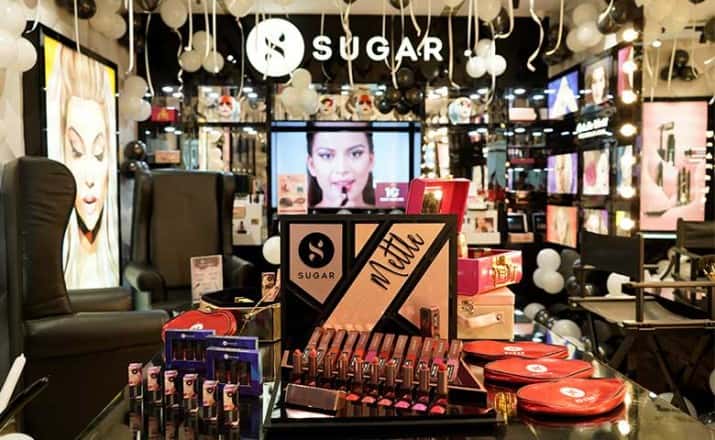
Sugar Cosmetics’ severe 80% valuation haircut—plummeting from its ₹3,000 crore peak in 2022 to just ₹500–₹600 crore today—exposes the brutal unit economics of scaling direct-to-consumer (D2C) brands into physical retail. While the internet provides a cheap launchpad for brand discovery, physical retail demands relentless working capital, inventory bloat, and massive marketing spend. Sugar expanded its offline footprint to over 45,000 retail outlets and 200 company-owned stores, but this aggressive omnichannel strategy actively cannibalized its cash flow.
The Revenue Contraction Reality
The numbers tell a story of forced deceleration. Sugar’s revenue trajectory broke abruptly, falling from ₹505 crore in FY24 to ₹404 crore in FY25. Projections for FY26 show a further dip to roughly ₹300–₹350 crore. Crucially, as top-line growth vanished, net losses doubled from ₹68 crore in FY24 to ₹134 crore in FY25.
The Growth-to-Survival Pivot
By heavily backing sub-brands like Quench Botanics and Sugar Pop, the company overextended its supply chain precisely when consumer internet funding dried up. A91 Partners’ ₹140–₹150 crore infusion is not growth capital; it is a structural bailout to service working capital debt and arrest the cash burn. For the broader D2C ecosystem, this reset establishes a grim precedent: venture markets will no longer subsidize unprofitable offline retail expansion simply for the sake of market share.
Frequently asked questions
Why is Sugar Cosmetics facing a down round?
Sugar Cosmetics is reportedly raising fresh capital at a much lower valuation than its previous round, which is the definition of a down round. The reset reflects tougher funding markets and investor focus on survival, efficiency, and realistic growth rather than aggressive expansion.
What is Sugar Cosmetics' new valuation in the A91 deal?
Reports suggest Sugar Cosmetics could be valued at roughly Rs 500 crore to Rs 600 crore in the new round led by existing investor A91 Partners. That is a steep drop from the company's earlier valuation of about Rs 3,000 crore.
How big is the valuation drop for Sugar Cosmetics?
If the new round closes at Rs 500 crore to Rs 600 crore, the company's valuation would be down by around 80% from its previous peak. That makes it one of the sharper valuation resets in the consumer brand and startup space.
What does a bailout round from an existing investor usually mean?
A bailout-style round from an existing investor often signals that the company needs capital to stabilize operations, extend runway, or avoid a more damaging fundraising outcome. It does not always mean failure, but it usually means the business has less leverage than it did in earlier growth rounds.
Why are consumer internet investors cutting startup valuations now?
Investors are repricing companies because higher growth is no longer enough on its own; margins, cash burn, and path to profitability now matter more. In consumer internet and direct-to-consumer brands, that shift has led to lower valuations, internal rounds, and tougher terms.
What should founders and employees learn from the Sugar Cosmetics valuation reset?
The main takeaway is that private valuations can change quickly when markets tighten and capital becomes selective. Founders may need to prioritize cash discipline and sustainable unit economics, while employees should understand that headline valuations do not always reflect long-term business health.