

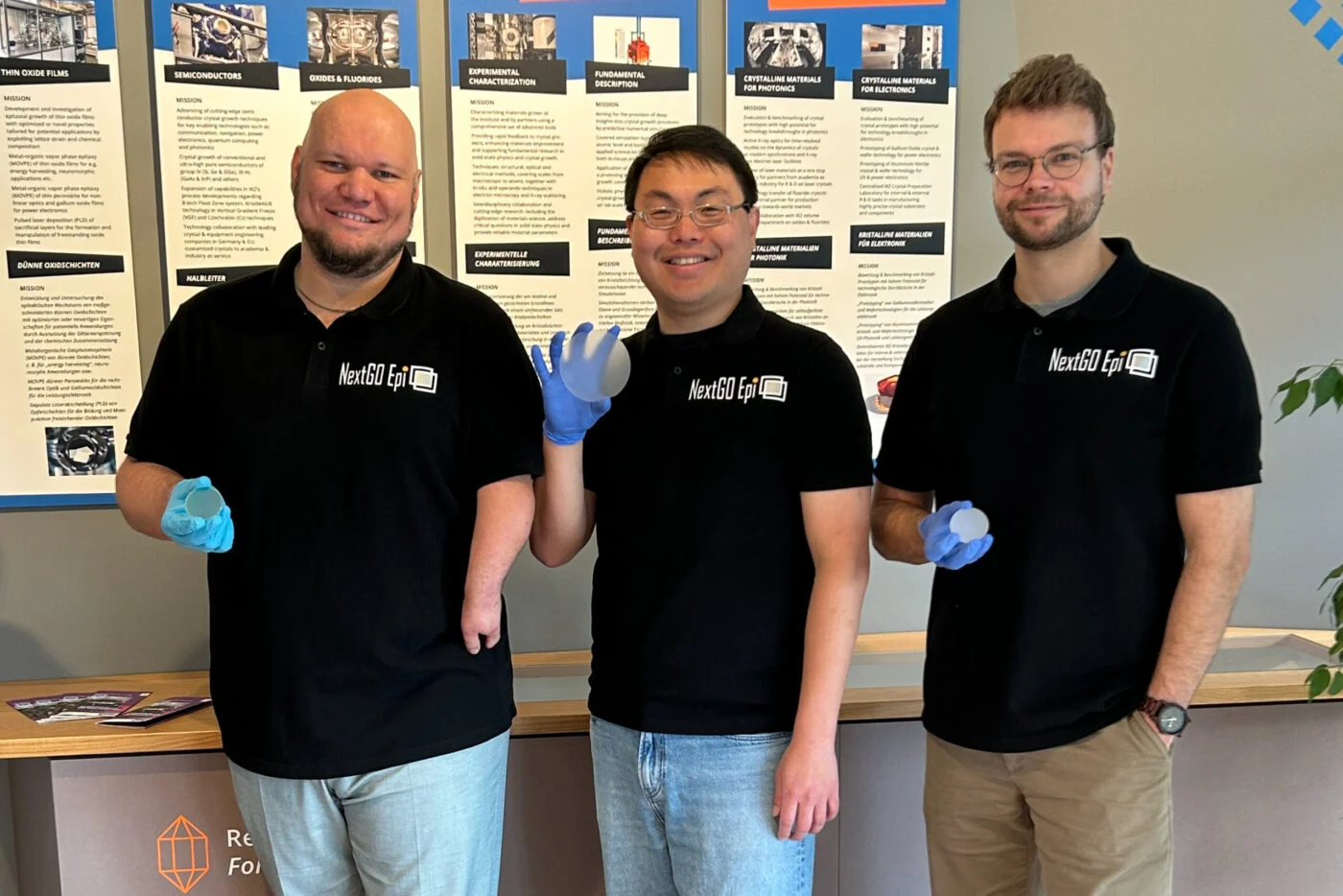
NextGO Epi secures funding for gallium oxide semiconductor development
With the fresh capital, NextGO Epi plans to accelerate product development, expand its team and strengthen its presence in Europe and international markets. The funding round was led by Vireo Ventures, with participation from Ultratech Capital Partners, IBB Ventures and business angel Boris Habets.
According to the company, NextGO Epi is currently the only European manufacturer producing industrial-grade gallium oxide epitaxy wafers with diameters of up to four inches. These wafers form the electrically active layer of next-generation power semiconductors and are expected to support future applications in electric vehicles, charging infrastructure, renewable energy systems and data centres.
Gallium oxide belongs to the class of ultra-wide-bandgap semiconductors. Compared with the silicon carbide (SiC) and gallium nitride (GaN) semiconductors widely used today, the material offers the potential for higher voltage resistance and lower energy losses.
According to the company, power semiconductors based on gallium oxide could significantly reduce fast-charging times for electric vehicles while also lowering component production costs. However, these advantages still need to be proven in mass-produced components and real-world vehicle applications.
The company already produces and supplies customers in Europe, North America, and Asia, according to its own statements. The founders boast over ten years of research experience in the field of gallium oxide and hold two international patents. NextGO Epi is also supported by Jochen Linck, the former COO of equipment manufacturer Aixtron.
The funding round coincides with European efforts to expand semiconductor production on the continent. Just a few days ago, the EU Commission introduced the Chips Act 2.0, which aims to strengthen Europe’s technological sovereignty in key technologies. While established manufacturers like Infineon are expanding their production of silicon and silicon carbide semiconductors, the Berlin-based start-up is working on material alternatives for the next generation of power semiconductors.
The industry is also currently increasing its investments in new semiconductor technologies. Bosch recently announced that, with support from the US CHIPS and Science Act, it will expand its production of silicon carbide semiconductors in Roseville, California. In parallel, a research project coordinated by Infineon in Europe is working on the next generation of power electronics based on various semiconductor materials such as silicon, silicon carbide, and gallium nitride. Gallium oxide could soon join this technological spectrum—provided its advantages are confirmed in industrial applications.








0 Comments