
Defense technology firm Hadrian secures $1.37B Series D, pushing its valuation to nearly $8 billion amidst growing investor confidence in modernizing the defense industrial base.
Hadrian Secures $1.37 Billion Series D, Valuing Defense Manufacturer at Nearly $8 Billion
Hadrian, the defense technology firm focused on automated manufacturing, announced a $1.37 billion Series D funding round on Thursday, pushing its valuation to $7.87 billion. The substantial capital infusion underscores growing investor confidence in modernizing the defense industrial base and digital manufacturing capabilities.
The lead investors in the round include WCM Investment Management, Washington Harbour Partners. This robust syndicate signals a strong market belief in Hadrian's strategy to streamline the production of critical defense components.
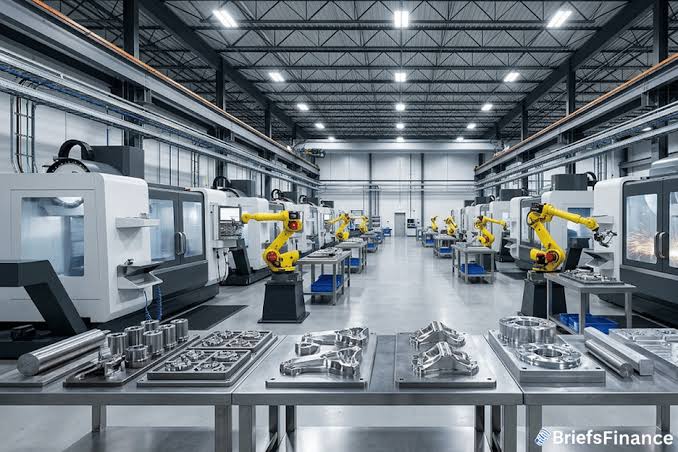
Hadrian's operational focus lies in establishing highly automated manufacturing facilities designed to mass-produce parts for existing military platforms, such as submarines, rather than developing new weapon systems. This strategic emphasis addresses persistent supply chain bottlenecks and aims to accelerate delivery timelines for essential defense infrastructure.
What do Hadrian's new funds mean for defense manufacturing?
The significant capital raise by Hadrian reflects a broader recalibration within venture capital towards defense technology, moving beyond traditional dual-use applications to direct industrial support for national security. This trend is driven by heightened geopolitical tensions and a renewed imperative to bolster domestic manufacturing capacity and supply chain resilience, particularly in advanced materials and precision engineering.
The investment signals a market recognition that conventional defense procurement and manufacturing processes are often too slow and inefficient to meet contemporary challenges. Hadrian's model, centered on automated, digital-first factories, promises to compress lead times and enhance the agility of the defense supply chain. This approach could trigger a paradigm shift in how defense contractors source components, favoring speed and technological integration over legacy systems.
Private capital is increasingly stepping in to fill gaps in defense industrial capacity, particularly where government investment alone has historically lagged in adopting cutting-edge commercial manufacturing techniques. The scale of this Series D round suggests that investors perceive a robust, long-term market opportunity in modernizing the foundational elements of defense production.
Hadrian just secured a massive $1.37 billion Series D round, skyrocketing its valuation to nearly $8 billion. This is not your typical software play. It is a loud declaration that the future of defense technology relies on physical and automated infrastructure. While legacy defense contractors struggle with supply chain bottlenecks, Hadrian is building Factories as a Service. By combining advanced robotics with physical AI, the startup is mass producing critical components for submarines and aerospace platforms at unprecedented speeds. With new sites rolling out across Arizona and Alabama, Hadrian is attempting to rewire the American industrial base from the ground up. For the venture capital world, this mega round signals a permanent shift. Investors are no longer shying away from asset heavy national security bets. As geopolitical tensions rise, capital is flooding directly into deep tech manufacturing rather than simple dual use software. Hadrian proves that speed and precision matter just as much as the weapons themselves. If the company successfully scales its automated hubs, it will redefine how military procurement operates. The defense complex is officially getting a Silicon Valley upgrade.
$7.87 Billion
Hadrian's post-money valuation after its latest $1.37 billion Series D round, reflecting strong investor confidence in its automated defense manufacturing model amid renewed geopolitical focus on industrial capacity.
What is Hadrian's strategy for industrial scale?
Hadrian's strategy centers on replicating and scaling its automated factory model to address critical component shortages across various defense programs. The company's facilities are engineered for mass production, integrating advanced robotics and artificial intelligence to achieve efficiencies and precision often unattainable through traditional methods. This industrial approach aims to provide a reliable and rapid supply of high-quality parts.
Plans for a third facility in Mesa, Arizona, are also in development.
The company's focus on foundational manufacturing for existing platforms distinguishes it from firms developing novel weapon systems, positioning it as a critical enabler of the broader defense ecosystem. By enhancing the efficiency and responsiveness of component production, Hadrian directly supports the readiness and technological superiority of national defense assets.
How does this funding reflect broader defense tech trends?
Hadrian's substantial fundraising round illustrates a significant trend in venture capital: a growing appetite for defense-focused technology companies that enhance the industrial base and supply chain resilience. This marks a departure from earlier periods where "dual-use" applications, appealing to both commercial and defense sectors, were often preferred by investors. Today, direct defense investments are gaining traction as geopolitical stability wanes.
The investment also underscores the strategic importance of advanced manufacturing and automation in national security doctrines. Governments globally are prioritizing domestic production capabilities to reduce reliance on foreign supply chains and mitigate risks associated with geopolitical shocks or trade disruptions. Companies like Hadrian are seen as integral to this "re-industrialization" effort, especially in high-precision and critical sectors.
This trend is further amplified by the shift towards agile procurement models within defense agencies, which seek to leverage commercial innovation and speed. Venture-backed defense tech firms, with their emphasis on rapid iteration and advanced engineering, offer a compelling alternative to slower, more bureaucratic incumbent contractors. Hadrian's success could pave the way for more private capital flowing into areas like materials science, additive manufacturing, and advanced robotics for defense applications.
Investors will be closely watching Hadrian's execution on its ambitious expansion plans, particularly the timely opening and ramp-up of new facilities like the one planned for Mesa, Arizona. Key metrics will include production volumes, contract awards from government entities, and the ability to integrate its automated systems seamlessly into the existing defense industrial complex, with further updates expected on specific program contributions throughout the upcoming fiscal year.
Frequently asked questions
What is Hadrian and what did they recently achieve?
Hadrian is a defense technology firm specializing in automated manufacturing for the aerospace and defense sectors. They recently secured $1.37 billion in Series D funding, boosting their valuation to nearly $8 billion.
What is Hadrian's valuation after this funding round?
After securing $1.37 billion in its Series D round, Hadrian's valuation has reached approximately $7.87 billion, pushing it close to an $8 billion valuation.
Who are the investors in Hadrian's Series D round?
While specific investors are not detailed in the preview, a Series D funding round of this magnitude typically involves a mix of leading venture capital firms and strategic investors keen on defense and advanced manufacturing technologies.
What does Hadrian specialize in within the defense sector?
Hadrian specializes in automated manufacturing, focusing on modernizing the defense industrial base by producing critical components for aerospace and defense with advanced, digital manufacturing processes.
Why is investor confidence growing in defense technology?
Investor confidence is growing in defense technology due to the increasing global demand for modernizing defense capabilities, the adoption of advanced manufacturing techniques, and the strategic importance of a robust defense industrial base.
What is the significance of a Series D funding round for a company like Hadrian?
A Series D funding round signifies a mature growth stage for Hadrian, providing substantial capital for aggressive expansion, scaling operations, and reinforcing its market position as a key player in modernizing the defense industrial base.